Sunday, June 26, 2022

Lofa

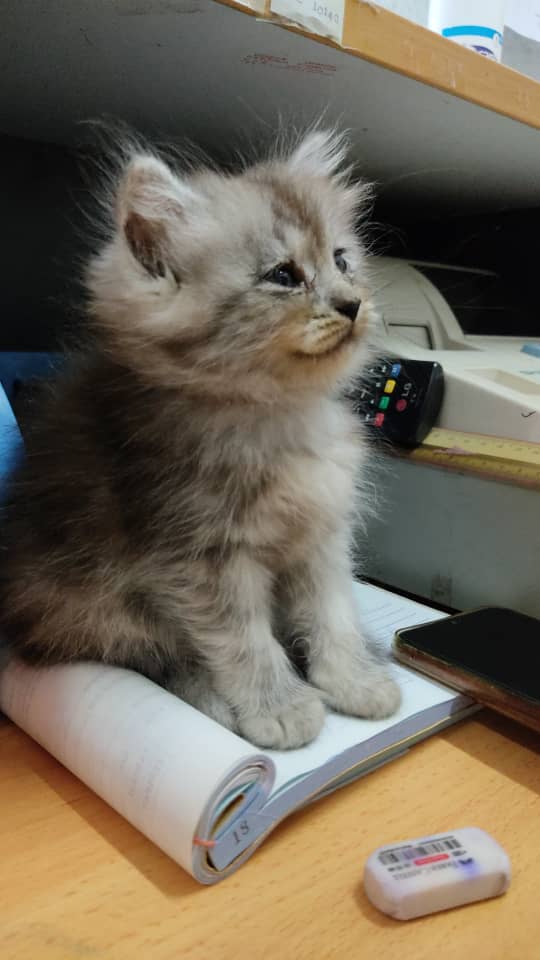
Yesterday was a sad day for all of us. Our favourite cat Lofa left us. She was having difficulty breathing that morning and was in my room. I was marking my students' test papers and she came and slept on them. My other half decided to bring her to the clinic after lunch. Little did we know that was the last we saw her. About an hour (or less), the clinic called my other half that our cat is dying. We brought her home to bury her in the back yard.


Lofa was probably the most intelligent and most active cat that we have. She was very observant of what we do and once would like to open a door to one of the rooms by reaching for the handle. We got her (given by someone) sometime in February 2021. These are the earliest pics of her.


Here she is with the 'triply punctured sphere':


She likes to explore everything she could (see pics below).


Once we brought her outside and let her go climb (unafraid) a tree in front of the house, almost looking like a koala bear.


Below are videos of Lofa exploring the fan, washing machine and the curtain to my son's room.


Here's Lofa in a group photo.


Lofa with my other half:


Being super-adorable, my other half sometimes dressed her up:


Just a day before she left, my other half put up the packing plastic near a chair in our living room as she begins to isolate herself from others.


She was the only cat in the house who is not afraid to go on the treadmill. The first video was taken when she was still healthy. The second one was taken in late May this year, after she recovered from respiration problems.


She started to become unwell only sometime in April where initially she had respiratory problems and then it was detected that she had a swollen heart besides the problematic lungs. It was sad for all us to have her leave that early. She will be missed by all of us. My son made up this video in her memory.


Goodbye Lofa and rest well.

Friday, June 24, 2022

Small

Yesterday my undergraduate student suddenly popped up the question why am I still not a professor despite my thirty years plus of working. I remembered my previous blogpost and somehow felt slighted but this is not the first time. I thought for a while and gave the honest answer, I did not apply for such a position. He then uttered the question that one has to apply, perhaps genuinely he did not know about it. Or he just wanted to make me feel small and perhaps spill some beans? The student is a student leader of some sort and my guess is that he should know some university matters.

In the past, there have been many times that students sort of question what I do. Some do irritate me for their arrogance and some I considered as simply ignorant or foolish. Reacting to these is quite delicate as one does not want to misuse one's position of 'authority'. It is only proper to guide the student to get the appropriate understanding and help him grow. I remembered once an undergraduate student who was under my supervision (way before I joined the institutes), bragged about his theoretical physics capability but he had this annoying habit of degrading the department/curriculum, bordering on some racial insinuations. Felt the need to educate him a little and challenged him to take up the MSc course in theoretical physics at my former university to prove himself he is that good. He actually did and we corresponded for a while. Later, I was informed that he sadly failed the course but scored well on the subject matter of the project I had supervised him. The point here is to be always careful not to let one's ego get bloated and underrate or undermine what efforts of everyone else in making progress (of science or whatever).

There are many instances in my life where others try to make me feel small. I can brushed off some of these, but some had some deep psychological impact on me (occasionally, I get nightmares). I often watched the insinuations and body languages of others when people interact with me, to see how they perceive me (students included). In many instances, one can see positions of power and popularity determine the way they behave. Being a 'lesser person', sometimes I see others (even those whom I thought was close friends) showed gestures, trying to avoid me simply because they have certain positions. For me, since the insinuation there is that I am not wanted, I tend to shy away from such people. However, the ones I try to avoid the most (not out of fear but wanting my life to be peaceful) are those who have acted in a way that had adverse effects on me in the university. Unfortunately, I can't really forget these events (even if I can forgive for what has happened). This is why I have always said that one should not be comfortable in positions of power and popularity for too long, else the risk of being a snob and vicious. I am not a person who likes to do office politics and I have never campaigned for any position; even after many meetings, I do not go and rub shoulders with anyone. I'm the type of person who likes to mind one's own business, unless some matters got me involved directly. So, perhaps that make me an unlikely person to lead any form of organization, which is perfectly fine for me. Indeed as I have said before, at this period in time, I do wish people leave me alone.

As I drove to work yesterday and got stuck in the toll's traffic jam, I took a picture of my wrinkled hand, to remind me of how old I am. 


Not sure how much time left I have to live, but as of today, I only have 181 days left to work in UPM (with only 129 weekdays). I wanted to finish off a few things before I go for retirement. When I met my student and younger colleague the other day, I tried to give all that I know (including possible future research). Hopefully it will get to be useful for them. Not sure of my future, but this is my situation now.


Monday, June 20, 2022

Students Supervised

In my last post, I mentioned some of the management books that I have read. Here, I felt the need to say that I don't read them cover-to-cover and in fact, whenever I wanted to use something from the books (or advices from others), I do tend to do a rethink. For me, a lot of the materials tend to come off as common sense but appreciation is still due given that the authors (or editors) have tried to systematise them. Management is not my cup of tea but having got myself into it, I would not want to dismiss it as easy (like some people think) but in fact, there are a lot of hard decision-making, thoughts of different scenarios (to foresee outcomes) and much more difficult, owing up to the decision that you have made (which could have been wrong). I'm glad that I am no longer in management but over the years, I do feel the younger people need to learn the history (and lessons) behind past decision making and also the humility to appreciate that others have thinking capabilities (right or wrong) just as good as they are.

Fast forward to last Thursday, it was the viva of my PhD student Mohammed Abdulmalek Abdulraheem Ahmed, probably my last international student. Mohammed's work is on thermal field theory and not quite a field that I dabble for research in the past. Because of this, we decided to have his previous MSc advisor Madjid Ladrem (Taibah University) and Faqir Khanna (emeritus professor at University of Alberta), a well-known expert on thermal quantum field theory (see his book here). This is probably the second time I have done this, supervision in collaboration with overseas professors. The first would be for Hassan Amirhashchi, who wanted to do a PhD in cosmology, with co-supervisor Anirudh Pradhan, who visited us in INSPEM, several times. Mohammed was my 24th graduate student and my ninth PhD student that had me as the main supervisor. Here is a pic.

Note in the above, one can see Prof. Kwek in the viva session. For Mohammed, we had two overseas external examiners (Prof. Kwek & Prof. Farhan) and one internal examiner (Assoc. Prof. Zulkifly Abbas). This just goes to show that we had difficulties to get examiners from our local community (and is generally true for most of our theoretical students).

The rest of my students are listed below (there were others that had me as a supervisor committee member within and outside of UPM).

  • Ahmed Bouketir (PhD, 2000), "Group-Theoretic Quantization on Spheres and Quantum Hall Effect"
  • Toh Sing Poh (MSc, 2002), "Cosmic Crystallography: CCP-Index of Thurston Manifold"
  • Abubaker Ahmed Mohamed Siddig (MSc, 2003), "Mathematica Packages for Solving Schrodinger Equation with One-Dimensional Rectangular Potentials"
  • Aslam Abdullah (MSc, 2006), "Extending Bianchi’s Classification of Homogenous Three-Manifolds"
  • Ch’ng Han Siong (MSc, 2006), "Accelerating Cosmologies with Extended Product Spaces"
  • Nurisya Mohd. Shah (MSc, 2008), "Energy Eigenequation Expansion for a Particle in Singly Punctured Two-Torus and Triply Punctured Two-Sphere System"
  • Toh Sing Poh (PhD, 2008), "Proofs of Kochen-Specker Theorem Using Projection-Valued Measure"
  • Mazlinda Zainy (MSc, 2009), "The Discrete Phase Space for 3-Qubit and 2-Qutrit Systems Based on Galois Field"
  • Abubaker Ahmed Mohamed Siddig (PhD, 2009), "Computation of Maass Cusp Forms on Singly Punctured Two-Torus and Triply Punctured Two-Sphere Using Mathematica"
  • Siti Nurul Ain Hj. Zaiton (MSc, 2010), "Qutrits and Lie Algebra Structure on Tensor Product of SU(3)"
  • Hassan Amirhashchi, (PhD, 2011), "New Anisotropic Cosmological Models and Two-Fluid Dark Energy Models"
  • Mojtaba Aliakbarzadeh (MSc, 2011), "Generating Mutually Unbiased Bases and Discrete Wigner Function for Three-Qubit System"
  • Lam Shi Xiang (MSc, 2013), "A Network Structural Analysis of Malaysian Stock Market with Edge Density Constraint"
  • Chan Kar Tim (PhD, 2013), "Parallel Computation of Maass Cusp Forms Using Mathematica"
  • Saeid Molladavoudi (PhD, 2013), "Symplectic Techniques in Geometric Quantum Mechanics and Nonlinear Quantum Mechanics"
  • Ahmad Hazazi Ahamad Sumadi (MSc, 2015), "Canonical Group Quantisation on One-Dimensional Complex Projective Space"
  • Syed Nasrullah Ali Qazi (MSc, 2015), "Two Fluid Scenario for Dark Energy Models in a Bianchi Type I Universe"
  • Choong Pak Shen, (MSc, 2016), "Characterizing Two- and Three-Qubit Entanglement by Their Tensors"
  • Nor Syazana binti Shamsuddin (MSc, 2017), "Maass Cusp Form on Asymmetric Hyperbolic Torus"
  • Zurita binti Ismail (MSc, 2019), "Structure of Co-Authorship Network in UPM Journal Publication Database From 2007-2010"
  • Siti Aqilah Muhammad Rasat (MSc, 2020), "The Role of Compositionality in Constructing Complementary Classical Structures Within Qubit Systems"
  • Mohd Faudzi Umar (PhD, 2021), "Deformed Heisenberg Group for a Particle on Noncommutative Spaces via Canonical Group Quantisation and Extension"
  • Umair Abdul Halim (PhD, 2021), "Classical Aspect of Uncertainty Principle for Spin Angular Momentum in Geometric Quantum Mechanics"
  • Mohammed Abdulmalek Abdulraheem Ahmed (PhD, 2022), "Real-Time Thermal Field Theory and Applications"
Besides graduate students, I also took in three postdoctoral fellows namely, Buang Ann Tay (I believe to be the first postdoc in UPM), Hassan Amirhashchi and Saeid Molladavoudi (after they graduated). I have another two PhD students (Choong Pak Shen, Ahmad Hazazi) and one MSc student (Ahmad Aqwa) who are about to submit their theses, hopefully in time before my retirement. Some of my colleagues told me this is more than enough for a professorship application but unfortunately supervised postgraduate students are not the only conditions; there are many others (some, mind-boggling). At this stage, I no longer consider  professorship as a realistic option particularly at this very late stage of my career. I have both internal and external reasons why I'm no longer considering such application (to the disappointment of my family and some colleagues). Maybe I will tell some of these after I retire or maybe they will die with me in the grave.

Thursday, June 16, 2022

Managing and Developing

I'm less than 200 days away from retirement. What happened last week? Well, for some unknown reasons, my left wrist was hurting sometime on Saturday. Ignored it for awhile, hoping that it will go away by the time I have to go to work (which is on Tuesday; Monday was a public holiday). By Monday evening, the pain worsened and told my wife that I can't drive in this condition and probably need doctor's attention to see if it will go away anytime soon. First suspicion, was gout, but the private hospital doctor suspected bacterial infection since my wrist is all red and a little swelling. He recommended me to do blood tests for both gout and bacterial infections. The answer was the latter. So I was given a three-day leave with antibiotics, anti-swelling pills and pain killers (tramadol+paracetamol). Tramadol essentially knocks me out for the whole of Tuesday and in part Wednesday (got a class and postgraduate seminar conducted online that day in my half-conscious state). I stopped taking the pain killer by Wednesday morning to make sure I can drive to campus on Thursday to conduct a test (while on medical leave). Knowing that I will still be groggy, I took leave on Friday to rest. In fact, my son drove me to Sri Sendayan mosque that Friday for Friday prayers.


In my last post about academic commitments, I wrote how I spent a substantial amount of money on journals, which is supposed to show how serious I was. I also mentioned about subscribing to Science when I was part of a management team (for scientific matters). Thought I should share here that even in management, I took it seriously despite what others might think of my management skills. My first exposure to management was through the relatively smaller departmental committees. At the time, there is this tendency of putting everything in a positive light, which at the time to me, sounded really pretentious. It is always the case that no matter how positive one is, there will always be negativity in one's midst and one needs to learn how to cope with this. Always unseen, one could try to be positive but one's superior has a negative image of you. Just like administrators tend to say that some people always complain, but usually unseen is that the administrators themselves are already complaining. This is why this 'all-positive' attitude is not authentic and the main gist behind all these are our difference of opinions on how things should be. This is why I appreciated the approach of Covey of the 7-habit fame: a principled approach. One should start correctly of what we think we are. First, us an academic in a university whose main role is teaching and research. We should have always this perspective in mind: our true appointment in the university is an academic first. (I recall in one event with people from industries, the speaker even told us we should not operate like industrial or business entities, but rather like a community of 'wise people' that sees in a different light, often with a vision of depth and long-term). Whatever administrative role we are landed with is really a secondary appointment and is not a permanent post. Being a leader in the administration does not mean one is boss and others are being subjects. As an academic, one should be considered equal to one another; the administrative position is temporary and is meant to help decision-making processes smoothly (and a responsible one), for otherwise one could end up with endless debate. Being part of an academic organization, one should realize that the main activities are really creativity-driven and such activities are highly-valued. The tendency to put constraints (or controls) run counter to this view.

When I was given an administrative role, I begin reading up management books e.g. 1-minute manager, Covey-related books, leadership, body languages, images that one carry etc. Below are some books that are in my possession.


I remembered once, I was given the task of speaking on work ethics in INSPEM, that had me brooding for days. I wanted to be able convey the idea of shifting perspectives and where we start on our outlook is an important one. This led me to refer to religious texts on what is essentially a wholistic human being - not just thought as a social and political animal, which are just partial. Below is a pic of the presentation I made.


Not sure how well it went but I dedicated one section on dealing with negativities and office politics, which are ordinary parts of life. Took some ideas from the book on the right shown above.


One must be made aware of these 'characters', not only in others but also in ourselves (no exception). I also borrowed from someone I wrote to and got a copyrighted document (the person is from abroad, and I can't find it while writing this post), on what constitutes to be a 'modern worker' (see below).


The point here is to highlight working as developing one's own self, not just 'servicing the boss'. Reflect on the Muslim belief of man as servant of God but whatever services rendered is for our own benefit, knowing well all the attributes of God. One must also take note that 'bosses' are not perfect; as humans we have impaired or limited sense of justice and moral compass,, incomplete knowledge and one's own base desires that tend to mislead us. There should always be an open platform over which workers and bosses can discuss work matters in amicable manner. Often today, we get 'unfriendly' e-mails or messages instead (doing things behind the screen is easier, right?). We also heard horrible stories (elsewhere) that authoritarian bosses resorting to bullying and worse playing revenge. To me, this type of bosses should not be there in the first place and if they realise themselves doing these, they should just resign. Again, I would highlight the fact that we are in an academic organization that has very little place for regimented management (usually this is reserved for areas of safety, security and time-criticality). So I tend to adopt a very flexible management style, encouraging creativity wherever possible. But this is me and I have seen many different styles of management. 

The other area of concern is the adoption of mechanistic management that seems not to care the actual human natural response. Sometimes we are asked to adopt a culture in a short period of time, with evidence-demanding style (without caring efforts made and that not all circumstances are within control). For instance, the adoption of ranking has always been debated and one has never really discussed the necessary (natural) dynamics to be a good top-tier university (almost always demanding good scientific culture). I believe everyone in the management now knows about Goodhart's law but yet we follow fixed KPIs almost blanketly throughout different disciplines. Once, I was told off by a senior management member to take this up with the Ministry and I was taken aback. The question is what and how to proceed? Lately, I have been interested in Snowden's dynamical systems approach, which is more open and perhaps a more natural evolution. I have yet to see any local organization taking this up. Somebody told me that it won't work in our environment. Perhaps, but then we ought to ask the question what drives this 'impossibility' and can we change the dynamics? Recently,  I have posted some document related to Snowden's work on Sensemaking which is made available free online - https://practicalactionpublishing.com/book/2622/the-learning-power-of-listening. I have yet to study this properly and hope someone is interested to see how this works.

Let me just stop here (need to prepare for my lectures) and end with this remark. I do see some younger leaders being very abrasive and very harsh in judgement. One can also see this in the social media, writing away as if everyone else is not doing enough thinking. It seems gone are the days that we have used to learn about diplomacy and more humanly concern about others. Perhaps they should reconsider their position?

Wednesday, June 08, 2022

Commitments and Costs

In the talk I gave at the undergraduate conference, I mention something that I did (as the extra mile) in realizing my dreams. I told the audience that I started subscribing to journals that I thought would help my career (paid from my own pocket). The first one would be International Journal of Modern Physics A and the letter version, Modern Physics Letters A, published by World Scientific, both of which I subscribed from the first issue. I roughly remembered that I got excited that World Scientific, based just next door, was about to publish their journals. I wrote to them and asked for a discounted rate for the subscription. The first issue of IJMPA had Witten's article on "Topological Tools in Ten-Dimensional Physics". It is this article that moved my interest away from supersymmetry, supergravity and even superstrings (despite the ten-dimensional physics is alluding to superstrings). The subtle use of abstract technical mathematics in physics (could be just normal physics) seems to attract me. I forgotten to highlight this matter in my talk. 

The IJMPA and MPLA subscriptions went on for a few volumes until I found myself not reading a large percentage of the articles that are experimental or phenomenological in nature. So I decided to subscribe to a journal which is closer to my specialization. At the time, World Scientific was about to publish the first issue of Reviews in Mathematical Physics in 1989. My subscription to this journal again went for a few volumes. The next journal that I subscribed to is even more specialised, namely Journal of Geometry and Physics. This went for a few years until I find myself can no longer afford it due to other financial commitments. Besides these journals, I have also subscribed to MAAS Journal of Islamic Science (much earlier) and also to the magazine Afkar Inquiry until both the journal & magazine went out of print. When I was part of administrative team in the institute, I subscribed to Science in order to get a broader view of science, with the idea that when deciding on science, my views will not be lop-sided. This too ended, after a few years.

Personal journal subscriptions are expensive. So why did I make all these subscriptions? Well, I was dead serious about being a good academician and was hoping to be comprehensive and up-to-date with things that I am interested in. Later, this ambitious outlook was humbled by less than ideal reality and by my own limited self. Today, I focus mostly on what I can do within constraints and the outlook has shrunk to a very small percentage of what I had in the beginning.

Sometime last week, I had a virtual chat with a friend from UniMaP on activities to improve our scientific environment. He has been very active in getting scientific luminaries from abroad to speak at local events. He had his impressive International STEM & Innovation Colloquia Series (ISICS) that include Nobel Laureates as speakers. We exchanged ideas on handling such activities. In comparison to what he has done, I must say what we did at UPM, say for EQuaLS, is at a smaller scale, with the modest target of building research ecosystem (as opposed to STEM goals). Knowing full well how much commitment and resources are needed to run the 'smaller' EQuaLS, I can only imagine what immense efforts are needed for him to run ISICS. For our own events, sometimes we need to put in our own 'personal funds' (big or small) to ensure that these events are successful. Even bigger challenge is to sustain the series of events. When we first started our lecture series, the earlier ones were funded well by the Science Ministry. Thereafter, no (dedicated) real funds were made available for us to organise these events. Sometimes we get scornful remarks when we tried to secure some funding for these events e.g. so how many EQuaLS do you want to do; EQuaLS 20? Any benefits? Some expect that we must have quick return of investment, for instance, establishing a research collaboration with the speakers and even producing articles together. This was not our intent in the first place; what we wanted is access to the working minds of reputable scientists through interactions among them and direct discussions with them (usually not available by reading papers alone). Also, it is very rare that collaborations are made within a short time period; normally they are build naturally over time. Indeed, forced collaborations will made us look foolish or scientifically immature. 

Another concern is that if we are doing events just for the sake of KPIs, particularly if they are seen as income generating events. Whatever fees that we were charging are often just enough to cover the expenses. With the pandemic last two years, it has become normal to hold these events as online events. This minimizes the cost but not necessarily absolves us from putting some minimal registration fees. The online events reduce the type of interactions that we have alluded earlier, which is rather a pity. I have now stopped chairing EQuaLS event and passed it to my younger colleagues (I also have avoided any other decision-making roles). Once, a friend from a different university, jokingly made the remark to me that I have become an event manager after holding so many EQuaLS event. I did try to get EQuaLS across to other universities but was not very successful partly due to it was seen more as our group's event. Whatever it is, I will let my younger colleagues to decide what they want to do with the future of EQuaLS.

Another topic that came up during my discussion with the UniMaP colleague, is the setting up of an institution that will help take care of these events. This is in fact harder to do. I think I have been part of several different committees that wanted to set up institutions like National Centre(s), National Laboratories, Joint International Labs and even attempted once to consider setting up Institute of Advanced Study, all of which are not realised. The one that we had a slight success of doing was to set up Malaysia-Italy Centre of Excellence for Mathematical Sciences, together with Polito through Prof. Lamberto Rondoni. Here is Prof. Rondoni giving congratulatory wishes to INSPEM for the 20th anniversary.


On the subject of setting up institutes, it is good for people to listen to Howard Burton's podcast at https://podcasts.apple.com/nr/podcast/howard-burton-first-principles-building-perimeter-institute/id426141945?i=1000526245464. Howard Burton was the founding director of Perimeter Institute. Also recommended is his book First Principles.

The above is just a small glimpse of what academics are doing. Thus, it pains me to see sometime how academics are being bashed indiscriminately. The cost and burden that academics have to carry went untold and their sacrifices are mostly hidden from the public eye. I do hope that things will improve later if not sooner.

Tuesday, May 31, 2022

209

Today, I have 209 days left to work in this university. While this body is physically ageing, I still push myself to work with the hope of finishing up my duties and often after work, my mind is pretty exhausted. However, it does seem that whatever one does is never enough. But let me start with good thins first.

As I have mentioned in the last post, I have been invited to the National Physics Undergraduate Project Conference as a keynote speaker. When I was first approached, I asked them what precisely they want me to speak on. They give me a tentative title "How to be a physicist". I searched the web for such a title and I thought it wasn't that enlightening. Thus, I counter-suggested the title "The Physicist: Some Modes of Thoughts" because this will let me explore what should be on the physicist's mind. I began reading some books that I had including Penrose's The Road to Reality book. It took me a while for me to conjure up some story. Essentially I left many other duties just to do this and put off a PhD student appointment on Friday afternoon since I did not want to get distracted from my brewing up ideas for my presentation. I began finally preparing the slides by Friday evening. The slide preparation continued on Saturday until Sunday 3am (skipped some Raya invitations that my other half went to). I was pretty exhausted thereafter and had a little nap before the presentation.

The presentation was recorded as FB live. On the Webex platform, I could see there were about 30+ people attended (including organizers), but on FB I saw more than a hundred views. I decided to download the video from FB and put it up on my YouTube channel so more can access it (apparently the video is copyrighted and YouTube said that the video cannot be monetized - which I did not intend to anyway). So here is the video.


I hope this will be useful to others.

Now let me get to something rather negative. On Friday itself, I received a warning letter regarding my reports for my research grant. This is due to having not sending in the second correction needed for my report - the first correction was submitted and I did not expect the second correction. Personally, I find this is very strange that reports are even "refereed" by administrators (like papers). I certainly think this should change, allow the researchers to focus on the real research, and trust researchers more. 

Just today, I discussed with an officer from INSPEM to help me out together with my PhD student. I really hope that this can be settled soon. Really appreciate the help. I can't imagine the future of researchers who are being heaped with extraneous duties which do not help much the research and teaching (the core duties) but only help administrators. Coupled this with an environment where academics had to report to different administrators and even support staff. (Quite a few times I have been told off by a support staff for various reasons with the thinking that academic staff haven't got enough on their hands.) Again, I do hope that someone will take this up.

Wednesday, May 25, 2022

Award, Upcoming Retirement and the Talk

Sometime last week, I received a call regarding an event whether I can be present or not. It is Majlis Gemilang Putra for 2022 (held yesterday) where staff are given awards for their work. It seems that I was one of the recipient for Jasa Putra award.


I was told to be early for the ceremony. Given that our traffic tend to be unpredictable, I decided to go to campus early yesterday, almost after Fajr prayers. Manage to get a bite or two, to make sure that I will have energy during the ceremony. I managed to arrive in campus before 7.30am. Given the advice that I should be early at the Main Hall, I began my walk to the hall at 7.45am. On arrival, I thought I was too early.


The event actually started roughly more than an hour later. Luckily, the Jasa Putra awards were given quite early in the ceremony after the JasaMu Dikenang awards given to relatives of staff members who have passed away. So, here is my picture accepting the award (taken by my ex-PA in INSPEM)


There were supposed to be others from the Faculty who should be receiving the same award but apparently they are not there, apart from Nik Afida.


I am happy to receive the award and much indebted to the university as a place where I have built my career on. It is nice to know, once in a while, that our work is being appreciated by others. Most of the time, we tend to have our self-doubts on how much we have done and whether it means anything to anyone. One thing I know is that when I join UPM (during an interview), I wanted to establish theoretical physics in the university and I think I have achieved this to a certain extent (maybe not as much as I wanted to). Putting myself down to earth, I am aware that the award is given to those who have retired or about to retire in 2022. Other awards are more distinguished in the sense that they are given to those who are very excellent in their work. 

Some people asked me what are my retirement plans. Let me say leaving the university for me is not easy; I have still desire to live up my scientific dreams and was hoping that it is realised within UPM. On the other hand, I have done what I can and I have to grow still, perhaps explore other avenues to realise whatever ambitions I have left. Despite what others might think, I am not a quitter and whatever decision I have made in the past is based on arising circumstances. I have learned a lot, being part of management of the various institutes, and the experience has broadened my horizon. To my younger colleagues, my advice is to practice patience and resilience. If I had been a quitter, I would probably have left theoretical physics altogether. Reality in universities today (local or abroad) are faced with new challenges (often self-created and self-propagated) and it does not tally with the traditional university and idealism one used to have in our youth. Work based on facts and not emotions, but use emotions (passion) to drive important and long term matters. Place respect where they are due; most academics are as talented as one is but it is always circumstances that make us modify our thoughts and eventually bury talent and creativity. Worse, when our ego gets in the way. In matters of disagreement, always keep this in mind. It is often easy to go on the complaining mode without having a clue on how constructive can one be when faced with undesirable problems. This article could help us with such a predicament.

Perhaps after retirement, I suppose, one of the things I could do is to give talks to the younger generation. For instance, this upcoming Sunday, I will be giving a talk at an undergraduate conference (see poster below). I was a bit surprised that I was invited because I don't consider myself that good of a speaker particularly on a general topic. I even asked them whether they would like to consider younger theorists instead. This is in part due to I still have bit of work left to do (one PhD thesis to examine and another to chair, my own students to graduate and a few projects in mind). Nevertheless, I have agreed and currently reading some materials to build ideas on.