Ever since I've met Prof. Lamberto Rondoni, particularly after the inauguration of Malaysia-Italy Centre of Excellence for Mathematical Sciences (MICEMS), I had my mind set to visit Turin and Politecnico di Torino. It was only three years later that it got realised when there was surplus funds from Erasmus+ that funded staff training. The trip to Turin came at however an unfortunate time; the weekend I was flying to Turin was the weekend that the university had the transformation workshop. I had to leave it to my younger heads of laboratory to present a case for INSPEM. Had kept my mobile phone on with international data roaming to receive updates.
My flight to Turin had two stop overs, Singapore and Frankfurt. Had to opt for this for a cheaper fare. Luckily the luggage went straight to Turin. The flight from Singapore to Frankfurt was about 12 hours long and we experienced some turbulence along the way. At Frankfurt, I received the news that the management had decided to close down INSPEM and be transformed as one research centre of excellence in the Faculty of Science. While I anticipated such result, I was still disappointed with the outcome for reasons that I have mentioned in the precious posts. On the flight to Turin, I was thinking on what should I be saying to Prof. Rondoni. MICEMS, however, is independent of INSPEM and the closure of INSPEM should not in principle affect MICEMS. Nevertheless how MICEMS is going to be placed within all these transformations is still uncertain. During the flight then, saw the sceneries of the Alps (see below), while thinking deeply of how much effort we have put in INSPEM and MICEMS.
On reaching Turin, took a cab to the University Residence at Paolo Borsellino (costing 31.50 Euros). Took a while activating my International Data Roaming before taking the keys to my room.
Rested a little before meeting up with our Research Fellow Santo Banerjee. We took a walk and I told him about INSPEM closing down. He was certainly visibly upset and stopped our walk, perhaps digesting implications for his position at the institute. I told him we have yet to discuss on migration of staff and there is no clear cut picture for this. We stopped at a park to take a rest before walking back to our residence.
The next day, we are supposed to meet Prof. Rondoni at Valentino Castle before he goes to University of Turin (nearby) for some lectures.
Lamberto gave a quick history of the castle which also housed the Faculty of Architecture. He brought us to some places which are not open to the public. We saw the meeting rooms of the Faculty (still being used).
Below is the ceiling of the Faculty of Architecture Dean's office.
At the time, they were preparing for Leonardo da Vinci exhibition due to be opened that afternoon. So we got a quick pre-exhibition glimpse of the displays. We saw some handwritten manuscripts by da Vinci and even some hand-built models of da Vinci. It was rather tempting to take photos of them but I did not, out of respect. Later I regretted it.
After the meet, we went to the International Office to sign some documents and then we had lunch.
While waiting for Lamberto, later that day, we met Francesco Malaspina, an algebraic geometer who, according to Santo, knew Bengali. We also met a collaborator of Prof. Rondoni, Paolo Mario de Gregorio during our discussion with him. Our discussions were mainly about INSPEM and MICEMS, some of which I should not disclose but he was concerned about the position of Santo due to INSPEM's closure.
The next day, I met INSPEM's mobility students who just arrived the day before.
We (me and Santo) also got our passes for our office (shared with others). Then we had lunch.
Later in the evening, we had discussions but more on scientific matters. We were contemplating of getting some international or private grants. I mention about the possible venture of using Nambu brackets to help quantize chaotic systems, which may be of use to semiconductor lasers (where I send some related news to Santo the next day). Then Lamberto asked to prepare a talk for the idea, the next day.
The next morning, I received another news about the possibility of INSPEM 'not being closed'. It would be based on the proposal of INSPEM 2.0 that Rezal (our head of lab) had presented on the Sunday workshop. Told Santo and Lamberto about this and they were happy about the news. In fact Santo immediately mentioned that he may proceed with the research proposal with Marco Pizzi of Altek Group. We (me and Santo as Lamberto had lunch appointment with the Vice Rector) then had lunch.
Much later that evening, I gave a talk on quantization and Nambu brackets. But I had to stop before the place I wanted to finish as it was getting late.
There were points about constraints and quantization raised by Lamberto that I could not answer and I was curious on how he could 'circumvent' this point in an earlier work he mentioned using Dirac brackets. He mentioned he had some notes on this and I was looking forward to see this.
The next day we are supposed to continue the discussion but early that morning, I received more messages, one of which slighted me off. It seems that I was sidelined from any further discussion on a new institute that was suggested to replace INSPEM. While I have mentioned that I prefer not to be in the 'new management' if there is one, I am still interested to see what goes into the new institute researchwise and there is of course MICEMS interest to be taken care of. It reminded me of the days before the formation of INSPEM and I went to form (unknowingly) Laboratory of Theoretical Studies in ITMA, only to find out that INSPEM was formed a few months after. Later this lab is closed down despite the message that I got was to merge.
So for that morning, I wasn't in the mood for discussion. We discussed only general matters. Lamberto gave me some references for his work but he could not find his notes. I had also left my notes in my room after reading his review article on transient fluctuations and steady-state fluctuations that are relevant to our discussions yesterday. Then Santo left to catch a flight in Milan and I simply waited for our lunch. At lunch (together with Paolo), I almost took pasta with meat in it but Lamberto generously bought me another pasta dish which is vegetarian. After lunch I said goodbye to Lamberto and Paolo but my mind was occupied.
Back in the room, I pondered on the situation. It seems clear that I'm not wanted in the new set-up. Even with INSPEM, sometimes I felt like I'm an outsider and it did not make my duties any easier. I hated the politics. Chatted with my other half, whether I should apply for early retirement. We have always discussed about this each time I'm stressed out with work problems. Should I do it? I know I have some pending duties with many students ungraduated yet and I do wish that I am able to do more work with MICEMS. I guess I'll wait until I reach home to decide on matters.
Today is Good Friday which is supposed to be a holiday (though some offices are not closed and Lamberto told me he was coming to office). However I have to checked out at 10am from the residence. I felt I should just check out and go straight to the airport. The cab now costs 34.50 Euros. At the Turin airport, I started to write this post (and conitinued in Munich) since I had so much time before the flight.
Saturday, April 20, 2019
Friday, April 12, 2019
The Week That Had Me Worried
From last week, I thought I would be spending this week to prepare for some research ideas to bring over to Turin. Instead, I spent much of this week, planning and defending our research institute in mathematical sciences. Got myself involved in discussions that are very volatile - once something is agreed upon, such decision will probably change in the next few hours. All of these are related to the fact the whole university is embarking on a huge transformation programme. Why is this happening, I am not particularly clear, though the word that seems to go around is essentially cost-saving and effective use of human resource. However, I am puzzled why measures for cost-saving and effective human resource cannot be done without making huge changes to the academic structure. When people argue that one needs to be adaptable to the changing times, there are usually assumptions underlying them. One should pose questions on what are the things changing and what are the things need to be adapted? Another argument that is always put forward to me in recent times as a justification for change is that people prefer the status quo but again what are the assumptions? I certainly do not want status quo if it means the lackadaisical environment that we had about twenty to thirty years ago - in fact, then I was screaming for change. But what is the situation now, we have in some way, improve researchwise and academically (comparing to the old times) over the years incrementally (of course it is not perfect). Disturbing the (academic) structure in such huge way, will put us in a far-from-equilibrium situation (in physics language) and if uncontrollable, it may end up in an undesirable state. Even if it is under control, it may take time for the system to relax back into a new equilibrium state. Take for instance the Putra Global 200 (PG200) aspiration which is only a year away. With the huge changes under way, this will put PG200 achievement at a great risk. Of course, I'm looking at this externally; maybe there are things that I do not know.
Going back to the institute, I can safely say that the institute has contributed substantially to the research ecosystem of mathematical sciences and I have facts and figures to support this. Somehow this is ignored and we are criticised for other aspects instead. We are ready to address these criticisms given the opportunity. In fact the last week or so, we have been brainstorming on some changes that we could do (and some of these even surprised me). We were then told that we could come up with many new ideas but this comes with uncertainties and risks, perhaps doubting that we could do it. I could have retorted that the huge imminent change brings even greater uncertainties and risks. Let us suppose that we do want to minimise the 'risk' and that the institute needs to change in the specified way that they wished for. Then I would say, whatever criteria and conditions that they use on our institute, should equally apply to others. Unfortunately I don't think it is so. We have been cherry-picked and that there was a campaign against us from the beginning. So it all boils down to politics. I have no wish to be involved in such politics. As far as I am concerned, we have been doing the job as we were asked to do without interfering others. It is very disappointing to see such politics in the academia and I prefer not to be in such environment. I hope those involved will be equally responsible when such political-play goes south as much as they had pushed for the situation.
To my colleagues in the institute, thanks for all the support you have given me and all the best in your future undertakings. For now I prefer to concentrate on the science.
Going back to the institute, I can safely say that the institute has contributed substantially to the research ecosystem of mathematical sciences and I have facts and figures to support this. Somehow this is ignored and we are criticised for other aspects instead. We are ready to address these criticisms given the opportunity. In fact the last week or so, we have been brainstorming on some changes that we could do (and some of these even surprised me). We were then told that we could come up with many new ideas but this comes with uncertainties and risks, perhaps doubting that we could do it. I could have retorted that the huge imminent change brings even greater uncertainties and risks. Let us suppose that we do want to minimise the 'risk' and that the institute needs to change in the specified way that they wished for. Then I would say, whatever criteria and conditions that they use on our institute, should equally apply to others. Unfortunately I don't think it is so. We have been cherry-picked and that there was a campaign against us from the beginning. So it all boils down to politics. I have no wish to be involved in such politics. As far as I am concerned, we have been doing the job as we were asked to do without interfering others. It is very disappointing to see such politics in the academia and I prefer not to be in such environment. I hope those involved will be equally responsible when such political-play goes south as much as they had pushed for the situation.
To my colleagues in the institute, thanks for all the support you have given me and all the best in your future undertakings. For now I prefer to concentrate on the science.
Sunday, March 31, 2019
MI Initiative
Its not Mission Impossible.
The Malaysia-Italy Centre of Excellence for Mathematical Sciences (MICEMS) was established on 10 March 2016 (see this post) and it was officiated by the Deputy Minister of Higher Education in the presence of the Italian Ambassador to Malaysia. At the time, I was carrying out the duties of the Director before Prof. Akma was appointed as the second director. of INSPEM The centre was initiated out of an existing collaboration with Politecnico di Torino (Polito - see also here) with MoU signed much earlier on September 26, 2013. When the idea of the centre was mooted by our Deputy Vice-Chancellor (Industry & Community Relations), I help wrote the proposal paper of MICEMS. To be clear here, at the time I wasn't part of the existing collaboration then but I knew it was a good opportunity and wished that we can make this a reality. Discussed some of the ideas with Prof. Lamberto Rondoni and one of the model we had discussed was of course the well-known International Centre for Theoretical Physics (ICTP) in Trieste. Along the way, some of these ideas had changed mainly to accommodate the administrative and financial realities of both universities. Personally, I had told Prof. Rondoni that within my personal capacity, I will try to see things work through for the centre. It is worthwhile to remember some of the hopes of the centre that we had mentioned to the university within five years of the proposal paper for MICEMS:
I have been telling my colleagues that we should continue supporting MICEMS as an initiative that was given support by governments of both countries. In fact, in my personal view, Malaysia has much more to gain, given that Italy has a longer scientific tradition than us. Italy was right there when Western civilization began its scientific revolution. I think all of us have at least heard the story of Galileo Galilei who helped revolutionize science in the west. Within mathematical sciences, we have from Italy, the following historical figures: Leonardo Fibonacci, Gerolamo Cardano and Giuseppe Luigi Lagrangia. In fact, DISMA has Lagrange's name attached to the department's name. Besides this, it is worthwhile to note that ISI has also launched the Lagrange Project to venture into complex systems and data science. Other notable Italian historical scientific figures are listed here. Today, Italy continues to 'export' its intellectuals worlwide in many different sciences. Apart from a few exceptional cases, our country has yet to come to this level. We will probably need to progress a lot more before attaining such height. In particular, with respect to mathematical sciences, an area often forgotten locally, we have to do much more. Perhaps MICEMS can help do this. For now, I hope to pursue MICEMS at the personal level, irrespective of the outcome of the institute's restructuring. It is sometimes difficult to get researchers to commit to some idea unless it is proven successful and thus the responsibility I personally feel. In any case, I would like to rally colleagues and friends to help support MICEMS initiatives so that we can achieve at least in part what we would like to see happen for mathematical sciences in Malaysia.
The Malaysia-Italy Centre of Excellence for Mathematical Sciences (MICEMS) was established on 10 March 2016 (see this post) and it was officiated by the Deputy Minister of Higher Education in the presence of the Italian Ambassador to Malaysia. At the time, I was carrying out the duties of the Director before Prof. Akma was appointed as the second director. of INSPEM The centre was initiated out of an existing collaboration with Politecnico di Torino (Polito - see also here) with MoU signed much earlier on September 26, 2013. When the idea of the centre was mooted by our Deputy Vice-Chancellor (Industry & Community Relations), I help wrote the proposal paper of MICEMS. To be clear here, at the time I wasn't part of the existing collaboration then but I knew it was a good opportunity and wished that we can make this a reality. Discussed some of the ideas with Prof. Lamberto Rondoni and one of the model we had discussed was of course the well-known International Centre for Theoretical Physics (ICTP) in Trieste. Along the way, some of these ideas had changed mainly to accommodate the administrative and financial realities of both universities. Personally, I had told Prof. Rondoni that within my personal capacity, I will try to see things work through for the centre. It is worthwhile to remember some of the hopes of the centre that we had mentioned to the university within five years of the proposal paper for MICEMS:
- To conduct at least three simultaneous research projects shared between our researchers and the researchers of Polito.
- To establish relationships with industries in Turin and other cities of Italy.
- To initiate an international research grant proposal with Polito.
- To plan research programmes and invite renowned international researchers to the centre.
In a way, my future visit to Polito is hoped to address some of these (with my sincere hope that my visit gets endorsed by the Ministry). On my visit's agenda, they are:
- To discuss possible research with Prof. Rondoni (DISMA) and Prof. Bianca Cerchiai (DISAT) respectively on geometric aspects of chaotic systems and quantum information systems.
- To visit Marco Pizzi at Eltek Group, an industry does research on many things including (I was told) semiconductor lasers.
- To visit SmartData@Polito, Data Science and Big Data Research Centre in Polito.
There are many other places I would love to visit of course, like University of Turin and Institute for Scientific Interchange (ISI). But for five-day visit, there is already much to do at Polito itself (including things not listed in the above). The main purpose of the visit is very much to chart MICEMS' future with our Polito partners and hopefully extend the scientific cooperation beyond whatever existing collaboration. In part, just about a week ago, we organized an international seminar on Recent Trends in Mathematical Physics as a MICEMS activity (see pic below) with guest mathematical physicists from within the country and abroad. My personal thought is that it is good to have such an activity introducing MICEMS and that we identified mathematical physics as an area for us to pursue further within the centre, since this is what I personally can do and that it also covers the existing research collaboration in chaotic systems.

Sunday, March 24, 2019
Returning to My Roots
The past few weeks, my mind was occupied regarding matters of the institute's restructuring to the point I had little time for other things. This is probably reflected in my last few posts. I have to convey my apologies to my guests who are here for our International Seminar on Recent Trends in Mathematical Physics (coorganized by INSPEM and MICEMS) but I did not quite have the time for them. Also, the next few days, I will be spending time with my family for my first son's convocation.
Our proposal for the restructuring has also taken a different turn. The proposal paper has been written and hopefully submitted for consideration. It took into consideration both the wishes of the researchers on the ground and the university administration. Hopefully it will be well-received for otherwise, we will be criticised by both sides.
Given that the proposal paper is done, my wish is that the matter will not be prolonged any further (noting that there are risks). Much time has been spent on this and it has only caused anxieties. In fact, the whole affair made me wonder whether I should stay on as deputy director. Particularly when my guests were around, I found better excitement when discussing with them, exploring new research ideas. Besides quantization, ideas followed by Syed (my visitor), we also stumbled onto the possibility of using some ideas of quantization that can be used for chaotic systems which is the area of research of our research fellow, Santo. That excitement reminded me of my old days and made me realise something. While matters of the institute is important and to ensure the tradition for mathematical sciences established firmly is what I believe in, perhaps I should be best left to research in mathematical physics and should have not gone into administration. Given my term ends on May 31, if I would be given any choice, I prefer to end my administrative days. I prefer to contribute only as a simple researcher and focus in graduating my students.
In my mind, I had different ideas of a mathematical institute than the one we have; one that explores sophisticated mathematics, very much like the famous institutes abroad. One of the things that we found out while writing up the proposal is the fact all these well-known institutes had relatively few publications (much less than us) but the work they produced are highly cited because the depth of ideas they explore. Also another important character of such institutes is that they are based on very strong visitor programs. Such an institute will probably not survived the number-chasing research environment and an administration that is overly concerned about expenses over long-term benefits. The composition of research areas in such institutes is often not dominated by only applied mathematics but at least a good balance of pure mathematics. This will probably helped us better in international recognition (see mathematics rankings of UM and USM). It is however unfortunate that our local mathematicians tend to shy away from such fields. If ever there is any who started off as pure mathematics, it is almost always, they get pressured by circumstances to change their fields. It is for this reason, I get furious when my junior colleagues (ex-students of mine doing theoretical physics) are asked to change fields to a more 'productive' one. One of our speakers at our recent event, Prof. Teo has assembled a team of mathematical scientists at Xiamen University, which I thought is very interesting. I am pretty sure if they ever wanted to be ranked, they will probably be doing well. Such would be my dream of what the mathematical institute would be. Another aspect would be the interdisciplinary character, which again I stress that this includes cross-overs within the mathematics sub-disciplines. Of course, I can only dream.
Having said I prefer not to continue in the new institute's administration, here are my wishes for the future leadership of the institute. I hope the person will be very open to developments of new mathematical fields and be knowledgeable in the general ideas of such fields. Another wish is for him/her to be more open to international outlook. Particularly whenever international guests are present in the institute, the person can strike interesting intellectual discussion with these guests. Such gestures often give a good impression of the institute, being aware of the development of mathematics as a whole.
So for now, I wish to return to my roots in trying my best to contribute in a challenging area of mathematical science.
Our proposal for the restructuring has also taken a different turn. The proposal paper has been written and hopefully submitted for consideration. It took into consideration both the wishes of the researchers on the ground and the university administration. Hopefully it will be well-received for otherwise, we will be criticised by both sides.
Given that the proposal paper is done, my wish is that the matter will not be prolonged any further (noting that there are risks). Much time has been spent on this and it has only caused anxieties. In fact, the whole affair made me wonder whether I should stay on as deputy director. Particularly when my guests were around, I found better excitement when discussing with them, exploring new research ideas. Besides quantization, ideas followed by Syed (my visitor), we also stumbled onto the possibility of using some ideas of quantization that can be used for chaotic systems which is the area of research of our research fellow, Santo. That excitement reminded me of my old days and made me realise something. While matters of the institute is important and to ensure the tradition for mathematical sciences established firmly is what I believe in, perhaps I should be best left to research in mathematical physics and should have not gone into administration. Given my term ends on May 31, if I would be given any choice, I prefer to end my administrative days. I prefer to contribute only as a simple researcher and focus in graduating my students.
In my mind, I had different ideas of a mathematical institute than the one we have; one that explores sophisticated mathematics, very much like the famous institutes abroad. One of the things that we found out while writing up the proposal is the fact all these well-known institutes had relatively few publications (much less than us) but the work they produced are highly cited because the depth of ideas they explore. Also another important character of such institutes is that they are based on very strong visitor programs. Such an institute will probably not survived the number-chasing research environment and an administration that is overly concerned about expenses over long-term benefits. The composition of research areas in such institutes is often not dominated by only applied mathematics but at least a good balance of pure mathematics. This will probably helped us better in international recognition (see mathematics rankings of UM and USM). It is however unfortunate that our local mathematicians tend to shy away from such fields. If ever there is any who started off as pure mathematics, it is almost always, they get pressured by circumstances to change their fields. It is for this reason, I get furious when my junior colleagues (ex-students of mine doing theoretical physics) are asked to change fields to a more 'productive' one. One of our speakers at our recent event, Prof. Teo has assembled a team of mathematical scientists at Xiamen University, which I thought is very interesting. I am pretty sure if they ever wanted to be ranked, they will probably be doing well. Such would be my dream of what the mathematical institute would be. Another aspect would be the interdisciplinary character, which again I stress that this includes cross-overs within the mathematics sub-disciplines. Of course, I can only dream.
Having said I prefer not to continue in the new institute's administration, here are my wishes for the future leadership of the institute. I hope the person will be very open to developments of new mathematical fields and be knowledgeable in the general ideas of such fields. Another wish is for him/her to be more open to international outlook. Particularly whenever international guests are present in the institute, the person can strike interesting intellectual discussion with these guests. Such gestures often give a good impression of the institute, being aware of the development of mathematics as a whole.
So for now, I wish to return to my roots in trying my best to contribute in a challenging area of mathematical science.
Saturday, March 16, 2019
The Fight for Mathematical Sciences Part 2
As I watched Avengers' Endgame new trailer today and the suspense it builds around it, I can't help thinking that I'm experiencing the suspense build around another endgame for the institute itself. Two days ago, when I chaired the institute meeting, there were voices of dissatisfaction, voices of the wants of mathematical community, some of which sounded patronising. Then I had the spur of realisation that this will not gel well with the university. The university management too has their wants that ought to be considered by all, to which I remarked in the meeting, if we can't frame our wants in the context of what benefits the university, we will forever be battling.
In the meeting, I had prepared a presentation to assess the progress that we had made as a community of mathematical scientists in UPM, particularly with reference to INSPEM. I was trying to move away from the position of only responding to the pressure of external factors of restructuring and high KPIs, which are not in our control, to a position of where we as a community of mathematical scientists would want to go amidst constraints. I had spent long hours on the presentation, thinking of what to say. But when it was presented, I didn't get to say as much as I wanted to say. So perhaps this post is to make up what I have missed.
I began with our recent QS subject rankings. Now I know there is this love-hate relationship between academics and rankings and some even spoke of ignoring rankings altogether. I do not subscribe to this view. Some go on to mock by taking a single datum, make singular comparison and confusing different datasets (between individual and organizational achievements) altogether. I prefer to approach the matter as a scientist by viewing the rankings are simply datasets and there is valuable information that comes with them. A single datum does not mean much but better information can be gotten when this is seen in a bigger context within one dataset or even correlating them with another dataset. I do agree however, rankings are open to abuse (as much as anything else) and administrators begin to become obsessive about them. But we should separate this form of poor judgement from seeking valuable information from the rankings (and yes, it takes effort to uncover useful information).
I have mentioned in the last post that UPM was ranked 201-250 for the subject of mathematics in 2019 along with UKM and UTM. I am pretty sure some of those who attended the meeting do not know about this. But what perhaps even more not known that we were also ranked 201-250 in the year before (at least I do not know it myself until I start to check this recently).
Perhaps what I wanted to point out is that we did not quite care about this before because of the different context we are experiencing and because of our own apathy. We are made aware of the ranking this year because of two things: the imminent threat of restructuring and the fact that there was a social media announcement that took the length of even reporting the top 300 and top 400 subjects being ranked in the university but mathematics was not mentioned. In other words, if we do not look for this piece of information, we will remain oblivious about the matter. Now our own 201-250 ranking information does not mean much but the fact that we are in the same bracket as UKM and UTM while UM and USM ranked above us, does mean something. It will be more meaningful if we look deeper into the ranking scores.
What we could see that our ranking relied mostly through our academic reputation, which we have build over the years. The things we need to further improve on are our citations per paper and the h-index scores. When I say improve, I don't mean manipulatively but more from the intrinsic value of each of our publication. As I said, one can make use of this ranking information to help us progress better in mathematics rather than being apathetic or even emotional about it. I also took the trouble of looking at the ranking of materials science in UPM (251-300) due to many of our university researchers are in this area. The scores reveal the opposite from that of mathematics; here the researchers need to work on the academic reputation as the citations per paper score is the highest among the Malaysian universities.
QS subject ranking relied more on citations. With growing concern of our increased KPI, the publication volume dataset will be another relevant source of information that we can look to. Note however, that larger number of scientific publications does not necessarily entail better scientific progress but may only increase its probability of being so. Let me show the UPM total math publication again from the last post.
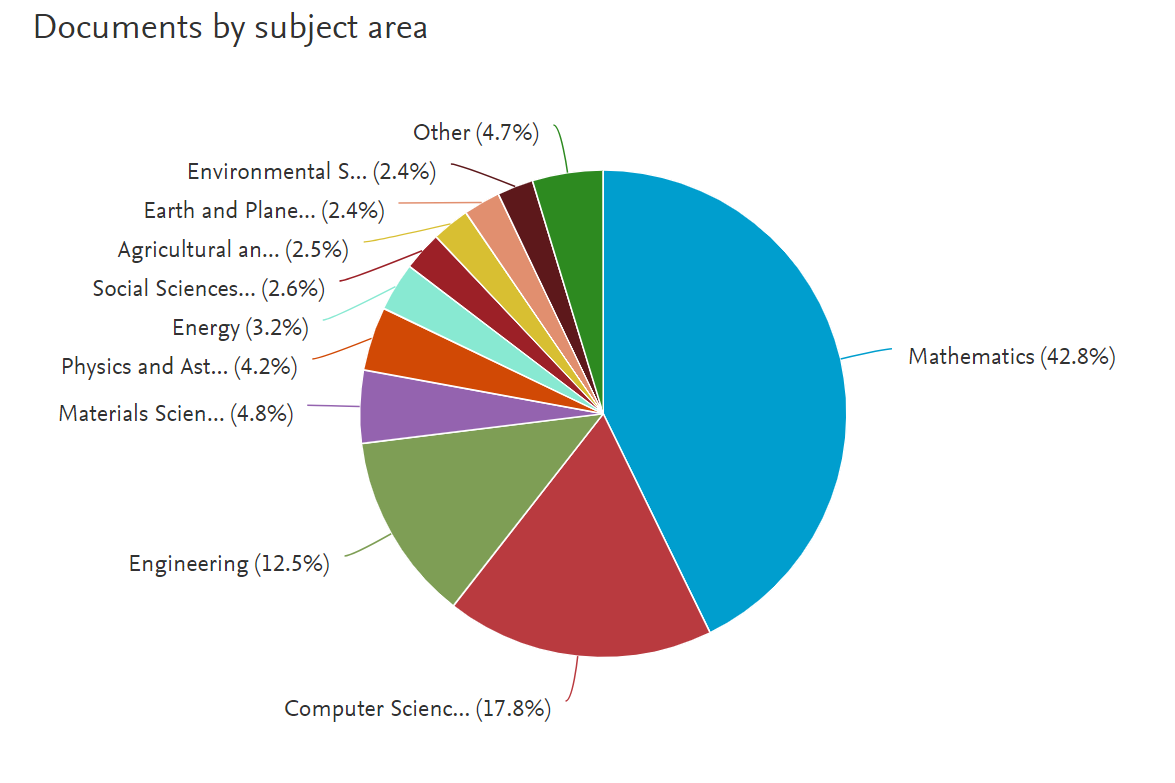
One can see clearly the steep increase of mathematics publications is after the declaration of research university status. It must be noted however, that not all of these publications come from mathematics department or the institute. Other entities also contribute to this volume of publications. The breakdown can be seen from the following piechart.
It can be seen that computer science and engineering contributed substantially to the total mathematics publications. This is followed by materials science and physics. This might seems to be a negative point to mathematicians but one should make use of this knowledge positively. We can use this to plan for a better future version of the institute and hence meet the interdisciplinary need of the institute.
It should be interesting also to compare the mathematics publication output of the other research universities with that of UPM. To do this, we limit the period of publications to only the last five years (2014-2018), so that each dataset is comparable to the other. This is shown below.
Apart from UKM, all the research universities (including UPM) follow the same trend and hence can be attributed to some conditions happening at the national level. This is particular the case for the dip in mathematics publications for last year (2018) and hence UPM's decrease in mathematics 2018 publications must not be seen in isolation. The UKM case seems to be anomalous but the dip in 2016 seems to be present also in UM, USM and UTM.
Let us go back to the mathematics publications of UPM. Do INSPEM contributions follow the same trend as UPM? Below we show the mathematics publications for the period of 2003-2019 (to coincide with INSPEMs) followed by INSPEM's own mathematics publications. (Please ignore the last data point since this only represents the publication volume for the first three months of 2019.)
INSPEM publications (the second one) do not follow closely the curve for UPM (the top one) but there is a similarity in trend. The dip in 2014 for UPM is shown in INSPEM as a decreasing trend and this decreasing trend on average continues. One can also see that the decrease in publications in 2018 is seen in both UPM and INSPEM. Hence decrease in 2018 INSPEM publications can be attributed to something that happens at the university level or even at the national level (referring to the earlier diagrams for all RUs). Let us do a more quantitative comparison by listing the fraction of UPM mathematics publications that come from INSPEM (see below).
Note that from 2010-2014, INSPEM' s contribution is always above 50% (apart from 2011). From 2015 onwards, it fell below 50% which is worrying. The year 2015 was the year before our second director took over from the first and I can only remember this was the period when we had much reduced budget and even lost some contract staff. Nevertheless, such decreasing trend should send us warning signals that we need to rectify the situation. Perhaps the university's insistence for higher KPIs will help, though my personal humble opinion that this should be done with care. As I have once said that the usual response to a threat is fight or flight. It would be much better that if the administrators can convince all researchers of the need to address the problem and by them owning up this problem, there will be a better working and research environment and hence help the university reach its desired targets. Again numbers are just numbers and they are only meaningful if there is indeed a genuine scientific progress made in the research ecosystem.
I ended the presentation with the same subject bubble plot that I have shown in my last post. The basic idea is to further refine the Malaysian mathematics publication analysis right down to the subfields within mathematics. The plot consists of a vertical axis of cites per document which shows the intrinsic (average) citation that a subfield has, while the horizontal axis is its (extrinsic) h-index whose value are determined by citations across a history of documents. Bubbles of each subfield are plotted in this parameter space with the size of the bubble is determined by the number of publications in the subfield for the considered period. In a way, these gives us an idea of how each subfield is trending in Malaysia. I gave both plots of the 2013-2014 period (five years ago) and the 2017-2018 period (last year). This is shown respectively below as the first one and the second one.
As clearly shown above, mathematics research is very dynamical. Let me take the example of mathematical physics, the field that I am in. In 2013-2014 diagram (the first one), it is represented by the bubble next to analysis. It has about 6 cites per document and the h-index of about 22 (taken from 33 documents). In 2017-2018, the cites per document is reduced to about 0.9 but h-index remains about 22 for mathematical physics. As stated earlier, the absolute values themselves may not mean much but the relative position in the parameter space reveals perhaps much more meaning. For mathematical physics, the intrinsic cites per document became the highest in mathematics but its h-index remains modest relative to other fields. The subject with the highest h-index is Modeling and Simulation (the bubble besides Applied Mathematics) with the value of 55. Its cites per document (about 0.4) is relatively high than most other subjects but is still much lower than Mathematical Physics.
Perhaps another important point that can be drawn by the diagram is that even the subfields of mathematics shows variations of citation culture, even within mathematics itself. It will probably be of no surprise if one is to plot the bubble diagram for the whole of science, one can see much more variation in the citation culture. I did not show such diagram in my presentation but below I give it for Malaysian publications in the period of 2017-2018.
One can see that mathematics citation culture is among the lowest of all the sciences. The other lower subjects (the bubbles to the left under mathematics) are Economics, Econometrics & Finance and Arts & Humanities. It is perhaps no wonder that researchers among the social sciences often felt underappreciated when they are being compared to the other sciences. But such feeling can be extended to the subject of mathematics itself. It is best that university administrators understand this cultural difference in citations among the different sciences or even more generally the cultural difference in research among the different sciences.
On the next day after the institute meeting, I met the former director who actually founded INSPEM to relay to him about our current worries. I can see his disappointment about the imminent changes to the institute. He mentioned his wishes that we (me and the management) will be able to carry INSPEM through in the future. I left his room with the feeling of a heavy burden on my shoulders. After coming back home from work, I had another spike in my blood pressure and hence rested thereafter. My nap was shortened as my mind went through many scenarios and having thoughts of this particular post. So how should we do the plot of the endgame?

In the meeting, I had prepared a presentation to assess the progress that we had made as a community of mathematical scientists in UPM, particularly with reference to INSPEM. I was trying to move away from the position of only responding to the pressure of external factors of restructuring and high KPIs, which are not in our control, to a position of where we as a community of mathematical scientists would want to go amidst constraints. I had spent long hours on the presentation, thinking of what to say. But when it was presented, I didn't get to say as much as I wanted to say. So perhaps this post is to make up what I have missed.
I began with our recent QS subject rankings. Now I know there is this love-hate relationship between academics and rankings and some even spoke of ignoring rankings altogether. I do not subscribe to this view. Some go on to mock by taking a single datum, make singular comparison and confusing different datasets (between individual and organizational achievements) altogether. I prefer to approach the matter as a scientist by viewing the rankings are simply datasets and there is valuable information that comes with them. A single datum does not mean much but better information can be gotten when this is seen in a bigger context within one dataset or even correlating them with another dataset. I do agree however, rankings are open to abuse (as much as anything else) and administrators begin to become obsessive about them. But we should separate this form of poor judgement from seeking valuable information from the rankings (and yes, it takes effort to uncover useful information).
I have mentioned in the last post that UPM was ranked 201-250 for the subject of mathematics in 2019 along with UKM and UTM. I am pretty sure some of those who attended the meeting do not know about this. But what perhaps even more not known that we were also ranked 201-250 in the year before (at least I do not know it myself until I start to check this recently).
Perhaps what I wanted to point out is that we did not quite care about this before because of the different context we are experiencing and because of our own apathy. We are made aware of the ranking this year because of two things: the imminent threat of restructuring and the fact that there was a social media announcement that took the length of even reporting the top 300 and top 400 subjects being ranked in the university but mathematics was not mentioned. In other words, if we do not look for this piece of information, we will remain oblivious about the matter. Now our own 201-250 ranking information does not mean much but the fact that we are in the same bracket as UKM and UTM while UM and USM ranked above us, does mean something. It will be more meaningful if we look deeper into the ranking scores.
What we could see that our ranking relied mostly through our academic reputation, which we have build over the years. The things we need to further improve on are our citations per paper and the h-index scores. When I say improve, I don't mean manipulatively but more from the intrinsic value of each of our publication. As I said, one can make use of this ranking information to help us progress better in mathematics rather than being apathetic or even emotional about it. I also took the trouble of looking at the ranking of materials science in UPM (251-300) due to many of our university researchers are in this area. The scores reveal the opposite from that of mathematics; here the researchers need to work on the academic reputation as the citations per paper score is the highest among the Malaysian universities.
QS subject ranking relied more on citations. With growing concern of our increased KPI, the publication volume dataset will be another relevant source of information that we can look to. Note however, that larger number of scientific publications does not necessarily entail better scientific progress but may only increase its probability of being so. Let me show the UPM total math publication again from the last post.
One can see clearly the steep increase of mathematics publications is after the declaration of research university status. It must be noted however, that not all of these publications come from mathematics department or the institute. Other entities also contribute to this volume of publications. The breakdown can be seen from the following piechart.
It can be seen that computer science and engineering contributed substantially to the total mathematics publications. This is followed by materials science and physics. This might seems to be a negative point to mathematicians but one should make use of this knowledge positively. We can use this to plan for a better future version of the institute and hence meet the interdisciplinary need of the institute.
It should be interesting also to compare the mathematics publication output of the other research universities with that of UPM. To do this, we limit the period of publications to only the last five years (2014-2018), so that each dataset is comparable to the other. This is shown below.
Apart from UKM, all the research universities (including UPM) follow the same trend and hence can be attributed to some conditions happening at the national level. This is particular the case for the dip in mathematics publications for last year (2018) and hence UPM's decrease in mathematics 2018 publications must not be seen in isolation. The UKM case seems to be anomalous but the dip in 2016 seems to be present also in UM, USM and UTM.
Let us go back to the mathematics publications of UPM. Do INSPEM contributions follow the same trend as UPM? Below we show the mathematics publications for the period of 2003-2019 (to coincide with INSPEMs) followed by INSPEM's own mathematics publications. (Please ignore the last data point since this only represents the publication volume for the first three months of 2019.)
INSPEM publications (the second one) do not follow closely the curve for UPM (the top one) but there is a similarity in trend. The dip in 2014 for UPM is shown in INSPEM as a decreasing trend and this decreasing trend on average continues. One can also see that the decrease in publications in 2018 is seen in both UPM and INSPEM. Hence decrease in 2018 INSPEM publications can be attributed to something that happens at the university level or even at the national level (referring to the earlier diagrams for all RUs). Let us do a more quantitative comparison by listing the fraction of UPM mathematics publications that come from INSPEM (see below).
Note that from 2010-2014, INSPEM' s contribution is always above 50% (apart from 2011). From 2015 onwards, it fell below 50% which is worrying. The year 2015 was the year before our second director took over from the first and I can only remember this was the period when we had much reduced budget and even lost some contract staff. Nevertheless, such decreasing trend should send us warning signals that we need to rectify the situation. Perhaps the university's insistence for higher KPIs will help, though my personal humble opinion that this should be done with care. As I have once said that the usual response to a threat is fight or flight. It would be much better that if the administrators can convince all researchers of the need to address the problem and by them owning up this problem, there will be a better working and research environment and hence help the university reach its desired targets. Again numbers are just numbers and they are only meaningful if there is indeed a genuine scientific progress made in the research ecosystem.
I ended the presentation with the same subject bubble plot that I have shown in my last post. The basic idea is to further refine the Malaysian mathematics publication analysis right down to the subfields within mathematics. The plot consists of a vertical axis of cites per document which shows the intrinsic (average) citation that a subfield has, while the horizontal axis is its (extrinsic) h-index whose value are determined by citations across a history of documents. Bubbles of each subfield are plotted in this parameter space with the size of the bubble is determined by the number of publications in the subfield for the considered period. In a way, these gives us an idea of how each subfield is trending in Malaysia. I gave both plots of the 2013-2014 period (five years ago) and the 2017-2018 period (last year). This is shown respectively below as the first one and the second one.
As clearly shown above, mathematics research is very dynamical. Let me take the example of mathematical physics, the field that I am in. In 2013-2014 diagram (the first one), it is represented by the bubble next to analysis. It has about 6 cites per document and the h-index of about 22 (taken from 33 documents). In 2017-2018, the cites per document is reduced to about 0.9 but h-index remains about 22 for mathematical physics. As stated earlier, the absolute values themselves may not mean much but the relative position in the parameter space reveals perhaps much more meaning. For mathematical physics, the intrinsic cites per document became the highest in mathematics but its h-index remains modest relative to other fields. The subject with the highest h-index is Modeling and Simulation (the bubble besides Applied Mathematics) with the value of 55. Its cites per document (about 0.4) is relatively high than most other subjects but is still much lower than Mathematical Physics.
Perhaps another important point that can be drawn by the diagram is that even the subfields of mathematics shows variations of citation culture, even within mathematics itself. It will probably be of no surprise if one is to plot the bubble diagram for the whole of science, one can see much more variation in the citation culture. I did not show such diagram in my presentation but below I give it for Malaysian publications in the period of 2017-2018.
One can see that mathematics citation culture is among the lowest of all the sciences. The other lower subjects (the bubbles to the left under mathematics) are Economics, Econometrics & Finance and Arts & Humanities. It is perhaps no wonder that researchers among the social sciences often felt underappreciated when they are being compared to the other sciences. But such feeling can be extended to the subject of mathematics itself. It is best that university administrators understand this cultural difference in citations among the different sciences or even more generally the cultural difference in research among the different sciences.
On the next day after the institute meeting, I met the former director who actually founded INSPEM to relay to him about our current worries. I can see his disappointment about the imminent changes to the institute. He mentioned his wishes that we (me and the management) will be able to carry INSPEM through in the future. I left his room with the feeling of a heavy burden on my shoulders. After coming back home from work, I had another spike in my blood pressure and hence rested thereafter. My nap was shortened as my mind went through many scenarios and having thoughts of this particular post. So how should we do the plot of the endgame?
Sunday, March 10, 2019
The Fight for Mathematical Sciences
These days of information glut, one needs a conscientiouss effort to thrust forward valuable information for our use. Otherwise valuable gems of information may simply get squashed by the volume of other information. Recently QS came out with their 2019 subject rankings and our university quickly highlighted those subjects that were ranked in the social media (see picture below).
Not seeing Mathematics in the picture, my gut feeling told me that it must have got ranked given the progress we have made so far. So I checked the QS Rankings for the subject of mathematics and yes, we were ranked at 201-250 (see below).
I informed my management colleagues and they felt that it should be highlighted by the university as well in the social media. Hence I mentioned it in one of the private university forums and they said that they will change this (so far I have not seen it). I do not think the absence of mathematics was purposely done but more probably is that less interest is taken in mathematics (which is a shame). I have no intent to make this as a big issue but such lack of interest in the progress made by our mathematical scientists can be misused by others, giving the impression that we have not progressed as much as in other sciences. On the other hand, while being ranked as such, we know ourselves that we still need better progress to move forward.
As part of the reason on why I would be surprised that we would be unranked is that there have been other studies showing that our country is progressing well in mathematics research. For instance, the paper "Mathematics Research in Association of Southeast Asian Nations Countries: A Scientometric Analysis of Patterns and Impacts" shows Malaysia is one of the four countries (the rest are Singapore, Vietnam and Thailand) that contribute most in the mathematics publications (95%) in ASEAN. In a way I was slightly surprised that we are comparable to Vietnam since Vietnam has a longer mathematical tradition associated to both French and Russian traditions (see particularly the math highly cited publications in the table below.
Some of these, as expected, are having international collaborators, which according to the paper makes our papers to be better cited. Malaysia, so it seems, are mainly having collaborators from Iran, India and Saudi Arabia (I was surprised by the third) - see the graph plot below. Uzbekistan, whose mathematical community in Malaysia is significant, seems to come fifth after USA. To digress, it was through Uzbek mathematician, Abdumalik Rakhimov (once our research fellow in the institute), that I got my Erdos number 4 (which of course does not say anything significant) - see below. Another observation is the graph density (not calculated in the paper); ours are as dense as Vietnam's but not as dense as Singapore's, showing better international diversity.
Now the question is how much of this is contribution from our university, UPM. First note that the dataset used in the above is from the period of 2006-2015. While I can't find (at the time of this writing) how mathematics contribution are distributed among say, the research universities, the distribution among broad science categories can be found here. Let us just focus on mathematics in UPM where I have done some information filtration through Scopus before this. Here is the mathematics publications affiliated with UPM from 1980-2019 (see below).
Prior to 1992, there seems to be negligible Scopus-cited mathematics publication from UPM. An appreciable increase in publications can be seen from 2000 onwards. A steep rise can be seen after 2006. It is plausible to make connections with some known events. Some notable events are (i) the formation of the institute INSPEM in April 2002; and (ii) the status of UPM as research university in October 2006. Of course, there is a multitude of factors that can be considered. We will next consider only those publications affiliated with INSPEM.
It is interesting to note that the first publication begins in 2003. It is very much plausible that there may be researchers of the institute that have published before this but without INSPEM affiliation since the institute is a new phenomenon. One can also note that from the side numbers, the number of publications for each year is lower than that for the whole of UPM. Until 2016, the percentage of INSPEM publication relative to UPM total math publication hovers between 42-60%. It is to be noted that researchers have the freedom to put down the INSPEM affiliation or not (even if the research grant is parked at the institute) in their papers. There is also the policy that the publications from the institute will still be counted at the various faculties. While this can be said as a disadvantage, the institute has always given the freedom to the researchers though we recommended to them to include the institute affiliation in their publications. The percentage of INSPEM publications dropped to around 30% beginning 2017. We are not quite sure why this is so but I have argued before that certainly this coincides with the period of reduced fundings and shrinkage of the number of staff.
Having observed the above, it is only natural for the institute to study whatever weaknesses and threats there are to the institute. This is the more reason why we at the institute should consolidate our strength and resources to ensure the survival of the institute. We have already heard the news of possible restructuring of the institute, which undoubtedly has brought the morale down and makes it even more difficult for us to progress. Recent setting of the KPIs has also worsened the situation for the institute mainly because the KPI setting is done without differentiating the research culture of each discipline. It is widely known that mathematics has modest publication rates, which is at best is two or lower per year - see the issued statement of American Mathematical Society over here. Another study of American mathematicians in fact revealed that it is even lower than one per year (see figure below).
Similarly for citations, the citation culture is different in mathematics, often lower than other sciences (and hence also for other indicators that depend on citations like h-index) - see the following study by International Mathematical Union and the following discussion (pg 32-34) in European Mathematical Society Newsletter. It would be terribly unjust to ignore these differences. It will be no surprise then by setting the KPI of publication rate at five papers per year (as main author), for instance, scares everyone away from being a member of the institute. Had it been KPIs being merely targets and unrelated to salary movement or promotion assessments, it would have been more acceptable. Unfortunately, this is usually not the case and most people see KPIs in the context of threats. The usual response would be fight or flight.
Setting a blanket KPI would be an easy route for university administrators to monitor progress, but one that will come at a price. Unrealistic KPIs would invite unethical approaches by researchers that often may embarrass the universities themselves (see Retraction Watch posts on Malaysia). At best, researchers will show indifference towards to the vision and goals of the university. Some may ask why should the university allow different treatments for a particular discipline. Why should we be considered 'special', as someone asked. Then one can respond back with the same reasoning of why should any ranking agencies be interested in ranking of universities by subjects. It is just a simple acknowledgement of the fact that there are research cultural differences one can't just ignore. I understand the fact the university wishes to progress and not be contented with present achievements. I believe everyone in their right mind, wants to be so. That is why I suggest that any progress be done realistically and incrementally based on past achievements and present resources. We could look to the subject ranking for mathematics as a guide. For instance, for the publication KPI that one needs to set is perhaps the average number of publications of a mathematician from the bracket of top 151-200 universities, since we have already being ranked at top 201-250. Now the criteria for the QS ranking was based mainly on citations and overall reputation and not publication rate, but with some efforts, we can get the average number of publications from Scopus dataset. Below are some breakdowns of the ranking indicators used.
The first column is the overall reputation, the second is citations per paper and the third is h-index citations. We can immediately see that we really need to work on the citations (and I don't mean manipulatively). One should now work on publishing our research materials in journals where the relevant community flocks to (and this does not necessarily means Q1 and Q2 journals as some would like to think). Each journal tends to have a particular following and we can look for those respectable ones where our research output would be most read by, particularly those which are more specialised. There are other 'strategies' that one could also use; for instance uploading preprints to some repository like the arXiv, making our work more visible (and hence also open to more critics). We can even go to more details; within the mathematics subfields, which are the ones more identifiable with our institute, build reputation around it. Here is a snapshot of the mathematical subfields found visible for Malaysia in 2017-2018 given by Scimago.
Let me just end this post with a saying that I have read elsewhere: as the university gets more critical with our achievements, one should also be equally critical with the critieria that we have been measured against. One can be easily deluded by 'numbers' that appears objective, but it is what do these numbers actually mean, which is the subjective part. Instead of being preoccupied with such numbers, we should be more concerned with the science that we grow. Deep within us, we know ourselves whether we are doing alright or not.
Not seeing Mathematics in the picture, my gut feeling told me that it must have got ranked given the progress we have made so far. So I checked the QS Rankings for the subject of mathematics and yes, we were ranked at 201-250 (see below).
I informed my management colleagues and they felt that it should be highlighted by the university as well in the social media. Hence I mentioned it in one of the private university forums and they said that they will change this (so far I have not seen it). I do not think the absence of mathematics was purposely done but more probably is that less interest is taken in mathematics (which is a shame). I have no intent to make this as a big issue but such lack of interest in the progress made by our mathematical scientists can be misused by others, giving the impression that we have not progressed as much as in other sciences. On the other hand, while being ranked as such, we know ourselves that we still need better progress to move forward.
As part of the reason on why I would be surprised that we would be unranked is that there have been other studies showing that our country is progressing well in mathematics research. For instance, the paper "Mathematics Research in Association of Southeast Asian Nations Countries: A Scientometric Analysis of Patterns and Impacts" shows Malaysia is one of the four countries (the rest are Singapore, Vietnam and Thailand) that contribute most in the mathematics publications (95%) in ASEAN. In a way I was slightly surprised that we are comparable to Vietnam since Vietnam has a longer mathematical tradition associated to both French and Russian traditions (see particularly the math highly cited publications in the table below.
Some of these, as expected, are having international collaborators, which according to the paper makes our papers to be better cited. Malaysia, so it seems, are mainly having collaborators from Iran, India and Saudi Arabia (I was surprised by the third) - see the graph plot below. Uzbekistan, whose mathematical community in Malaysia is significant, seems to come fifth after USA. To digress, it was through Uzbek mathematician, Abdumalik Rakhimov (once our research fellow in the institute), that I got my Erdos number 4 (which of course does not say anything significant) - see below. Another observation is the graph density (not calculated in the paper); ours are as dense as Vietnam's but not as dense as Singapore's, showing better international diversity.
Now the question is how much of this is contribution from our university, UPM. First note that the dataset used in the above is from the period of 2006-2015. While I can't find (at the time of this writing) how mathematics contribution are distributed among say, the research universities, the distribution among broad science categories can be found here. Let us just focus on mathematics in UPM where I have done some information filtration through Scopus before this. Here is the mathematics publications affiliated with UPM from 1980-2019 (see below).
Prior to 1992, there seems to be negligible Scopus-cited mathematics publication from UPM. An appreciable increase in publications can be seen from 2000 onwards. A steep rise can be seen after 2006. It is plausible to make connections with some known events. Some notable events are (i) the formation of the institute INSPEM in April 2002; and (ii) the status of UPM as research university in October 2006. Of course, there is a multitude of factors that can be considered. We will next consider only those publications affiliated with INSPEM.
It is interesting to note that the first publication begins in 2003. It is very much plausible that there may be researchers of the institute that have published before this but without INSPEM affiliation since the institute is a new phenomenon. One can also note that from the side numbers, the number of publications for each year is lower than that for the whole of UPM. Until 2016, the percentage of INSPEM publication relative to UPM total math publication hovers between 42-60%. It is to be noted that researchers have the freedom to put down the INSPEM affiliation or not (even if the research grant is parked at the institute) in their papers. There is also the policy that the publications from the institute will still be counted at the various faculties. While this can be said as a disadvantage, the institute has always given the freedom to the researchers though we recommended to them to include the institute affiliation in their publications. The percentage of INSPEM publications dropped to around 30% beginning 2017. We are not quite sure why this is so but I have argued before that certainly this coincides with the period of reduced fundings and shrinkage of the number of staff.
Having observed the above, it is only natural for the institute to study whatever weaknesses and threats there are to the institute. This is the more reason why we at the institute should consolidate our strength and resources to ensure the survival of the institute. We have already heard the news of possible restructuring of the institute, which undoubtedly has brought the morale down and makes it even more difficult for us to progress. Recent setting of the KPIs has also worsened the situation for the institute mainly because the KPI setting is done without differentiating the research culture of each discipline. It is widely known that mathematics has modest publication rates, which is at best is two or lower per year - see the issued statement of American Mathematical Society over here. Another study of American mathematicians in fact revealed that it is even lower than one per year (see figure below).
Similarly for citations, the citation culture is different in mathematics, often lower than other sciences (and hence also for other indicators that depend on citations like h-index) - see the following study by International Mathematical Union and the following discussion (pg 32-34) in European Mathematical Society Newsletter. It would be terribly unjust to ignore these differences. It will be no surprise then by setting the KPI of publication rate at five papers per year (as main author), for instance, scares everyone away from being a member of the institute. Had it been KPIs being merely targets and unrelated to salary movement or promotion assessments, it would have been more acceptable. Unfortunately, this is usually not the case and most people see KPIs in the context of threats. The usual response would be fight or flight.
Setting a blanket KPI would be an easy route for university administrators to monitor progress, but one that will come at a price. Unrealistic KPIs would invite unethical approaches by researchers that often may embarrass the universities themselves (see Retraction Watch posts on Malaysia). At best, researchers will show indifference towards to the vision and goals of the university. Some may ask why should the university allow different treatments for a particular discipline. Why should we be considered 'special', as someone asked. Then one can respond back with the same reasoning of why should any ranking agencies be interested in ranking of universities by subjects. It is just a simple acknowledgement of the fact that there are research cultural differences one can't just ignore. I understand the fact the university wishes to progress and not be contented with present achievements. I believe everyone in their right mind, wants to be so. That is why I suggest that any progress be done realistically and incrementally based on past achievements and present resources. We could look to the subject ranking for mathematics as a guide. For instance, for the publication KPI that one needs to set is perhaps the average number of publications of a mathematician from the bracket of top 151-200 universities, since we have already being ranked at top 201-250. Now the criteria for the QS ranking was based mainly on citations and overall reputation and not publication rate, but with some efforts, we can get the average number of publications from Scopus dataset. Below are some breakdowns of the ranking indicators used.
The first column is the overall reputation, the second is citations per paper and the third is h-index citations. We can immediately see that we really need to work on the citations (and I don't mean manipulatively). One should now work on publishing our research materials in journals where the relevant community flocks to (and this does not necessarily means Q1 and Q2 journals as some would like to think). Each journal tends to have a particular following and we can look for those respectable ones where our research output would be most read by, particularly those which are more specialised. There are other 'strategies' that one could also use; for instance uploading preprints to some repository like the arXiv, making our work more visible (and hence also open to more critics). We can even go to more details; within the mathematics subfields, which are the ones more identifiable with our institute, build reputation around it. Here is a snapshot of the mathematical subfields found visible for Malaysia in 2017-2018 given by Scimago.
Let me just end this post with a saying that I have read elsewhere: as the university gets more critical with our achievements, one should also be equally critical with the critieria that we have been measured against. One can be easily deluded by 'numbers' that appears objective, but it is what do these numbers actually mean, which is the subjective part. Instead of being preoccupied with such numbers, we should be more concerned with the science that we grow. Deep within us, we know ourselves whether we are doing alright or not.
Saturday, February 23, 2019
Seed Bed
(Another post that I had to share due to its importance)
This post is about seminars particularly the institute's weekly seminar. No, it's not about controversies raised around this matter but more on how to resurrect the spirit of scholarly activity and discussions in seminars. Regarding whatever controversy there is (if there is one), my wish is that everyone place some appropriate concern about the institute, beyond own self or own group, solving the (many) problems of the institute. I'm not too much bothered who is more right or who is more wrong but I will be more glad to see someone offering solutions in action (not simply in thoughts).
The institute has religiously conducted its weekly seminars since the early days until now. This is a good tradition to keep. I remember during my PhD days we had this weekly Friday seminars, where members of the Centre for Particle Theory from both Department of Physics and Department of Mathematical Sciences, went to these talks religiously. Besides this, we had also an internal Journal Club lunchtime talks given by both staff and students. In DAMTP, Cambridge, I remember they had several group seminars almost all days in the week and I went to some of them when the topic is highly interesting to me and the seminar rooms were always filled by interested staff and students. I also had the experience of going to String Theory Workshop(s) in DAMTP and LMS Durham Symposia where the lecture halls were filled to the brim. I had the fond memory of attending Spinors, Twistors and Complex Structures in General Relativty in 1988 (chaired by Roger Penrose and Chris Isham) and went to almost all of the talks. Remembered the incident of Claude LeBrun's talk having used index free notation and the audience wanted them with indices. He proceeded with even more notations without indices. Later when Trautman gave his talk, he joked that the audience will now see some index and he was talking about index theorems. The other symposium that I went was on Geometry of Low-Dimensional Manifolds in 1989 and Ed Witten was one of the speakers. In all of these events, the atmosphere was electrifying and the corridor and coffee conversations were about the progress in science. That is why when I go to many of the local events here, it is frustrating and embarrassing to see such an atmosphere is really rare. Our conversations tend to revolve around gossips, politics, holiday-plans and of course, food instead. When we go to parallel sessions of a conference, sometimes the audience is simply the speakers of the session themselves. Once in an international conference held locally, the audience that were left are the international speakers and participants and I heard one of them made the remark, where are all the local people. Once also in the social media, I read a remark of a participant in one of the (local) international conferences made derogatory remarks about the scientific intent of the event. This has to be taken seriously by us local academics - don't let it get any worse.
Going back to our weekly seminars, we noticed the reduced number of participants and the lack of interactions over the years. While I do not think going to all seminars being practical, I have always thought that whenever the topic is on a particular area, the appropriate research group should be there but this is often not the case. We tried different things to have better response for the seminars. We have now announcements on the social media (used to be on twitter too but I guess many of us do not do twitter). The past director had also made the change that the speakers should be from outside or among the academic staff to ensure better attraction and hopefully participation. This is because at one stage, we had too frequently student speakers for the seminars. In principle, there is nothing wrong with this, provided the student is well-prepared for the talk and willing to take up questions professionally. During my student days, we had our own separate student events separate from the official and regular ones. Presently our theoretical physics group is doing just that for the QuEST group meetings (QuEST stands for Quantum Explorations of Science & Technology). Thankfully, this is going well each week (apart from some festive season and conference periods). So the question is why can't we have the weekly seminars highly-spirited like we ought to. When I chaired the talk yesterday and I was about to start the Q&A session, the speaker even made the remark that maybe the audience was too tired for this (?). Perhaps we have hit rock bottom?
When I wanted to write up this post, I tried to search for some history of the seminar tradition. I came across two interesting ones: (i) The academic seminar as emotional community; and (ii) Creative discomfort: The culture of the Gelfand seminar at Moscow University. Let's leave the second one for some remarks at the end and focus on the first. In the first article, it tells us that the word seminar (coming from Latin seminarium) refers to nursery or seed bed. I thought this is fitting since it is from seminars and ensuing discussions, that we often get research ideas. However it was the title emotional community that really caught my attention, particularly the word emotional itself. We all know when we organise seminars, workshops and conference, they are meant to serve some particular community. But having emotional attachments? Perhaps, as discussed in the first paper, it's a spiritual fellowship or brotherhood of equals joining forces in the pursuit of truth, with the seminar (participants as fellows) as a manifestation. I quote in full, the ending sentence of the paper:
"A good seminar, based in a community of shared emotions - and in which the individual can both become part of the collective and at the same time find his or her own unique way to creative self-realisation - is still a guiding academic utopia"
Our weekly seminar should have, over the years, made some form of impact, at least, to the research ecosystem that we have built. If we have not felt it, then there must be some elements that made it ineffective. Perhaps we have not shown the seminar tradition the respect it deserves. If we did not, then it is highly unlikely that anyone else (beyond the fellowship) will. I have already heard someone mention the scepticism in passing that we have been organising the seminars for the ump-teenth time but yet the impact is unknown. On the other hand, I have also heard others being envious of our consistency in organising the weekly seminars when they still find it problematic to get people to give talks regularly. So we have to keep examining ourselves to ensure the spirit of our seminars is not lost. If we feel that our seminars are not worth going, others will probably feel the same way even more. The seminar should bind us together (and not make us fall apart).
In some places, the seminars that the institution conduct, tend to give the unique characteristic or identity that the institution (or generally the fellowship) has. I have already mention a few examples during my student years. In the past, I have always looked at the online talks of KITP, Perimeter Institute and MSRI, knowing how informative they are. Not only they organise seminars regularly but they also put them online for the whole world to see. Perhaps in the (far) future, when we do not have to deal with petty matters, we can do this also (we did try this at some point, with videos, uploaded in our YouTube channel instead of hosting it ourselves - see https://www.youtube.com/watch?v=n4HTVaRqPFA for instance, with the expertise help of Majalah Sains then - apologies for the absence of credit in the video clip).
One exceptional series of seminars that had caught the attention of many in the mathematical world is of course the legendary Gelfand Seminars led by I.M. Gelfand at Moscow State University, which one can read in the second article above. The seminar is held on Monday nights and can last to four hours straight with intimidating questioning. It is not the kind of seminar that may suit many. However, the impact that it made, are felt by mathematicians across the world. One can read the tributes to Gelfand in https://www.ams.org/notices/201301/rnoti-p24.pdf and https://www.ams.org/notices/201302/rnoti-p162.pdf. While we read in awe such exceptional cases, we should put in energy to make our weekly seminar series be impactful to us and respectable to many, the very least. We may or may not see this realised within our lifetime (particularly with the uncertainties ahead - yes, despite what we have heard earlier in Monday afternoon) but at least the future generations will not curse us for not trying.
This post is about seminars particularly the institute's weekly seminar. No, it's not about controversies raised around this matter but more on how to resurrect the spirit of scholarly activity and discussions in seminars. Regarding whatever controversy there is (if there is one), my wish is that everyone place some appropriate concern about the institute, beyond own self or own group, solving the (many) problems of the institute. I'm not too much bothered who is more right or who is more wrong but I will be more glad to see someone offering solutions in action (not simply in thoughts).
The institute has religiously conducted its weekly seminars since the early days until now. This is a good tradition to keep. I remember during my PhD days we had this weekly Friday seminars, where members of the Centre for Particle Theory from both Department of Physics and Department of Mathematical Sciences, went to these talks religiously. Besides this, we had also an internal Journal Club lunchtime talks given by both staff and students. In DAMTP, Cambridge, I remember they had several group seminars almost all days in the week and I went to some of them when the topic is highly interesting to me and the seminar rooms were always filled by interested staff and students. I also had the experience of going to String Theory Workshop(s) in DAMTP and LMS Durham Symposia where the lecture halls were filled to the brim. I had the fond memory of attending Spinors, Twistors and Complex Structures in General Relativty in 1988 (chaired by Roger Penrose and Chris Isham) and went to almost all of the talks. Remembered the incident of Claude LeBrun's talk having used index free notation and the audience wanted them with indices. He proceeded with even more notations without indices. Later when Trautman gave his talk, he joked that the audience will now see some index and he was talking about index theorems. The other symposium that I went was on Geometry of Low-Dimensional Manifolds in 1989 and Ed Witten was one of the speakers. In all of these events, the atmosphere was electrifying and the corridor and coffee conversations were about the progress in science. That is why when I go to many of the local events here, it is frustrating and embarrassing to see such an atmosphere is really rare. Our conversations tend to revolve around gossips, politics, holiday-plans and of course, food instead. When we go to parallel sessions of a conference, sometimes the audience is simply the speakers of the session themselves. Once in an international conference held locally, the audience that were left are the international speakers and participants and I heard one of them made the remark, where are all the local people. Once also in the social media, I read a remark of a participant in one of the (local) international conferences made derogatory remarks about the scientific intent of the event. This has to be taken seriously by us local academics - don't let it get any worse.
Going back to our weekly seminars, we noticed the reduced number of participants and the lack of interactions over the years. While I do not think going to all seminars being practical, I have always thought that whenever the topic is on a particular area, the appropriate research group should be there but this is often not the case. We tried different things to have better response for the seminars. We have now announcements on the social media (used to be on twitter too but I guess many of us do not do twitter). The past director had also made the change that the speakers should be from outside or among the academic staff to ensure better attraction and hopefully participation. This is because at one stage, we had too frequently student speakers for the seminars. In principle, there is nothing wrong with this, provided the student is well-prepared for the talk and willing to take up questions professionally. During my student days, we had our own separate student events separate from the official and regular ones. Presently our theoretical physics group is doing just that for the QuEST group meetings (QuEST stands for Quantum Explorations of Science & Technology). Thankfully, this is going well each week (apart from some festive season and conference periods). So the question is why can't we have the weekly seminars highly-spirited like we ought to. When I chaired the talk yesterday and I was about to start the Q&A session, the speaker even made the remark that maybe the audience was too tired for this (?). Perhaps we have hit rock bottom?
When I wanted to write up this post, I tried to search for some history of the seminar tradition. I came across two interesting ones: (i) The academic seminar as emotional community; and (ii) Creative discomfort: The culture of the Gelfand seminar at Moscow University. Let's leave the second one for some remarks at the end and focus on the first. In the first article, it tells us that the word seminar (coming from Latin seminarium) refers to nursery or seed bed. I thought this is fitting since it is from seminars and ensuing discussions, that we often get research ideas. However it was the title emotional community that really caught my attention, particularly the word emotional itself. We all know when we organise seminars, workshops and conference, they are meant to serve some particular community. But having emotional attachments? Perhaps, as discussed in the first paper, it's a spiritual fellowship or brotherhood of equals joining forces in the pursuit of truth, with the seminar (participants as fellows) as a manifestation. I quote in full, the ending sentence of the paper:
"A good seminar, based in a community of shared emotions - and in which the individual can both become part of the collective and at the same time find his or her own unique way to creative self-realisation - is still a guiding academic utopia"
Our weekly seminar should have, over the years, made some form of impact, at least, to the research ecosystem that we have built. If we have not felt it, then there must be some elements that made it ineffective. Perhaps we have not shown the seminar tradition the respect it deserves. If we did not, then it is highly unlikely that anyone else (beyond the fellowship) will. I have already heard someone mention the scepticism in passing that we have been organising the seminars for the ump-teenth time but yet the impact is unknown. On the other hand, I have also heard others being envious of our consistency in organising the weekly seminars when they still find it problematic to get people to give talks regularly. So we have to keep examining ourselves to ensure the spirit of our seminars is not lost. If we feel that our seminars are not worth going, others will probably feel the same way even more. The seminar should bind us together (and not make us fall apart).
In some places, the seminars that the institution conduct, tend to give the unique characteristic or identity that the institution (or generally the fellowship) has. I have already mention a few examples during my student years. In the past, I have always looked at the online talks of KITP, Perimeter Institute and MSRI, knowing how informative they are. Not only they organise seminars regularly but they also put them online for the whole world to see. Perhaps in the (far) future, when we do not have to deal with petty matters, we can do this also (we did try this at some point, with videos, uploaded in our YouTube channel instead of hosting it ourselves - see https://www.youtube.com/watch?v=n4HTVaRqPFA for instance, with the expertise help of Majalah Sains then - apologies for the absence of credit in the video clip).
One exceptional series of seminars that had caught the attention of many in the mathematical world is of course the legendary Gelfand Seminars led by I.M. Gelfand at Moscow State University, which one can read in the second article above. The seminar is held on Monday nights and can last to four hours straight with intimidating questioning. It is not the kind of seminar that may suit many. However, the impact that it made, are felt by mathematicians across the world. One can read the tributes to Gelfand in https://www.ams.org/notices/201301/rnoti-p24.pdf and https://www.ams.org/notices/201302/rnoti-p162.pdf. While we read in awe such exceptional cases, we should put in energy to make our weekly seminar series be impactful to us and respectable to many, the very least. We may or may not see this realised within our lifetime (particularly with the uncertainties ahead - yes, despite what we have heard earlier in Monday afternoon) but at least the future generations will not curse us for not trying.
Saturday, February 16, 2019
Not Quite Equal As Yet
*Due to the importance of the issues discussed here, I will advertise again this particular post in the students and staff FB private groups.
Thank goodness, this week went by without 'unwanted incidents'. Sometimes one gets so tied up with petty matters that we forget the larger perspective of things. I join the institute (initially IMM, then ITMA and finally INSPEM) because of this larger perspective. My general vision is to establish tradition in sophisticated, technical theoretical sciences and in particular theoretical physics.
Parts of what I do are also related to some modern developments of mathematics (mainly geometry side) and thus when I joined INSPEM with better mathematical environment, I was hoping some of these get further developed with mathematicians. There was no geometrists around (the closest being algebraists) but the director then had a research group interested in number theory (and on the application side is cryptography). So when I did the first lecture series in INSPEM, EQuaLS1, it had a theme "Geometry, Number Theory and Quantum Physics". The people I brought over were top-notch scientists and my hope that it will spur interests among mathematicians and physicists that will help cross traditional disciplines. This did not quite happen; I guess being identified too much as a quantum theorist may have caused very few mathematicians were interested in the event. The same is true for the next EQuaLS2 (despite the theme is "Foundations of Quantum Science & Technology"), which I hope will attract theoretical computer scientists working on logic and category theory. The next few EQuaLS became closer and closer to physics after realizing that it is hard to garner interests from the mathematicians. The last EQuaLS was EQuaLS8 which ended with the tragic departure of mentor-friend Prof. Syed Twareque Ali. We had not done another EQuaLS since then.
Without our mentor, our international networking of established researchers shrunk. That was not the only reason; the financial support for inviting established researchers was also declining. Initially there was capacity building grant from Ministry of Science - this no longer exists. The latter events also use in part the visiting scientist programme under the institute funded by mostly our research grants. Recently, this too became difficult as additional requirements are imposed for visiting scientists namely to coauthor publications with our local researchers. This is a bit awkward - most of the scientists I invited are top-notch scientists from whom we simply wanted to learn from. To coauthor publications require long-established relationships and our local researchers are able to generate ideas/work of mutual interest for the established researchers. Thus, with such conditions, the network of international researchers became even smaller. Not having research grants the last two years made it even worse.
So what should we do now? My personal wish is that we continue with EQuaLS at a smaller scale so that the tradition at least continues with a lesser stature. I have only a few years of services left to see this happening. We do now have a small group in existent and I hope they will continue the efforts to establish sophisticated and respected theoretical research here and hopefully crossing physics-mathematics boundary. Hope my younger colleagues will continue this vision with the same sense of urgency (whether in the current institute or possible forthcoming one).
With near retirement, the usual advice one gets is to help the younger scientists to excel. This can only be done if the younger generation of scientists and students are receptive. In this respect, I still have reservations on the matter. This semester I'm supposed to teach Special Relativity and Classical Fields. The initial already small number of registered students dwindled down to the number shown in the pic below. I guess many still avoid theoretical subjects that are often perceived as difficult. Luckily the department still supports the course to continue. Last semester, I was supposed to teach Advanced Quantum Mechanics but had to cancel it as almost everyone dropped the subject. I ended up teaching another subject beginning the third week. There is truth about theoretical subjects being more difficult but I sincerely wish that the students view this more as a challenge in taking up more sophisticated materials, more in-depth skills for them to bring away from their studies.
Another matter recently brought up was the attendance to the institute's weekly seminar. The number has decreased over the years and one finds that the audience comprises more of international students than local students. While I do not expect all students to attend each seminar (which may not be on the topic of their choice) but I do expect that students of the appropriate research group to come to the seminar of the relevant topic. Has it come to the point that one perceives one's own work (whatever that may be - more often just personal work) being more important than supporting an academic tradition. What had happened to thirst of knowledge? One has to rectify this and the best way is ourselves (both staff and academics) to be exemplary in this case. I had once suggested that one should avoid having meetings on Friday afternoons (the regular time for our weekly seminars). I will also start asking my own students to avoid making appointments at this time. Take even odd hours (like lunch time - normally I stay in office) if necessary. Hopefully by doing this way, others will start to treat our weekly seminars with more respect.
Thank goodness, this week went by without 'unwanted incidents'. Sometimes one gets so tied up with petty matters that we forget the larger perspective of things. I join the institute (initially IMM, then ITMA and finally INSPEM) because of this larger perspective. My general vision is to establish tradition in sophisticated, technical theoretical sciences and in particular theoretical physics.
Parts of what I do are also related to some modern developments of mathematics (mainly geometry side) and thus when I joined INSPEM with better mathematical environment, I was hoping some of these get further developed with mathematicians. There was no geometrists around (the closest being algebraists) but the director then had a research group interested in number theory (and on the application side is cryptography). So when I did the first lecture series in INSPEM, EQuaLS1, it had a theme "Geometry, Number Theory and Quantum Physics". The people I brought over were top-notch scientists and my hope that it will spur interests among mathematicians and physicists that will help cross traditional disciplines. This did not quite happen; I guess being identified too much as a quantum theorist may have caused very few mathematicians were interested in the event. The same is true for the next EQuaLS2 (despite the theme is "Foundations of Quantum Science & Technology"), which I hope will attract theoretical computer scientists working on logic and category theory. The next few EQuaLS became closer and closer to physics after realizing that it is hard to garner interests from the mathematicians. The last EQuaLS was EQuaLS8 which ended with the tragic departure of mentor-friend Prof. Syed Twareque Ali. We had not done another EQuaLS since then.
Without our mentor, our international networking of established researchers shrunk. That was not the only reason; the financial support for inviting established researchers was also declining. Initially there was capacity building grant from Ministry of Science - this no longer exists. The latter events also use in part the visiting scientist programme under the institute funded by mostly our research grants. Recently, this too became difficult as additional requirements are imposed for visiting scientists namely to coauthor publications with our local researchers. This is a bit awkward - most of the scientists I invited are top-notch scientists from whom we simply wanted to learn from. To coauthor publications require long-established relationships and our local researchers are able to generate ideas/work of mutual interest for the established researchers. Thus, with such conditions, the network of international researchers became even smaller. Not having research grants the last two years made it even worse.
So what should we do now? My personal wish is that we continue with EQuaLS at a smaller scale so that the tradition at least continues with a lesser stature. I have only a few years of services left to see this happening. We do now have a small group in existent and I hope they will continue the efforts to establish sophisticated and respected theoretical research here and hopefully crossing physics-mathematics boundary. Hope my younger colleagues will continue this vision with the same sense of urgency (whether in the current institute or possible forthcoming one).
With near retirement, the usual advice one gets is to help the younger scientists to excel. This can only be done if the younger generation of scientists and students are receptive. In this respect, I still have reservations on the matter. This semester I'm supposed to teach Special Relativity and Classical Fields. The initial already small number of registered students dwindled down to the number shown in the pic below. I guess many still avoid theoretical subjects that are often perceived as difficult. Luckily the department still supports the course to continue. Last semester, I was supposed to teach Advanced Quantum Mechanics but had to cancel it as almost everyone dropped the subject. I ended up teaching another subject beginning the third week. There is truth about theoretical subjects being more difficult but I sincerely wish that the students view this more as a challenge in taking up more sophisticated materials, more in-depth skills for them to bring away from their studies.
Another matter recently brought up was the attendance to the institute's weekly seminar. The number has decreased over the years and one finds that the audience comprises more of international students than local students. While I do not expect all students to attend each seminar (which may not be on the topic of their choice) but I do expect that students of the appropriate research group to come to the seminar of the relevant topic. Has it come to the point that one perceives one's own work (whatever that may be - more often just personal work) being more important than supporting an academic tradition. What had happened to thirst of knowledge? One has to rectify this and the best way is ourselves (both staff and academics) to be exemplary in this case. I had once suggested that one should avoid having meetings on Friday afternoons (the regular time for our weekly seminars). I will also start asking my own students to avoid making appointments at this time. Take even odd hours (like lunch time - normally I stay in office) if necessary. Hopefully by doing this way, others will start to treat our weekly seminars with more respect.
Friday, February 08, 2019
Three Short Tales
It is properly clear to the staff that I practiced very open participatory management and am open to ideas and even criticisms (not toxic ones of course). As a scientist, the possibility of being at fault is very much entertained though this should not be construed as self-admission of guilt or weakness. One employs self-criticisms to help improve oneself. Having said so, one would like to see others do the same. In this post, I would like to tell three stories of recent events that made me self-reflect. I will not mention names but only retelling them for us to learn.
Story 1: Recently one hears about Cambridge International University from a politician. Don't bother looking up this university as the website has been hacked. I have no wish to comment further on the viralled news of the politician (one can look up many news items on this). But it made me remember an incident I had with an ex-Adelaidean friend. When we corresponded then, I told my friend that I am studying Part III in University of Cambridge. The person then responded, asking 'Which Cambridge am I in?' perhaps doubting my capability to be even a Cambridge student. I did not respond back and kept quiet (for those doubting, please look at this post). To me, it is not that important that I had been a Cambridge student, but more importantly is how one acts thereafter. Sometimes one finds people boasting about their prestigious university background but does not quite live up to its prestigious names. This leads me to a recent discussion about what are the traits of our university students; their employability and what-nots. The natural discussion thereafter was the traits of our university professors. While the discussion was on a particular skill, I am actually more concerned with the technical knowledge that a professor should have - particularly when interacting with professors in other parts of the world within the same area. Failure to be seen to profess the technical knowledge may tarnish the university's professorial image. One should live up to the expectations of the title of professor, much like one has to live up the expectations of being a Cambridge student (when one claimed so). Indeed, it is a heavy responsibility to have the professor title, something I always remind myself.
Story 2: This is an independent story and not to be misconstrued with the story above. Recently I was under fire by a professor for failing to defend the institute during the restructuring plans and later to defend the unique fields of study that we offered. One day, the professor met with the institute's administrative officer (and also others but not me) and complained about the institute's restructuring that we are asked to do. The officer tried to explain that the decision was the university's wish but the professor still has the opinion that we have not really done our best to defend the institute, The professor goes on to threaten that research grants under the professor's name at the institute will be pulled out. In the first place, the grant is public money (not personal money) entrusted to the professor for carrying out research at the institute but I leave this to the wisdom of our Research Management Centre if the person decides to do so. We then had a long break for the Chinese New Year and I thought everyone has cooled down and that we can resume our usual duties without too much headache. Unfortunately, the professor came again to complain about the same thing to another officer with more stories to tell. I see this as a personal attack on me and the actions seem to be like a smear campaign. The professor threatened again to pull out the grants and now also mentioned withdrawing the students as well. For me using threats is simply unprofessional and mafia-like. My immediate feelings is that I wish not to work with such a person and it will take considerable time, if ever, for me to trust this professor again. Let me add that this is not the first incident that I had problems with this professor on made-up accusations.
Story 3: Students can sometimes have very strong opinions about the academics they see or work with. They may have high opinions of themselves and at times get hypercritical of others (which I would usually cautioned them to be more self-critical with themselves first before others). The incident here is I was asked to sign a recommendation letter by a student whom I co-supervised (I was also acting as the institute coordinator for graduate studies). Frankly I do not see the idea of supervisory committee works well for mathematical or theoretical areas but this would be a different issue. I was of the opinion that I shouldn't be signing the letter since it is inappropriate. Then word gets to me that she (the student) thought (or someone else, I do not know) that I refused signing the letter because I was not listed as co-author for her proceeding papers. To me, this is an insulting accusation. At no times, I forced anyone to put me as a coauthor on their papers. Even research work with my own students, I have at many times told students that if they feel I have not contributed to the research, they can leave my name out. If in doubt, they can always refer to the Vancouver protocols. Finally, the graduate school asked me to sign her appeal letter instead of a recommendation letter.
Story 1: Recently one hears about Cambridge International University from a politician. Don't bother looking up this university as the website has been hacked. I have no wish to comment further on the viralled news of the politician (one can look up many news items on this). But it made me remember an incident I had with an ex-Adelaidean friend. When we corresponded then, I told my friend that I am studying Part III in University of Cambridge. The person then responded, asking 'Which Cambridge am I in?' perhaps doubting my capability to be even a Cambridge student. I did not respond back and kept quiet (for those doubting, please look at this post). To me, it is not that important that I had been a Cambridge student, but more importantly is how one acts thereafter. Sometimes one finds people boasting about their prestigious university background but does not quite live up to its prestigious names. This leads me to a recent discussion about what are the traits of our university students; their employability and what-nots. The natural discussion thereafter was the traits of our university professors. While the discussion was on a particular skill, I am actually more concerned with the technical knowledge that a professor should have - particularly when interacting with professors in other parts of the world within the same area. Failure to be seen to profess the technical knowledge may tarnish the university's professorial image. One should live up to the expectations of the title of professor, much like one has to live up the expectations of being a Cambridge student (when one claimed so). Indeed, it is a heavy responsibility to have the professor title, something I always remind myself.
Story 2: This is an independent story and not to be misconstrued with the story above. Recently I was under fire by a professor for failing to defend the institute during the restructuring plans and later to defend the unique fields of study that we offered. One day, the professor met with the institute's administrative officer (and also others but not me) and complained about the institute's restructuring that we are asked to do. The officer tried to explain that the decision was the university's wish but the professor still has the opinion that we have not really done our best to defend the institute, The professor goes on to threaten that research grants under the professor's name at the institute will be pulled out. In the first place, the grant is public money (not personal money) entrusted to the professor for carrying out research at the institute but I leave this to the wisdom of our Research Management Centre if the person decides to do so. We then had a long break for the Chinese New Year and I thought everyone has cooled down and that we can resume our usual duties without too much headache. Unfortunately, the professor came again to complain about the same thing to another officer with more stories to tell. I see this as a personal attack on me and the actions seem to be like a smear campaign. The professor threatened again to pull out the grants and now also mentioned withdrawing the students as well. For me using threats is simply unprofessional and mafia-like. My immediate feelings is that I wish not to work with such a person and it will take considerable time, if ever, for me to trust this professor again. Let me add that this is not the first incident that I had problems with this professor on made-up accusations.
Story 3: Students can sometimes have very strong opinions about the academics they see or work with. They may have high opinions of themselves and at times get hypercritical of others (which I would usually cautioned them to be more self-critical with themselves first before others). The incident here is I was asked to sign a recommendation letter by a student whom I co-supervised (I was also acting as the institute coordinator for graduate studies). Frankly I do not see the idea of supervisory committee works well for mathematical or theoretical areas but this would be a different issue. I was of the opinion that I shouldn't be signing the letter since it is inappropriate. Then word gets to me that she (the student) thought (or someone else, I do not know) that I refused signing the letter because I was not listed as co-author for her proceeding papers. To me, this is an insulting accusation. At no times, I forced anyone to put me as a coauthor on their papers. Even research work with my own students, I have at many times told students that if they feel I have not contributed to the research, they can leave my name out. If in doubt, they can always refer to the Vancouver protocols. Finally, the graduate school asked me to sign her appeal letter instead of a recommendation letter.
Subscribe to:
Posts (Atom)