Tuesday, June 07, 2016

A Trip To Terengganu

Alhamdulillah, we have reached at another Ramadhan. Trying to improve myself and take advantage as much as I could in this blessed month. This post will however be about the trip last weekend to Terengganu, how it got started, the talk I gave there, discussions and some sight-seeing.

It all began with my face-to-face discussions with Assoc. Prof. Dr. Zabidin Salleh. I knew him since his student days (under the supervision of Prof. Adem Kilicman). He has been a regular participant of my EQuaLS event. Thus, when he mooted the idea of me giving a talk at his School of Informatics and Applied Mathematics in Universiti Malaysia Terengganu, I naturally agreed. At the time, I jokingly mentioned that please invite me during the school holidays, so that I can bring my children along. And so I did. The talk was scheduled on 31 May 2016, when the school holidays had just started. To clear up any doubts about my trip, I would also have gone to give the talk there even if the invitation is not during the school holidays because I have been eyeing on building research relationship with either him or Roslan Hasni (the two whom I know at UMT that work in mathematical areas that are not common in Malaysia) and also to get to know the community there (see here). In any case, I have always tried to maximise the benefit of a trip in whatever way I could and in this case, making my family equally happy. One of my son who is studying at UPM could not however make it for this trip, but we already have planned another trip for him to Terengganu when my other half attends a conference there at the end of July (I will stay back then with my youngest). To further eliminate any criticism, most of my time during this trip was spent on preparing the slides (the day before), the talk and the extended discussion with members of the school (and not sight-seeing) and of course the travel. We had decided to drive there to save us the cost of buying flight tickets and also my family gets to use the car for their own sight-seeing . The long drive was bearable since we took turns driving between myself, my other half and my eldest son.

The talk that I gave was pretty much general but hinges in the areas of my research. I had given myself the title "Aspects of Interaction Between Theoretical Physics and Mathematics: Geometry, Algebraic Structures and Graphs", agreed upon by my host. My idea was to get the mathematicians to be interested in some topics of theoretical physics that we do. The contents of my talk is outlined as follows:
  • Introducing Physics-Mathematics Interplay
  • Geometry & Classical Mechanics
  • Enter Quantum Reality (At Your Own Risk)
  • Hyperbolic Excursions
  • Network Detour
  • Summary & References
It took me quite a while to think on how to start off the talk and finally I thought I should begin with the age-old question of whether mathematics is discovered or invented giving the position of a platonist or a formalist respectively. I have always thought that philosophy has a way of analysing things that delineates extreme positions (labeling each accordingly) and that one should not be trapped in this Boolean dichotomy but rather should entertain the whole spectrum between the two. Thus, I relate physics in its way of describing (modeling) external reality with all its abstractions and generalizations, leading to a platonist standpoint. The formalist standpoint comes from further abstraction and generalization that are far divorce from describing any external world, turning mathematics into a gameplay. Having mentioning this, then I started to describe surprises from the physics-mathematics interplay from physicists creating new ideas in mathematics and mathematicians inventing ideas that later led to a surprising usage in physics.

After the introduction, I began to speak on my own research interests. I had to begin with generalized description of classical mechanics in relation to phase spaces the (co-)tangent bundle of R^n as a start and generalised further to nonlinear phase spaces. At this juncture, I also digressed into symbolic dynamics via cutting sequences in the hope to connect with an interest I have in hyperbolic geometry.

With classical mechanics explained, then the discussion proceeded to quantum mechanics via the similarities of the algebras from classical mechanics. This allows me to dwell a bit on the topic of quantization and in fact I did it too long. This leaves me little time to speak on the next topic of quantum theory, namely Kochen-Specker theorem and quantum contextuality. Here I begin introducing graphs with their two-coloring problem and operator algebras. Had I have more time, I would have also introduced geometric contextuality as explained by Planat and collaborators. Another topic I would have loved to introduce is the use of category theory in formalising quantum mechanics via Coecke's diagrammatic calculus; had to limit myself though to certain mathematical ideas in the talk (as mentioned in the title).

The hyperbolic excursion essentially came from my interest in quantizing a particle system on hyperbolic surfaces. I explained that we had to delve into numerically computing eigenfunctions on the surfaces to see the role of the discrete groups appearing in forming the hyperbolic surfaces. Showed the nice pictures that Chan had produced. I also describe some open problems regarding this work. Classical billiards on hyperbolic surfaces exhibit chaotic motion and hence considering quantum theory on these surfaces may lead to research on quantum chaos. I did not get to mention this and neither did I mention the symbolic dynamics which have nice connections to number theory.

The last topic was finally the use of graphs in complex networks, that seems to be a bit far from what I usually do. I explained then that my interest in this was spurred by the few available works in relating hyperbolic geometry with complex networks. Of course, the other point of attraction is its use in describing diverse systems with large datasets. All theorists have this secret dream of having his work being used even in the normal day-to-day experiences and hence my interest in complex networks. 

Finally I summarised with some observations and remarks. I did not get to mention my other interest in mathematical cosmology. I would have loved to say the group-gemetry interplay in describing space-times and even connect with hyperbolic geometry through ideas of cosmic crystallography but that would have been too much. In any case, I'm phasing out my cosmology research for now.

Besides this talk, I also gave an introduction to INSPEM as a publicity drive for the institute (in fact it was requested). Discussions that follow thereafter is the idea of INSPEM as a national institute. The Deputy Dean of the School, Assoc. Prof. Dr. Abdul Fatah Wahab was formerly a staff in the Maths Dept of UPM and he mentioned that he had helped draft the concept paper of the institute. My reply is that I was not there during the initial formulation of the institute and would have not known what are the goals and strategies toward the setting up of a national institute. So far, I did say that INSPEM has been allowing academics from other universities to be external research associates and are welcomed to use available facilities of the institute. Having said this, I can see now two options (which I did not say in the discussion) to go in the direction of a national institute: (1) apply for the MOHE Centre of Excellence; (2) leverage on MICEMS set-up within INSPEM. Both requires high commitment from its members and a lot of hard work.

After the two talks, the discussion went on beyond lunch time, much to ideas being churned out on possible research and on how we can collaborate. My own view is that we have to take what is natural; we first get to know each other's research first and then if something clicks, then we will be able to collaborate better. Finally, we (Zabidin, Roslan, Abdul Fatah, Gobi and myself) went for a late lunch at a seafood restaurant. They discovered later that I do not take seafood. During my parting with them, the idea of a joint seminar with them in INSPEM was mooted. Hopefully we get to realise this.

Here are some pics:


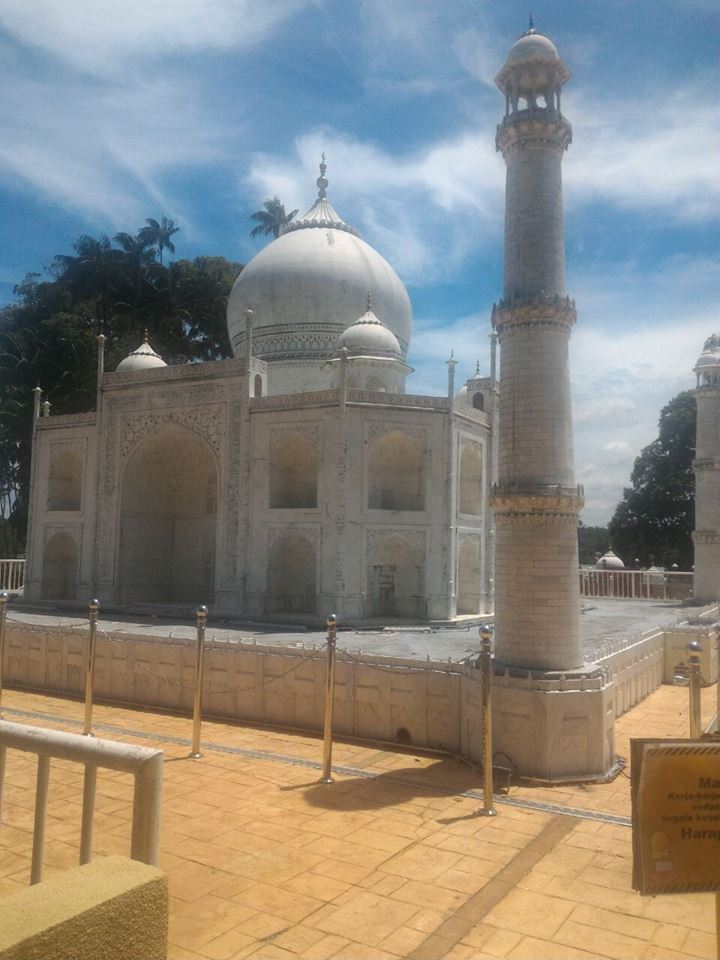
While I was busy preparing my slides and the day I gave the talk, my family went out to do sight-seeing and souvenir-hunting. I only joined them in the trip to the Crystal Mosque, the Monument Park of Taman Tamaddun Islam nearby and in the evening after the talk, the Batu Buruk beach. Here are more pics.


... and the boat ride


The Monument Park is a couple of minutes walk from the Crystal Mosque and is part of Islamic Heritage Park. They display down-sized models of mosques, monuments and tombs (with interior decorations replicated) all around the world.




Late evening, after the talk we went to Batu Buruk beach:


In the late evening (before the morning when we left), I got to meet and a student of mine, Cikgu Ramli Abdullah. He was a school teacher who went on to get his Bachelor degree and he had to take my quantum mechanics class (sorry for him and his colleagues). We talked about old times and some fellow students during then.


All in all, it was a fun working holiday trip.

Tuesday, May 24, 2016

Wishes of 55 at 25

This is a belated post from Rejab; it is now already past mid-Shaaban. The month before, I "celebrated" my birthday according to Hijri calendar i.e. on 25 Rejab. I am 55 (instead of 54 using Gregorian calendar). Yes, I am that old. Since the Hijri year is shorter (354 or 355 days), one tends to be older in this calendar. Every (approximately) 19 years, the solar and lunar calendars will coincide in what is known to be the Metonic cycle. When I mention how old I am to Prof. Rondoni and others, some were surprised. It was a good time for me to reflect on things. The last few weeks have been challenging enough to see me visibly tense, easily angered and physically weaker (added by the age factor). Thus I thought I list what we have done (for explanation sake) and what we wish for.
  • Making things work
    My involvement in many of the institute's activities are sometimes my own initiatives but many more are initiated by others. In both cases, I have always tried to make them successful as much as possibly could. In the latter, I do expect others to own up the activity at least as much as I do. Never I have the intent to make things fail but what usually happens are that there are many matters which are beyond our control. Currently, I see three main matters I have taken up (initiated by others) that I wish will be successful.
    i) Collaboration with University of Auckland
    This was initiated by my Uzbekistan colleagues and the idea for an international lab for "Algorithms, Logic and Complexity". I took the opportunity to push this with the intent of including my interest in quantum logic and quantum foundations in this initiative. With my colleagues having left the university and the absence of funding, this initiative has been stalled. Nevertheless, I do wish our Numerical Analysis group (who have connections there) will take up where we left and pursue some form of collaboration with Auckland. I will also be happy to rejuvenate my interest in quantum logic etc., when things are more conducive.
    ii) Collaboration with Politecnico di Torino (Polito) and MICEMS
    This was initiated by the Laboratory of Cryptography, Analysis and Structures who had close connection with researchers in Polito. MICEMS was launched last March and we are in the midst of realising some programmes. My own interest here would probably in some fundamental and quantum aspects of nonequilibrium issues and statistical mechanics and we are still exploring. Another interest that can be pursued is on complexity and complex networks. These are still much in the exploratory stage which I hope will solidify soon.
    iii) Collaboration with a regulatory body
    This was initiated by a research fellow in the Laboratory of Computational Statistics and Operations Research. Since the other party is interested in complex networks applied to their problem, naturally I join this initiative and push for an MoA which has yet to be signed. In a way, this will be my first experience working with an 'industry' and I certainly like to see further progress.
    There are also many other things (initiated by others) which I had muddled with, including the studentship program under EMS. By saying all these, I am not staking claims of success (failure?) or what-nots but merely expressing I am doing what I can to make things work and hopefully are appreciated. My hope is that I will still be motivated enough to contribute wherever I can.
  • The institute is bigger than any of us
    Like any other organizations, there will always be problems and office politics. But whatever the problems are, I have always maintained the view that the institute should be bigger than any of our personal power play, grumbles or even grudges. In a way, while attending these problems and burning our brain cells to solve them, the bigger focus should be on the science we develop at the institute. The institute has progressed, received recognition and has contributed significantly to the university and the country, sometimes to the envy of others. The institute should always be framed in the bigger view of future generations of mathematical scientists and the scientific progress that we can bring, not from small personal and territorial views. It is thus sad indeed to see if there are views and efforts to undermine the institute. We need good visionary, selfless leaders and workers for us to move on and progress.
  • Thriving research environment
    One of the things that we do in the institute is to organize (frequently) events that will promote research. To do this is not easy since it really use up our resources (energy, time, money) and what more if we invited over established and internationally renowned research scientists. Doing these events are not just to make us look busy or fulfilling the KPIs but the purpose of enhancing and stimulating research is real. The urgency is real. Try and look at the well-known institutes in the west e.g. Isaac Newton Institute for Mathematical Sciences in Cambridge, UK and Perimeter Institute for Theoretical Physics in Waterloo, Canada, how they are replete with scientific activities. Certainly we would like to emulate them to a certain degree within all the constraints that we have. It is too bad that the current financial situation has sort of reduce the intensity of activities that we would like to do. Not only this, our library subscription of journals are badly affected that we are no longer subscribing journals from American Physical Society, American Institute of Physics, Institute of Physics, Springer collection etc. (at least for now). Now we are very much dependent on arXiv repository. Constrained as we are, we will nevertheless proceed to do the necessary things to make our research environment better. I look forward to the day when major part of our conversation are scientific ones and not ones on trying to solve mundane problems.
  • Academia and creativity
    Now, the academia in the country has changed much and most of us have been adapting to the changes rather reactively. Many has succumbed to an industry-like view of doing things, playing to the rules of market forces instead of being a society-shaping institution. In our own little ways, we try to do the latter as much as we can, intellectually shaping young researchers through the research environment we try to build as mentioned above. We try to celebrate creativity and constructive differences of opinions. Administrativewise, some avenues of creativity (and differences) must be made available, rather than algorithmic nature of procedures that we tend to follow. I subscribe to the idea that humanity are much too rich and complex to be algorithmic in form. Hope we have enough wisdom to lead for our academic future.
  • The next life
    Being a Muslim at this age, my preparations fro the next life have been very little. I look forward to the upcoming Ramadhan to train me to be a better person, hopefully enough for me to depart.
These are my wishes.

Wednesday, April 27, 2016

Issues, Quo Vadis?

Two of the most important lessons that I have learned in my duty as an administrator is the difficulty and sensitivity in 'managing' people (what we actually do is really manage their actions/tasks) and finding solutions/alternatives to conflicting goals/interests. This post is about these matters. At certain places, I will be very blunt and this post might not be liked by many but the issues raised deserve some deep thoughts if people really cared about the institute. Some requires a certain amount of selflessness and devotion to an idea or a goal, for otherwise we can continue bickering about small matters and not progress to a greater good.

So what are the issues that I thought would be good to thrash out in the best interest of the institute? There is no particular order in what I have listed below:

  1. Does the institute have a hidden agenda beyond what is written in the vision, mission, goals and functions of the institute?

    I certainly hope not. Is there a need for a non-written agenda? Should it serve interests of an individual, a group, a department or a faculty? I think there is no problem with working together with an individual, a group, a department or a faculty as long as it is transparent and clear to its members and players. With regards to faculty-institute relationship, one should see complementary roles ideally. There should be plenty of cooperation between faculties and institutes but it doesn't make sense to have us competing against each other due to the large overlap of members of institute and faculties (leading to conflict of interest of members). Administrativewise, however, the institute should be considered independent from any individual, group, department or faculty given that it is a separate identity serving the needs of the university to which we all belong to. The institute has its own vision and goals to achieve beyond the individual and any group. The independence also make sense if the institute is supposed to complement the faculty particularly in research. How this is done, my take is that there is still plenty of room for us to experiment on what is best.
  2. How much should we change for the better?

    I have said this to my colleague that we ought to be careful how we put in changes to the institute. We already had a system of doing things for the past 14 years and only recently we have seen a change in the institute's leadership. Any change has to be gradual so as not to uncontrollably perturb the system. The same wisdom actually applies beyond the institute; there are too many changes to the point that we can't really tell the difference between transient phenomena and the outcomes of the instituted changes. Also, underlying changes are also changes in utilising resources. Hence limits and constraints of resources should be factored in.

    Whether there should be changes or not is a nontrivial matter but certainly we need to be adaptable enough to respond to external changes. I say this because I believe there must be some core values and ideals to education and research. These core values can be changed according to 'market forces' or alternatively the core values can shape the society we want.
  3. Matters of the meetings

    Time and again, we always find grouses of having too many meetings. Sometimes it is difficult to tell which meetings are meaningful or not and worse, it can be subjective. If one is in charge of a certain duty, then meetings related to the duty will be meaningful to the person but they might not be so to those who are distant to the duty. In recent discussions, there are proposals to reduce the frequency of the management meeting and the research officers' meeting. I find the proposal misplaced. The more frequent meetings are the ones coming from our many activities. Management meeting is only twice a month and the research officers' meeting is once every two months. Management meetings are too important to reduce their frequency further since many matters (financial, appointment etc) requires the management's endorsement. Also, if one believes in the institute is of the faculty's stature, then really one should operate as such with the appropriate number of management meets.

    The research officers' meeting is currently more of the reporting type and hence can be reduced in frequency. Caution is needed though since there is still a tendency of the "out of sight, out of mind" attitude - not all officers have the same degree of commitment to research and being relatively younger in terms of research, a certain amount of monitoring is needed. However more importantly to me is the fact that the research officers are permanent officers of the institute and they should have more collective sense of responsibility towards the institute's development. There is a tendency for the research officers to go tangent off to their specialised areas of research with little interaction with others. I find this does not concur well with the nature of the institute which should have some form of interdisciplinary research. Being permanent researchers of the institute, they should in fact be catalytic agents for bridging different research areas/disciplines while retaining the importance of specialised research skill sets. I find it disappointing to see young researchers to dismiss off other research areas as totally unrelated and worse, unimportant. I foresee that a good platform for discussing bridging research ideas and charting future research directions of the institute would be the research officers' meeting together with the management members.

    To address back the issue of many meetings stemming from many activities, a partial solution is to make these meetings more decision-making and task oriented (as opposed to reporting). Another solution will be discussed next in the "Division of Labour" item.
  4. Divisions of Labour

    In the institute, it is certainly an issue of how we distribute the work among staff since the number of staff members is quite small. In fact, the number of staff has in fact decreased over the years due to lack of funding. Perhaps another thing conveniently ignored is the number of academics that are temporarily seconded to the institute are only a few (director, deputy director, heads of laboratories, members of management and graduate studies committee). Thus, many administrative tasks are carried out by these academics and the staff. On specific events, we have also our associate members helping us out to do these activities as part of their contribution to the institute (voluntarily).

    As mentioned earlier, much of our workload comes from research-related activities. Some of these are at institute level involving almost all disciplines of mathematical sciences and hence the need to mobilise the whole institute. Many of our activities however are meant for specialised disciplines. The experience that I had in the previous institute I was in is that such events are organised by interested parties of the relevant laboratories. Thus in our case the research officers, relevant associate researchers and students of the interested laboratory will be involved. Of course, we still need the support of central expertise of a webmaster, banner/bunting/poster designers, financial officers. We can also cut down all the ceremonial matters (which often gives additional costs anyway) and focus more on the scientific content.

    Another possibility is to minimise the activities themselves, which I guess will be the easiest to do but not necessarily desirable. I would agree this to be the case for the conferences; there are already too many conferences in the country to cater our relatively smaller pool of mathematical scientists. However for seminars, workshops and the likes, one should emulate the well-known and prominent institutes that have plenty of such activities, providing intense research atmosphere that attracts distinguished and active scientists.
  5. Office politics

    Ideally, an organization will have all its members working together with little friction. Practically such situation is non-existent. There will always be groups with their own self-interests and tendencies of stereotyping the other parties. Being an academic, I've heard administrators say that we academics had it easy. In the days when research is less emphasized, they would say that we had only a few hours to teach, not knowing the many hours we put in the preparation and the hours interacting with students. When the days of research emphasis came, they start saying that we had it easy since we have research students doing all the work for us as if research ideas come from free and our interactions with students and the training for research independence meant very little. Now there are cases of bad apples (like any other occupation) which do the things they accused us of but I certainly do think these are in the minority. To be fair, I have also seen academics treating administrative officers unfairly, sometimes thinking that they must be subservient often with the reason that we are in an academic organization.

    For the institute, I have seen in the past how conflict can emerge from the different cliques, between science officers and research officers, between officers higher up in the hierarchy with those below. Much is due to distrust, self-interest and envy. There is no quick solution to all of these but the longer process of inculcating good values, respect for each other and sharing the common vision of the institute. Each of us has a role to play in the institute and we are not merely cogs in the wheel but are thinking and emotional beings. One should realise that the purpose of the institute is bigger than all of us and our self-interests. In fact, one should highlight the importance of displaying professional and good values given that we will engage more actively with our international partner in the future.
Having said all these, these are merely my thoughts and opinions. People are free to pick and choose what can be accepted and what can be ignored. I still believe in the idea of the institute and I pray that it will continue to progress to be an internationally respectable institute of mathematical sciences.

Thursday, April 14, 2016

Getting Things To Work

Tomorrow, finally INSPEM will have a new director: Prof. Noor Akma Ibrahim, a professor of statistics from the mathematics department. Being the previous Deputy Director (before me), she is certainly the natural candidate for the Director's post. There is a sense of relief after some extended period of uncertainty and I will also no longer need to answer the question of who is the new director each time I go to a meeting or meet some people (it can be very embarrassing at times).

Prior to this, I was carrying out the duties of the director and I tried as much not to make major decisions beyond what is necessary then. Officially, it was from 18 March but I was already carrying several different tasks before the date, some of which were very important. For instance, the inauguration of MICEMS happened three weeks after Prof. Dato' Kamel Ariffin's retirement. Much effort was actually put into the event and we managed to pull it off. Some critical discussions were also made for the future programmes of MICEMS. Besides MICEMS, attended other matters that include decisions regarding our EMS-ERCE studentship programs, decisions regarding our ScholarOne usage for MJMS, and discussions of future research collaboration with Securities Commission Malaysia. I am retelling this merely to say we are not sitting idle in the absence of a director and we are trying our best to make things work. No more, no less.

During this period, I attended some meetings that I have not been in before. I learned quite a few things about the running of the university. I'm very much aware of the need to prepare standardised formal working papers or proposals and the need of presenting these papers in a legal-like language (sometimes feeling rather awkward) from my previous experience. Rather new was the different committees (some of which are closely related) each having different purposes. Unaware of some of these, there were instances that I found myself in an embarrassing situation where I presented papers to the wrong committee. Due to my own quiet personality, I often speak minimally during these meetings, watching and learning from others. From all of these, I've learned it is important to be aware of the decision-making structure of the university even if one is not directly involved as such. Some of these structures could also be mimicked at our micro (institute) level and help facilitate matters. Another lesson is regarding the passing down of important decisions or information, which is tricky these days, when one is already information overloaded.

With Prof. Noor Akma on board, I hope INSPEM can now move in full force with her being the new director at the centre of things. I certainly wish that INSPEM will grow further and develop a distinctive rejuvenated identity, in particular with MICEMS.

Friday, April 01, 2016

Fourteenth Anniversary

While others may remember this day as April Fool's day, we, at the institute, celebrate this day as the 14th anniversary of the day that INSPEM is established. It was on the 1st April 2002 that the formation of the institute is officially declared. The groundwork for it is of course went much earlier and can even be traced back to a conceived idea declared during a national conference way back in 1988. I was not there then and also during the beginning of the institute but I joined the institute only four years later. Nevertheless, I believe I'm very much part of the institute now.

Today we will not have a birthday bash or at least have not planned one as yet. Perhaps more meaningful for us is the forthcoming workshop on our KPIs and strategic planning scheduled on 13th April 2016. Note that we are aware that this is considered late but this is due very much to many of our activities early in the year. We are currently in our 'teen' phase, growing up very fast and hence we must plan well the directions that we are going to take, building up a stronger identity.

Personally, I would like to see the following issues to be discussed:

  • Impactful Q1 & Q2 publications - these have been emphasized much by the university and also the ministry. In dealing with these, one should be very well aware of the differences in publication culture even within the specific communities of mathematical scientists. My own take on this is that one should publish in journals where one's own community normally publishes. In this way, one's work gets more relevant and more citations may take place. Again, one exercises caution on chasing citations so that self-citations or close colleagues' citations are not the ones we should be aiming for. Also, are we pursuing relevant fertile areas that the institute can build communities on.
  • INSPEM's role in MICEMS - this has so far being discussed mainly at individual level. We need to bring the discussion to the broader institute-wide discussion to build better and more coherent co-operation with our Italian counterparts. We need to build concrete programs, both research and post-graduate. We also need to discuss our reciprocating actions to the Italian contributions to MICEMS with longer-term views.
  • Building success stories - ones that can build up stronger reputation and visibility. This may sounds cosmetic but it is really a nontrivial matter. The works of mathematical scientists have often being long-term and relegated almost always to the background in a way that people in general hardly noticed our contributions. We need to tell/convince people why we need to be here.
  • Meeting challenges in the face of declining resources - whether in terms of research grants or other financially-related matters. We need people who can champion the cause of the institute among decision-makers, investors and other possible income-generating actions. In a way, this is very related to the previous point.
None of these are easy and we are very much dependent on the support of our members on how to move forward to a brighter future.

Wednesday, March 30, 2016

Charting Territories

It has been nearly a month since the inauguration of MICEMS. I was searching the media for any news item on this event but it only appeared in the STAR, to the best of my knowledge. Slightly earlier is the news item of UPM. Notwithstanding the small publicity, we will keep pushing on, making the centre work true to its name which I hope to address below. In a way, I'm perhaps more comfortable with working silently in the background. It has also been more than a month that INSPEM is without a director and I am taking up the duty for now. I hope the appointment of the new director will be resolved in the very near future so that the he/she will be in the centre of things, in particular with respect to MICEMS.

With MICEMS, once again the thoughts of charting out directions of research filled one's mind. What follows are simply my own personal reflections and in no way representing the view of the institute. When I first joined the institute, I have been 'asking' what directions are the institute taking and the publicly known secret question, what differentiates it from the mathematics department. The answer that one often gets is the one stated in one of INSPEM's listed objectives, namely high-end areas of mathematics. This could then be anything of course since any subject area can always be pushed to some high-end stuff and it is also subjective what will that be.

In a few exercises of the university to restructure the institute, the laboratories did go through some name changes perhaps reflecting some realignments. I remembered vaguely how difficult this can be, trying to find a focus of the institute while remaining inclusive of disparate expertise of our mathematicians. The difficulty stems from the different culture of mathematicians who often do not collaborate in large numbers (see here and also here for the different culture of mathematicians). My own personal hope was to make things more interdisciplinary whether within areas of mathematics themselves or with areas of other sciences. Consciously or unconsciously, some patterns did emerge from the last "restructuring" of the labs. Most of our labs now have something "computational" in nature; two of which are present in the name of the laboratories. The other two had for instance cryptography whose connection with computer science is obvious, while the educational lab has research on technological aspects and digitization of ethnomathematics manuscripts. Whether this is by design or merely coincidental, it remains that there is a common thread along the computational direction. At around the same time, I was toying around ideas of research in theoretical computer science in relation to quantum computing, quantum foundations and quantum logic. There was also an idea of forming an international laboratory with Auckland along these lines. Anticipating this, we had also designed a postgraduate field of study called Computable Structures and Scientific Computing. This field complements the field of study of Computational Mathematics which focuses more on numerics and algorithms (see here). Years went by and there seems no financially viable option to realise the intended laboratory. On the subject matter, we did not stop effortwise; some of my students are now pursuing the direction of complex networks (using graph theory to extract computable information) and categorical quantum mechanics (using category theory to elucidate logical structures of quantum theory).

For MICEMS, it has been suggested that the pursuance of research directions in mathematical sciences that are closely related to industries. This is very much the research direction of Disma of Polito - as it says on their website, fostering multi-faceted interactions in engineering and architectural sciences. In Malaysia, applications of mathematics have been pursued in a few places under the name of industrial mathematics and applied mathematics. Most notable is UTM Centre of Industrial and Applied Mathematics which has partnered with Oxford Centre of Industrial and Applied Mathematics. It will make good sense if we can complement what they have done. In overlapping areas, we should harness where our strengths are (either from the Italian side or the Malaysian side). From Polito, we can refer to their research group webpage and we will do well if we can match or align accordingly. More from a personal side, it would be nice if alignments can be made from the areas that I have pursued thus far. In connection to computable structures and scientific computing, it would be nice to think along the lines of big data analytics and even more exotic areas of theoretical and applied computer science. Personally, I would like to see unexpected areas of (pure) mathematics come into real world applications. I have already mentioned the use of graph theory in complex networks. Lie groups and Lie algebras have been used in robotics for instance. Algebraic topology has come into play in computer vision and data mining. These are but a few examples of how abstract mathematics are put into real applications. I would love to see some of these realised in MICEMS. We will see how things evolve. More importantly, INSPEM should boost up efforts and take an equal part in shaping up MICEMS for the benefit of both countries.

Friday, March 11, 2016

MICEMS Inauguration

Today (10 March 2016) was a big day for INSPEM. After a few years of planning, we have managed to officially launch the Malaysia-Italy Centre of Excellence for Mathematical Sciences. Below are some pics (more pics can be found at https://www.facebook.com/inspem.upm.1/media_set?set=a.1747368525484148.1073741931.100006330514104&type=3).


UPM Vice-Chancellor giving welcoming remarks
The Deputy Minister of Higher Education Malaysia, giving her officiation speech
The token of endorsement from Italian government to Malaysia
Arrival of Italian Ambassador to INSPEM building
At INSPEM Gallery

Italian Ambassador officiates MICEMS office at INSPEM


The event went quite smoothly though there could have been some improvements. The planned press conference did not happen. I'm not sure what will appear in the press tomorrow but we did prepare a press release as follows:

"Recognising the importance of Mathematical Sciences and the expertise in Malaysia, the Italian government has given the endorsement to initiate Malaysia-Italy Centre of Excellence for Mathematical Sciences (MICEMS) at one of Malaysia’s research university, namely, Universiti Putra Malaysia (UPM). This initiative will be spearheaded by the Institute for Mathematical Research in UPM and the Department of Mathematical Sciences in Politecnico di Torino, Italy. The Institute for Mathematical Research (INSPEM) at UPM was established since April, 2002 and has recently been awarded the status of Emerging Regional Centre of Excellence (EMS-ERCE) by European Mathematical Society (EMS). The Italian partner, Department of Mathematical Sciences “Giuseppe Luigi Lagrange” is based in the oldest technical university in Italy, which was founded in 1859. This university is well known due to its wide range of research alliances with industries throughout the whole world.

The MICEMS initiative is the first of its kind in Malaysia and it would focus on research and development in mathematical sciences like algebraic structures, functional analysis, mathematical physics, statistics and their applications in industries and societies at large e.g. cryptography, biomedical sciences and complex networks. The initiative will also open further opportunities for Italy to embark on a broader educational framework in Malaysia.

The MICEMS initiative was officiated by YB Datuk Mary Yap Kain Ching, Deputy Minister of Higher Education, Malaysia at UPM on 10 March 2016. The ceremony was attended by UPM’s Vice-Chancellor Prof. Datin Paduka Dr. Aini Ideris and The Italian Ambassador to Malaysia, His Excellency, Mr. Mario Sammartino, together with high ranking officials of the university and research leaders of Malaysian community of mathematical scientists. This event signifies the importance of the MICEMS initiative undertaken by UPM, to both Malaysia and Italy."

The event is very much done to mark as official recognition of the centre by governments of both countries. Next, is the real work - living up to its name. Busy years ahead and pray that the centre be a great success.

Saturday, March 05, 2016

Malaysia-Italy Collaboration@INSPEM

A few days ago, I would have kept what I'll be writing below under the wraps. However since the following 'poster' was leaked out in social media, I thought it could use some publicity and perhaps some explanation.


On 10 March 2016, there will be an inauguration ceremony of Malaysia-Italy Centre of Excellence for Mathematical Sciences (MICEMS) initiative, officiated by the Malaysian Deputy Minister of Higher Education, YB Datuk Mary Yap Kain Ching. The Italian ambassador to Malaysia, His Excellency, Mr. Mario Sammartino will be coming and I'm informed that there will be a video message from the Italian Minister of Education, University and Research, Her Excellency, Prof. Stefania Giannini during the officiation ceremony.

The origin of the idea goes as far back as in March 2014 when we had an MoU signed with Politecnico di Torino (Polito; see also here). We were very pleased to had this signed as Polito is the oldest technical university in Italy and unlike commonly perceived ideas of technical universities like we have here, Polito is a top-notch research university that boasts of many research alliances with industries world wide (including Malaysian industries). At that time, we had our researchers (Santo Banerjee and Muhammad Rezal Kamel Ariffin) collaborating with Lamberto Rondoni from Polito. When the MoU was signed, talks of possibly forming a joint institute and thoughts of ICTP-like institute were floating around but one which is based more broadly on mathematical sciences. This is indeed ambitious and of course we proceeded cautiously with the proposal for some time. Well, it took about two years to come to this form of realization of MICEMS.

Now MICEMS is a kind of endorsement made from the Italian government through INSPEM in UPM. I likened it very much like European Mathematical Society (EMS) endorsement of INSPEM as an Emerging Regional Centre of Excellence in May 2014 (see here). The difference is that MICEMS will now have an office in INSPEM. Things are very much fluid at the moment, as far as I can understand, and MICEMS will be led from the Italian side with Malaysians involved in research projects in INSPEM. This may of course grow to something bigger to like what we had envisaged in the very beginning but presently we will let it run its natural course.

Personally, I'm very much committed to the idea and I saw plenty of opportunities here for us to grow scientifically. Those who knew about history of science in Europe, much of it began in Italy and today we can see many Italians leading reputable research organizations and groups (like CERN, for example). In my own small way, I would indeed like to collaborate in someway with Prof. Rondoni who is well known for his work on nonequilibrium statistical physics. I would be very interested in ideas of irreversibiity and other fundamental ideas in nonequilibrium statistical physics. We had of course also discussed other more applied ideas, some of which are quantum thermodynamics in flavour and others in the direction of complex networks. We would also like others to explore ideas with their Italian counterparts as we hope to make this initiative bigger as it should be. Now for those who are interested in what Prof. Rondoni is doing (partly), he will be giving a public talk on Tuesday, 8 March 2016 at 9 am in al-Farabi Seminar room, INSPEM, on the topic of "On Irreversibility, the Arrow of Time, and Cosmological Implications". The abstract is given below:

"Our understanding of the structure of matter tells that reversible microscopic mechanical laws lead to irreversible macroscopic laws, that can be verified in our daily life. We will illustrate how the transition from the reversible microscopic realm to the irreversible macroscopic world is realized in microscopic models of macroscopic phenomena, discussing the relation between the different levels of description of Nature. We will see how the ultimate explanation of these issues has been connected with the evolution of the Universe, of which the recently observed gravitational waves constitute a most intriguing aspect."

I would recommend all to come to this talk.

Now, I leave this post with some photos from our photo shoot yesterday taken at the MICEMS office, meant to be partially included in some multimedia presentations (and, we giggled through our photoshoot poses).


Friday, February 26, 2016

Pause to View A Bigger Picture

Today is our youngest son's birthday and I decided to take leave. I'm taking some rest off what seems to be a flurry of events and duties that we have taken up. It is quite easy to be given the impression that we are doing a lot of work, while most of what we do may not be critical to our core activities. (research, teaching and extension). So, it is perhaps wise once in a while to pause and take a step back, to look at the bigger picture. In a way, I find this article interesting in making us conscious of the different cultures that have crept in higher education.

Before this, I thought I should stop blogging for a while and be silent amidst all the uncertainties in fear of what I say might be misconstrued as looking for positions. However I feel I need to say some things out so that a visible bigger picture of what I do is made apparent to all.

Currently, I'm pushing for things what I consider important for the institute in the long run, namely, potential and committed international collaborations. These are not meant only for mere "making names" or "internationalization activities". I see them as strengthening and expanding our research horizon. Elsewhere in the world, institutions from different parts of the globe are collaborating in a systematic and concerted way. An example is our down south neighbour has their institutions collaborating with France to form Majulab (joint effort of NUS, NTU, CNRS and Nice Univ.). Having said that, sometimes people are too quick in making judgments that we are going to be poor copycats. I can safely say for the things that we are going to do, they are a mixture of availability of opportunities and visions of what we want to be. This, we do not do blindly. National agenda is certainly within our mind and thoughts are being put in how we can converge our different research directions and cultural inclinations. Not only that, thoughts and efforts are being put in to essentially just make things work (which people tend to forget as if the things we do are automatic). Sceptics will always be there, sometimes painting us as lesser beings (do we really want to side with them), and it has been a significant part of my life to challenge these stereotypings. Thus I pray that we will prove these sceptics wrong.

With the present transition that the institute is going through, my hope is that we remain strong in our goals and work our best to see things through.

Thursday, February 18, 2016

Making Waves

I think I will break my blog silence for reasons I think should be made public below.

Let me backtrack  a few days before the Chinese New Year. Earlier in the year, the passing of Prof. Twareque Ali had shocked all of us. Then on February 6, 2016, news came to me on FB that Assoc. Prof. Dr. Mansor Hashim passed away at 3.30pm. Dr. Mansor was a senior colleague at the Physics Department whom I respect very much. When I first joined the department, he encouraged me to continue work on fundamental sciences. He himself was very interested in the fundamentals of magnetism and his research later was on ferrites. He was awarded the National Design/Invention Award (Anugerah Rekacipta Negara) in 1996. After retiring from the department, he joined the Institute of Advanced Technology (ITMA) as a research fellow. Our involvement in the institutes made us further apart and we see less of each other. It was only just a few days before his departure that I have learned that he was diagnosed with cancer. Now that he is gone, I regret that I did not get the chance to meet him while he was around. My prayers to him that Allah grant mercy on his soul.

This Chinese New Year often comes associated with the Chinese zodiac and astrological elements and the present one is associated to the animal monkey and the element fire - the year of Fire Monkey. It is said that such year will be unlucky. All the events above seem to suggest so together with all the current situation in Malaysia. But I don't subscribe to such ideas. To me, the future is (humanly) open - we make our future what it seems to be.

The doom and gloom was broken with some good news for the community of physicists. About a week ago, they announce that they have found direct evidence of gravitational waves. Before this, there has been indirect evidence of gravitational waves. The Nobel Prize to Russell Hulse and Joseph Taylor Jr on the discovery of a binary pulsar whose orbit period is decreasing according to what is predicted if gravitational waves are emitted. The evidence was indirect. The present discovery comes from the merging of two black holes, violent enough to cause ripples of space-time to propagate far and significant enough for us to detect. Rumours of the discovery have been flying around before the announcement. The announcement coincides with the publication of the results in Physical Review Letters. Like any other physicist or scientist, I was equally excited with the official announcement and shared this piece of news on my FB timeline. I did not look up the original paper and who were on the list of authors.

It was Monday this week that I had the nice surprise of knowing a Malaysian was on the list of authors. It came through a private conversation with a close colleague of mine in IIUM. We were actually discussing about whether we should apply for LRGS or not. Then the conversation of the gravitational waves discovery came up and he made the remark that one of the authors is IIUM staff-trainee. I asked for her name and he mentions Hafizah Noor Isa. Then I said the name is familiar. True enough, we had communicated before. It was during Prof. Martin Hendry's visit to UPM with Elaine Lim. We organized a public talk by Prof. Hendry (see the poster below) on Gravitational Wave Astronomy and she was interested in coming.


The e-mail exchanges between three of us were short and I can't precisely remember meeting her face-to-face. But I guess that is how she met Prof. Martin Hendry and I did not know that she went on to join his group in Glasgow.

I looked up the ground-breaking paper that was published and search for her name (and also Prof. Hendry's). True enough her name was there written as H.N. Isa. Captured some images of the paper and posted it on FB.


Made the following remark with it: Little did people know that the recent breakthrough paper on the direct observation of gravitational waves involves a Malaysian, Hafizah Noor Isa, currently pursuing her PhD studies in Glasgow University from IIUM. I believe the remark is direct and unpretentious, no overclaiming and everyone is free to check it. At the time, I figured not many people knew it and it was too good not to share it with at least my close friends and students. Of course, I also commented that, "Was happy that she came to the talk by Prof. Martin Hendry that we organized in UPM on Gravitational Wave Astronomy. Little things like this make us happy". By saying so, it was merely thinking of how chain of events led to something good. In no way, I was claiming responsible for her success.

Perhaps being a surprise to many, the FB post went viral. It had more than 400 likes and almost 300 shares, the last time I look (not that I'm taking those indicators seriously).


Little did I know that it had also caught the media attention. Malaysiakini first came out with the news in both English and Malay. Next was Astro Awani and today it was the Star. All these reports quoted from my FB post (without my knowledge) and I would like to make it clear that I did not meet the press. Malaysiakini did email asking some questions but I hesitated to answer and had waited for my colleague's response. Finally I replied saying that they should get the news on the matter first hand from IIUM but I will be happy to share things I know on the physics of the discovery. I replied the same (to contact IIUM) to Astro Awani today when they had messaged me.

All the media attention on the matter is perhaps good to spur interest in fundamental science and help inspire younger generations. However I was also cautious about it since it can be manipulated and misinterpreted. True enough, some negative comments began to emerge. Some bordered on belittling the achievement, quoting the over a thousand authors in the paper (belittling the Malaysian's contribution is in a way belittling the rest of the individual scientist's contribution in the collaboration). Some hinted about people taking advantage of her success in this discovery (not sure what benefits I have from posting her story so far; I'm not from her institution, by the way). Some even had racial overtones like this comment:

"I bet if she is a chinese, the little thing that makes them happy will go down the drain ..."


Gosh, what were they thinking? Why the racial card? I would have done the same, irrespective of colour, creed or what have you, if there is news of a breakthrough and I found the person involved, had benefited from things that I have done. So, please do not drag me into these racial matters. For those who know me, they will see that I have students of many race and if they are good, I will them that they are good. If they think that they do not learn anything from me, I will tell them to find somebody else better (or harsher, buzz off) whether they are Malay, Chinese, Indian or international students. 

A student of mine told me that I should ignore the negative comments. These comments show how self-centred and fractured some of us are and it is increasingly difficult to ignore negative things like this. But I will keep the faith there is something good in all of us that we should all try to promote; we have to. I will take the good things from this affair.

I reiterate my FB post is simply meant to share some information not known to many. I did not expect it to go viral and least of all the media attention. From conversations with my colleague, Hafizah will probably shy away from all the publicity. In this sense, I think I owe her an apology for this unintended spur of publicity perhaps causing unnecessary extra pressure and extra attention diversions from her study. I would also like to move on, back to my own more serious work.

Thursday, February 04, 2016

Between Labels: Mathematical Physics

Labels are often used as a convenience for quick identifications and sometimes to delineate boundaries. In this perspective, they are essentially tools (and not goals). With respect to labels, sometimes one finds a difficulty of explaining oneself of being a mathematical physicist. Are you in physics or are you in mathematics? My physics colleagues may ask the question why are you in an institute spearheading mathematical sciences, while my mathematician friends also may wonder why am I in the current position. My short answer is by accident.

In the past, I use to care about such labels but at this elderly age, I don't anymore and I have grown to respect all areas of sciences and art, each with their unique characteristics. In fact, being in the current position, it is necessary for me to care about all areas of mathematical sciences without favour. Of course, if pressed for an answer of what am I, I would say a theoretical physicist or even wider, a theoretical scientist because some of the systems that we study are not quite physical systems. I love both physics and mathematics because they are respectively grounded in 'reality' and a universal language to describe 'reality' both quantitative and qualitatively.

If pressed for my formal tertiary educational background, again you will find it ambiguous. My B.Sc. (Hons.) was from Department of Mathematical Physics, University of Adelaide. This department no longer exists and was fused with Department of Physics to become Department of Physics and Mathematical Physics (see history here) and now they are part of School of Physical Sciences. Note that one can also find mathematical physicists scattered in the School of Mathematical Sciences in University of Adelaide. Later I went to do Part III of Mathematical Tripos at the Department of Applied Mathematics and Theoretical Physics (DAMTP). This is now considered as a Master of Mathematics/Advanced Study. For this, I recall a colleague saying that theoretical physics is just applied mathematics. I told him that in some circles, applied mathematics are considered different from theoretical physics and I mention DAMTP. After Part III, I joined the Department of Mathematical Sciences, University of Durham for my PhD. Theoretical and mathematical physicists there, are divided into two departments, Physics and Mathematical Sciences; but there is an overarching centre, to which the theoretical and mathematical physicists from both departments belong to i.e. Centre for Particle Theory. Thus, with such background, personally I feel at home with both labels of physics and mathematics, if you ask me.

So what is really mathematical physics? And what is theoretical physics? Rather than try to define them here, I just would like to link to the wikipedia articles of mathematical physics and theoretical physics. For me, mathematical physics is a subset of theoretical physics, one which has more mathematical rigour. A paper in theoretical physics could dwell so much in conceptual matter, leaving little room for mathematics. The adjective of mathematical and theoretical is also used much in the same way as in mathematical and theoretical biology. The difference between theoretical and mathematical is not always clear cut and there may be a whole spectrum between these two labels. I would consider myself more of a theoretical physicist relying much more on intuition, while the late Prof. Twareque Ali for example is more of mathematical physicist.

Now is mathematical physics part of mathematics? Perhaps it is best to look at the AMS Mathematics Subject Classification. Mathematical physics used to be a subject on its own in the past (see here) but now it has gone under the various sections of "mechanics" in the 2010 classification (my own interest is in 81-XX, 82-XX, 83-XX). Note they also appear in the AIP Physics and Astronomy Classification Scheme (PACS). One can also check many mathematical topics are listed there. So the answer to the question at the beginning of this paragraph is in the affirmative.

Now the late Prof. Twareque once told me that it would be nice to have a centre of mathematical physics within the region. Indeed it would. However practically, I find that such idea is best to be part of the present institute. Theoretical physicists in the country are still a handful in number and we may not form a critical mass for such idea. Moreover, a centre that deals mainly with fundamental sciences may have difficulty in finding funding here. I also perceive proliferation of centres will not be a good idea (like proliferation of committees). Thus INSPEM would be best for us and it is a natural home for theoretical physicists particularly if we think of theoretical physics as an interdisciplinary subject, as I have told my younger colleagues.

Multidisciplinary and interdisciplinary research areas are now commonplace as scientists address more complex problems. Mathematical sciences are not excluded from this trend. Even in mathematics itself, the use of concepts and techniques from different subdisciplines in a particular subdiscipline has become more common. Once my younger colleague mentioned to me that he feared that he is drifting away from physics as he gets more involved in complex networks research. I pointed out that much of physics research in the department has become more chemistry-like and engineering-like and thus there is no need for such concern. Boundaries of traditional disciplines have very much disappeared, though there will always be room for pure disciplines such as in pure mathematics as much as a language can be studied for its own intrinsic beauty.

Finally I have no qualms in being labelled a mathematician or non-mathematician. What matters is what we do. In many ways, I feel sorry for those who feel the need of feeling superior by subscribing to a particular label.

Tuesday, February 02, 2016

Get Well and Take Care Izzuddin

Yesterday, I had to take leave to attend to my youngest son who was about to be discharged from the hospital. My other half had to attend her clinic since Monday is usually a busy day.

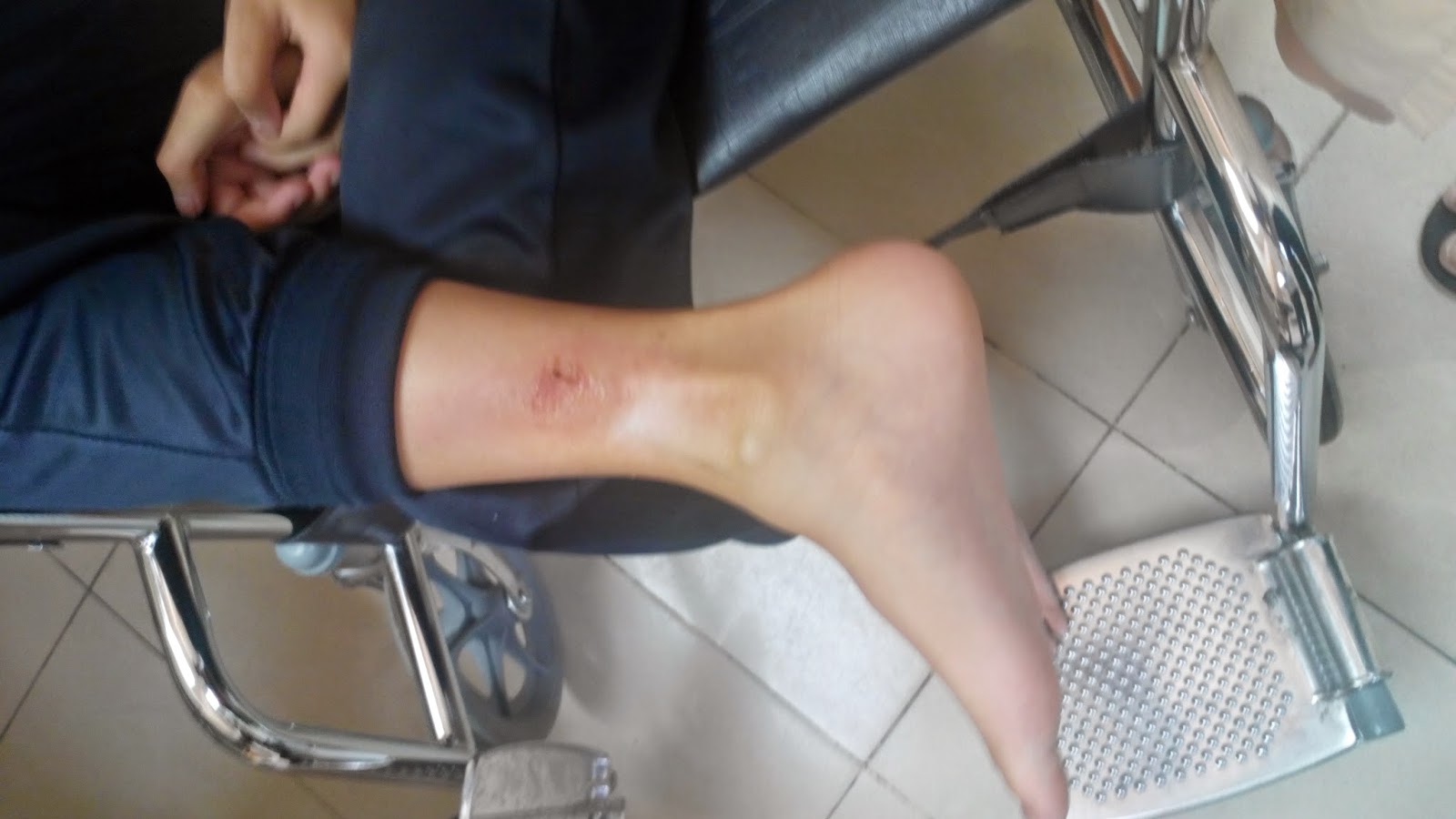
My son had his left foot swollen and was unable to walk sometime last week. It began I supposed on Wednesday when he was involved in a marching session. He didn't complain anything the time he came home and it was already evening (his school session is in the evening) and we did not notice anything (I was also busy then). It was only the next day that he told his elder brother, Ihsan, that his foot is hurting and is visibly swollen. We told Ihsan to bring him to the clinic. There were some insect bite marks near his ankle and guessed that could be the problem. We searched for the bug in the bedroom but we did not find any; we thought probably he got it during his marching session. Antibiotics were prescribed, medical leave was given and we did not think much about it, hoping that the swelling will go away soon. Two days passed, the swelling seemed to get worse (see pic) and we got worried.


We decided then we have to take him to the hospital before it gets any worse. We do not want to make a fuss out of this (it's quite easy to belittle the problem) but knowing the medical history of our son, we are not taking it lightly. When he was quite small he had acute tonsilitis and was not responding well to antibiotics. At the time, I was foolish to be at a function of the university, leaving my son with my better half in the hospital. Should not have done it, particularly when the function could have proceeded without me. Learned my lesson. When he was a few years old, he broke his collar bone and we made extra effort to get him treated. When he was about six, he was again hospitalised for some bad viral infection (initially thought to be dengue). Later at about ten years old, he broke his arm (near the elbow). But it was when he was eleven, that I can't bear to see him suffer. A ping-pong table dropped on his leg and his leg was broken (see pics below).


I can't imagine the pain that he was going through then (try dropping a ping-pong table on one's leg if this is really a small matter). Thus, when we knew his leg was swollen, the first thing comes to mind, was it the same leg? It was not. Nevertheless, we knew that we should take the swelling seriously, get the ankle x-rayed to remove whatever other (sinister) possibilities and administer antibiotics intravenously since he was not responding well to the ones taken orally.

So we got him admitted on Saturday, last weekend at Columbia Asia Hospital in Seremban (the nearest to our home). It was only after giving him the antibiotic intravenously that the swelling is reduced. Thus by Sunday night, we were told that he can be discharged the next day. Despite there was a scheduled meeting, I made sure I was there to take care of the discharge process. Took leave and was thinking of going to the office just for the meeting but fortunately enough the meeting is postponed.


Izzuddin is now at home and on medical leave till the end of the week. He still walks with a limp but is much better. We hope he will get well soonest as he is missing a lot of classes. Given that what he has gone through, I can't help being overprotective and overconcerned sometimes. Do take care, Izzuddin.