Today is our youngest son's birthday and I decided to take leave. I'm taking some rest off what seems to be a flurry of events and duties that we have taken up. It is quite easy to be given the impression that we are doing a lot of work, while most of what we do may not be critical to our core activities. (research, teaching and extension). So, it is perhaps wise once in a while to pause and take a step back, to look at the bigger picture. In a way, I find this article interesting in making us conscious of the different cultures that have crept in higher education.
Before this, I thought I should stop blogging for a while and be silent amidst all the uncertainties in fear of what I say might be misconstrued as looking for positions. However I feel I need to say some things out so that a visible bigger picture of what I do is made apparent to all.
Currently, I'm pushing for things what I consider important for the institute in the long run, namely, potential and committed international collaborations. These are not meant only for mere "making names" or "internationalization activities". I see them as strengthening and expanding our research horizon. Elsewhere in the world, institutions from different parts of the globe are collaborating in a systematic and concerted way. An example is our down south neighbour has their institutions collaborating with France to form Majulab (joint effort of NUS, NTU, CNRS and Nice Univ.). Having said that, sometimes people are too quick in making judgments that we are going to be poor copycats. I can safely say for the things that we are going to do, they are a mixture of availability of opportunities and visions of what we want to be. This, we do not do blindly. National agenda is certainly within our mind and thoughts are being put in how we can converge our different research directions and cultural inclinations. Not only that, thoughts and efforts are being put in to essentially just make things work (which people tend to forget as if the things we do are automatic). Sceptics will always be there, sometimes painting us as lesser beings (do we really want to side with them), and it has been a significant part of my life to challenge these stereotypings. Thus I pray that we will prove these sceptics wrong.
With the present transition that the institute is going through, my hope is that we remain strong in our goals and work our best to see things through.
Friday, February 26, 2016

Thursday, February 18, 2016
Making Waves
I think I will break my blog silence for reasons I think should be made public below.
Let me backtrack a few days before the Chinese New Year. Earlier in the year, the passing of Prof. Twareque Ali had shocked all of us. Then on February 6, 2016, news came to me on FB that Assoc. Prof. Dr. Mansor Hashim passed away at 3.30pm. Dr. Mansor was a senior colleague at the Physics Department whom I respect very much. When I first joined the department, he encouraged me to continue work on fundamental sciences. He himself was very interested in the fundamentals of magnetism and his research later was on ferrites. He was awarded the National Design/Invention Award (Anugerah Rekacipta Negara) in 1996. After retiring from the department, he joined the Institute of Advanced Technology (ITMA) as a research fellow. Our involvement in the institutes made us further apart and we see less of each other. It was only just a few days before his departure that I have learned that he was diagnosed with cancer. Now that he is gone, I regret that I did not get the chance to meet him while he was around. My prayers to him that Allah grant mercy on his soul.
This Chinese New Year often comes associated with the Chinese zodiac and astrological elements and the present one is associated to the animal monkey and the element fire - the year of Fire Monkey. It is said that such year will be unlucky. All the events above seem to suggest so together with all the current situation in Malaysia. But I don't subscribe to such ideas. To me, the future is (humanly) open - we make our future what it seems to be.
The doom and gloom was broken with some good news for the community of physicists. About a week ago, they announce that they have found direct evidence of gravitational waves. Before this, there has been indirect evidence of gravitational waves. The Nobel Prize to Russell Hulse and Joseph Taylor Jr on the discovery of a binary pulsar whose orbit period is decreasing according to what is predicted if gravitational waves are emitted. The evidence was indirect. The present discovery comes from the merging of two black holes, violent enough to cause ripples of space-time to propagate far and significant enough for us to detect. Rumours of the discovery have been flying around before the announcement. The announcement coincides with the publication of the results in Physical Review Letters. Like any other physicist or scientist, I was equally excited with the official announcement and shared this piece of news on my FB timeline. I did not look up the original paper and who were on the list of authors.
It was Monday this week that I had the nice surprise of knowing a Malaysian was on the list of authors. It came through a private conversation with a close colleague of mine in IIUM. We were actually discussing about whether we should apply for LRGS or not. Then the conversation of the gravitational waves discovery came up and he made the remark that one of the authors is IIUM staff-trainee. I asked for her name and he mentions Hafizah Noor Isa. Then I said the name is familiar. True enough, we had communicated before. It was during Prof. Martin Hendry's visit to UPM with Elaine Lim. We organized a public talk by Prof. Hendry (see the poster below) on Gravitational Wave Astronomy and she was interested in coming.

The e-mail exchanges between three of us were short and I can't precisely remember meeting her face-to-face. But I guess that is how she met Prof. Martin Hendry and I did not know that she went on to join his group in Glasgow.
I looked up the ground-breaking paper that was published and search for her name (and also Prof. Hendry's). True enough her name was there written as H.N. Isa. Captured some images of the paper and posted it on FB.


Made the following remark with it: Little did people know that the recent breakthrough paper on the direct observation of gravitational waves involves a Malaysian, Hafizah Noor Isa, currently pursuing her PhD studies in Glasgow University from IIUM. I believe the remark is direct and unpretentious, no overclaiming and everyone is free to check it. At the time, I figured not many people knew it and it was too good not to share it with at least my close friends and students. Of course, I also commented that, "Was happy that she came to the talk by Prof. Martin Hendry that we organized in UPM on Gravitational Wave Astronomy. Little things like this make us happy". By saying so, it was merely thinking of how chain of events led to something good. In no way, I was claiming responsible for her success.
Perhaps being a surprise to many, the FB post went viral. It had more than 400 likes and almost 300 shares, the last time I look (not that I'm taking those indicators seriously).

Little did I know that it had also caught the media attention. Malaysiakini first came out with the news in both English and Malay. Next was Astro Awani and today it was the Star. All these reports quoted from my FB post (without my knowledge) and I would like to make it clear that I did not meet the press. Malaysiakini did email asking some questions but I hesitated to answer and had waited for my colleague's response. Finally I replied saying that they should get the news on the matter first hand from IIUM but I will be happy to share things I know on the physics of the discovery. I replied the same (to contact IIUM) to Astro Awani today when they had messaged me.
All the media attention on the matter is perhaps good to spur interest in fundamental science and help inspire younger generations. However I was also cautious about it since it can be manipulated and misinterpreted. True enough, some negative comments began to emerge. Some bordered on belittling the achievement, quoting the over a thousand authors in the paper (belittling the Malaysian's contribution is in a way belittling the rest of the individual scientist's contribution in the collaboration). Some hinted about people taking advantage of her success in this discovery (not sure what benefits I have from posting her story so far; I'm not from her institution, by the way). Some even had racial overtones like this comment:
"I bet if she is a chinese, the little thing that makes them happy will go down the drain ..."
Gosh, what were they thinking? Why the racial card? I would have done the same, irrespective of colour, creed or what have you, if there is news of a breakthrough and I found the person involved, had benefited from things that I have done. So, please do not drag me into these racial matters. For those who know me, they will see that I have students of many race and if they are good, I will them that they are good. If they think that they do not learn anything from me, I will tell them to find somebody else better (or harsher, buzz off) whether they are Malay, Chinese, Indian or international students.
A student of mine told me that I should ignore the negative comments. These comments show how self-centred and fractured some of us are and it is increasingly difficult to ignore negative things like this. But I will keep the faith there is something good in all of us that we should all try to promote; we have to. I will take the good things from this affair.
I reiterate my FB post is simply meant to share some information not known to many. I did not expect it to go viral and least of all the media attention. From conversations with my colleague, Hafizah will probably shy away from all the publicity. In this sense, I think I owe her an apology for this unintended spur of publicity perhaps causing unnecessary extra pressure and extra attention diversions from her study. I would also like to move on, back to my own more serious work.
Let me backtrack a few days before the Chinese New Year. Earlier in the year, the passing of Prof. Twareque Ali had shocked all of us. Then on February 6, 2016, news came to me on FB that Assoc. Prof. Dr. Mansor Hashim passed away at 3.30pm. Dr. Mansor was a senior colleague at the Physics Department whom I respect very much. When I first joined the department, he encouraged me to continue work on fundamental sciences. He himself was very interested in the fundamentals of magnetism and his research later was on ferrites. He was awarded the National Design/Invention Award (Anugerah Rekacipta Negara) in 1996. After retiring from the department, he joined the Institute of Advanced Technology (ITMA) as a research fellow. Our involvement in the institutes made us further apart and we see less of each other. It was only just a few days before his departure that I have learned that he was diagnosed with cancer. Now that he is gone, I regret that I did not get the chance to meet him while he was around. My prayers to him that Allah grant mercy on his soul.
This Chinese New Year often comes associated with the Chinese zodiac and astrological elements and the present one is associated to the animal monkey and the element fire - the year of Fire Monkey. It is said that such year will be unlucky. All the events above seem to suggest so together with all the current situation in Malaysia. But I don't subscribe to such ideas. To me, the future is (humanly) open - we make our future what it seems to be.
The doom and gloom was broken with some good news for the community of physicists. About a week ago, they announce that they have found direct evidence of gravitational waves. Before this, there has been indirect evidence of gravitational waves. The Nobel Prize to Russell Hulse and Joseph Taylor Jr on the discovery of a binary pulsar whose orbit period is decreasing according to what is predicted if gravitational waves are emitted. The evidence was indirect. The present discovery comes from the merging of two black holes, violent enough to cause ripples of space-time to propagate far and significant enough for us to detect. Rumours of the discovery have been flying around before the announcement. The announcement coincides with the publication of the results in Physical Review Letters. Like any other physicist or scientist, I was equally excited with the official announcement and shared this piece of news on my FB timeline. I did not look up the original paper and who were on the list of authors.
It was Monday this week that I had the nice surprise of knowing a Malaysian was on the list of authors. It came through a private conversation with a close colleague of mine in IIUM. We were actually discussing about whether we should apply for LRGS or not. Then the conversation of the gravitational waves discovery came up and he made the remark that one of the authors is IIUM staff-trainee. I asked for her name and he mentions Hafizah Noor Isa. Then I said the name is familiar. True enough, we had communicated before. It was during Prof. Martin Hendry's visit to UPM with Elaine Lim. We organized a public talk by Prof. Hendry (see the poster below) on Gravitational Wave Astronomy and she was interested in coming.

The e-mail exchanges between three of us were short and I can't precisely remember meeting her face-to-face. But I guess that is how she met Prof. Martin Hendry and I did not know that she went on to join his group in Glasgow.
I looked up the ground-breaking paper that was published and search for her name (and also Prof. Hendry's). True enough her name was there written as H.N. Isa. Captured some images of the paper and posted it on FB.


Made the following remark with it: Little did people know that the recent breakthrough paper on the direct observation of gravitational waves involves a Malaysian, Hafizah Noor Isa, currently pursuing her PhD studies in Glasgow University from IIUM. I believe the remark is direct and unpretentious, no overclaiming and everyone is free to check it. At the time, I figured not many people knew it and it was too good not to share it with at least my close friends and students. Of course, I also commented that, "Was happy that she came to the talk by Prof. Martin Hendry that we organized in UPM on Gravitational Wave Astronomy. Little things like this make us happy". By saying so, it was merely thinking of how chain of events led to something good. In no way, I was claiming responsible for her success.
Perhaps being a surprise to many, the FB post went viral. It had more than 400 likes and almost 300 shares, the last time I look (not that I'm taking those indicators seriously).

Little did I know that it had also caught the media attention. Malaysiakini first came out with the news in both English and Malay. Next was Astro Awani and today it was the Star. All these reports quoted from my FB post (without my knowledge) and I would like to make it clear that I did not meet the press. Malaysiakini did email asking some questions but I hesitated to answer and had waited for my colleague's response. Finally I replied saying that they should get the news on the matter first hand from IIUM but I will be happy to share things I know on the physics of the discovery. I replied the same (to contact IIUM) to Astro Awani today when they had messaged me.
All the media attention on the matter is perhaps good to spur interest in fundamental science and help inspire younger generations. However I was also cautious about it since it can be manipulated and misinterpreted. True enough, some negative comments began to emerge. Some bordered on belittling the achievement, quoting the over a thousand authors in the paper (belittling the Malaysian's contribution is in a way belittling the rest of the individual scientist's contribution in the collaboration). Some hinted about people taking advantage of her success in this discovery (not sure what benefits I have from posting her story so far; I'm not from her institution, by the way). Some even had racial overtones like this comment:
"I bet if she is a chinese, the little thing that makes them happy will go down the drain ..."
Gosh, what were they thinking? Why the racial card? I would have done the same, irrespective of colour, creed or what have you, if there is news of a breakthrough and I found the person involved, had benefited from things that I have done. So, please do not drag me into these racial matters. For those who know me, they will see that I have students of many race and if they are good, I will them that they are good. If they think that they do not learn anything from me, I will tell them to find somebody else better (or harsher, buzz off) whether they are Malay, Chinese, Indian or international students.
A student of mine told me that I should ignore the negative comments. These comments show how self-centred and fractured some of us are and it is increasingly difficult to ignore negative things like this. But I will keep the faith there is something good in all of us that we should all try to promote; we have to. I will take the good things from this affair.
I reiterate my FB post is simply meant to share some information not known to many. I did not expect it to go viral and least of all the media attention. From conversations with my colleague, Hafizah will probably shy away from all the publicity. In this sense, I think I owe her an apology for this unintended spur of publicity perhaps causing unnecessary extra pressure and extra attention diversions from her study. I would also like to move on, back to my own more serious work.
Thursday, February 04, 2016
Between Labels: Mathematical Physics
Labels are often used as a convenience for quick identifications and sometimes to delineate boundaries. In this perspective, they are essentially tools (and not goals). With respect to labels, sometimes one finds a difficulty of explaining oneself of being a mathematical physicist. Are you in physics or are you in mathematics? My physics colleagues may ask the question why are you in an institute spearheading mathematical sciences, while my mathematician friends also may wonder why am I in the current position. My short answer is by accident.
In the past, I use to care about such labels but at this elderly age, I don't anymore and I have grown to respect all areas of sciences and art, each with their unique characteristics. In fact, being in the current position, it is necessary for me to care about all areas of mathematical sciences without favour. Of course, if pressed for an answer of what am I, I would say a theoretical physicist or even wider, a theoretical scientist because some of the systems that we study are not quite physical systems. I love both physics and mathematics because they are respectively grounded in 'reality' and a universal language to describe 'reality' both quantitative and qualitatively.
If pressed for my formal tertiary educational background, again you will find it ambiguous. My B.Sc. (Hons.) was from Department of Mathematical Physics, University of Adelaide. This department no longer exists and was fused with Department of Physics to become Department of Physics and Mathematical Physics (see history here) and now they are part of School of Physical Sciences. Note that one can also find mathematical physicists scattered in the School of Mathematical Sciences in University of Adelaide. Later I went to do Part III of Mathematical Tripos at the Department of Applied Mathematics and Theoretical Physics (DAMTP). This is now considered as a Master of Mathematics/Advanced Study. For this, I recall a colleague saying that theoretical physics is just applied mathematics. I told him that in some circles, applied mathematics are considered different from theoretical physics and I mention DAMTP. After Part III, I joined the Department of Mathematical Sciences, University of Durham for my PhD. Theoretical and mathematical physicists there, are divided into two departments, Physics and Mathematical Sciences; but there is an overarching centre, to which the theoretical and mathematical physicists from both departments belong to i.e. Centre for Particle Theory. Thus, with such background, personally I feel at home with both labels of physics and mathematics, if you ask me.
So what is really mathematical physics? And what is theoretical physics? Rather than try to define them here, I just would like to link to the wikipedia articles of mathematical physics and theoretical physics. For me, mathematical physics is a subset of theoretical physics, one which has more mathematical rigour. A paper in theoretical physics could dwell so much in conceptual matter, leaving little room for mathematics. The adjective of mathematical and theoretical is also used much in the same way as in mathematical and theoretical biology. The difference between theoretical and mathematical is not always clear cut and there may be a whole spectrum between these two labels. I would consider myself more of a theoretical physicist relying much more on intuition, while the late Prof. Twareque Ali for example is more of mathematical physicist.
Now is mathematical physics part of mathematics? Perhaps it is best to look at the AMS Mathematics Subject Classification. Mathematical physics used to be a subject on its own in the past (see here) but now it has gone under the various sections of "mechanics" in the 2010 classification (my own interest is in 81-XX, 82-XX, 83-XX). Note they also appear in the AIP Physics and Astronomy Classification Scheme (PACS). One can also check many mathematical topics are listed there. So the answer to the question at the beginning of this paragraph is in the affirmative.
Now the late Prof. Twareque once told me that it would be nice to have a centre of mathematical physics within the region. Indeed it would. However practically, I find that such idea is best to be part of the present institute. Theoretical physicists in the country are still a handful in number and we may not form a critical mass for such idea. Moreover, a centre that deals mainly with fundamental sciences may have difficulty in finding funding here. I also perceive proliferation of centres will not be a good idea (like proliferation of committees). Thus INSPEM would be best for us and it is a natural home for theoretical physicists particularly if we think of theoretical physics as an interdisciplinary subject, as I have told my younger colleagues.
Multidisciplinary and interdisciplinary research areas are now commonplace as scientists address more complex problems. Mathematical sciences are not excluded from this trend. Even in mathematics itself, the use of concepts and techniques from different subdisciplines in a particular subdiscipline has become more common. Once my younger colleague mentioned to me that he feared that he is drifting away from physics as he gets more involved in complex networks research. I pointed out that much of physics research in the department has become more chemistry-like and engineering-like and thus there is no need for such concern. Boundaries of traditional disciplines have very much disappeared, though there will always be room for pure disciplines such as in pure mathematics as much as a language can be studied for its own intrinsic beauty.
Finally I have no qualms in being labelled a mathematician or non-mathematician. What matters is what we do. In many ways, I feel sorry for those who feel the need of feeling superior by subscribing to a particular label.
In the past, I use to care about such labels but at this elderly age, I don't anymore and I have grown to respect all areas of sciences and art, each with their unique characteristics. In fact, being in the current position, it is necessary for me to care about all areas of mathematical sciences without favour. Of course, if pressed for an answer of what am I, I would say a theoretical physicist or even wider, a theoretical scientist because some of the systems that we study are not quite physical systems. I love both physics and mathematics because they are respectively grounded in 'reality' and a universal language to describe 'reality' both quantitative and qualitatively.
If pressed for my formal tertiary educational background, again you will find it ambiguous. My B.Sc. (Hons.) was from Department of Mathematical Physics, University of Adelaide. This department no longer exists and was fused with Department of Physics to become Department of Physics and Mathematical Physics (see history here) and now they are part of School of Physical Sciences. Note that one can also find mathematical physicists scattered in the School of Mathematical Sciences in University of Adelaide. Later I went to do Part III of Mathematical Tripos at the Department of Applied Mathematics and Theoretical Physics (DAMTP). This is now considered as a Master of Mathematics/Advanced Study. For this, I recall a colleague saying that theoretical physics is just applied mathematics. I told him that in some circles, applied mathematics are considered different from theoretical physics and I mention DAMTP. After Part III, I joined the Department of Mathematical Sciences, University of Durham for my PhD. Theoretical and mathematical physicists there, are divided into two departments, Physics and Mathematical Sciences; but there is an overarching centre, to which the theoretical and mathematical physicists from both departments belong to i.e. Centre for Particle Theory. Thus, with such background, personally I feel at home with both labels of physics and mathematics, if you ask me.
So what is really mathematical physics? And what is theoretical physics? Rather than try to define them here, I just would like to link to the wikipedia articles of mathematical physics and theoretical physics. For me, mathematical physics is a subset of theoretical physics, one which has more mathematical rigour. A paper in theoretical physics could dwell so much in conceptual matter, leaving little room for mathematics. The adjective of mathematical and theoretical is also used much in the same way as in mathematical and theoretical biology. The difference between theoretical and mathematical is not always clear cut and there may be a whole spectrum between these two labels. I would consider myself more of a theoretical physicist relying much more on intuition, while the late Prof. Twareque Ali for example is more of mathematical physicist.
Now is mathematical physics part of mathematics? Perhaps it is best to look at the AMS Mathematics Subject Classification. Mathematical physics used to be a subject on its own in the past (see here) but now it has gone under the various sections of "mechanics" in the 2010 classification (my own interest is in 81-XX, 82-XX, 83-XX). Note they also appear in the AIP Physics and Astronomy Classification Scheme (PACS). One can also check many mathematical topics are listed there. So the answer to the question at the beginning of this paragraph is in the affirmative.
Now the late Prof. Twareque once told me that it would be nice to have a centre of mathematical physics within the region. Indeed it would. However practically, I find that such idea is best to be part of the present institute. Theoretical physicists in the country are still a handful in number and we may not form a critical mass for such idea. Moreover, a centre that deals mainly with fundamental sciences may have difficulty in finding funding here. I also perceive proliferation of centres will not be a good idea (like proliferation of committees). Thus INSPEM would be best for us and it is a natural home for theoretical physicists particularly if we think of theoretical physics as an interdisciplinary subject, as I have told my younger colleagues.
Multidisciplinary and interdisciplinary research areas are now commonplace as scientists address more complex problems. Mathematical sciences are not excluded from this trend. Even in mathematics itself, the use of concepts and techniques from different subdisciplines in a particular subdiscipline has become more common. Once my younger colleague mentioned to me that he feared that he is drifting away from physics as he gets more involved in complex networks research. I pointed out that much of physics research in the department has become more chemistry-like and engineering-like and thus there is no need for such concern. Boundaries of traditional disciplines have very much disappeared, though there will always be room for pure disciplines such as in pure mathematics as much as a language can be studied for its own intrinsic beauty.
Finally I have no qualms in being labelled a mathematician or non-mathematician. What matters is what we do. In many ways, I feel sorry for those who feel the need of feeling superior by subscribing to a particular label.
Tuesday, February 02, 2016
Get Well and Take Care Izzuddin
Yesterday, I had to take leave to attend to my youngest son who was about to be discharged from the hospital. My other half had to attend her clinic since Monday is usually a busy day.
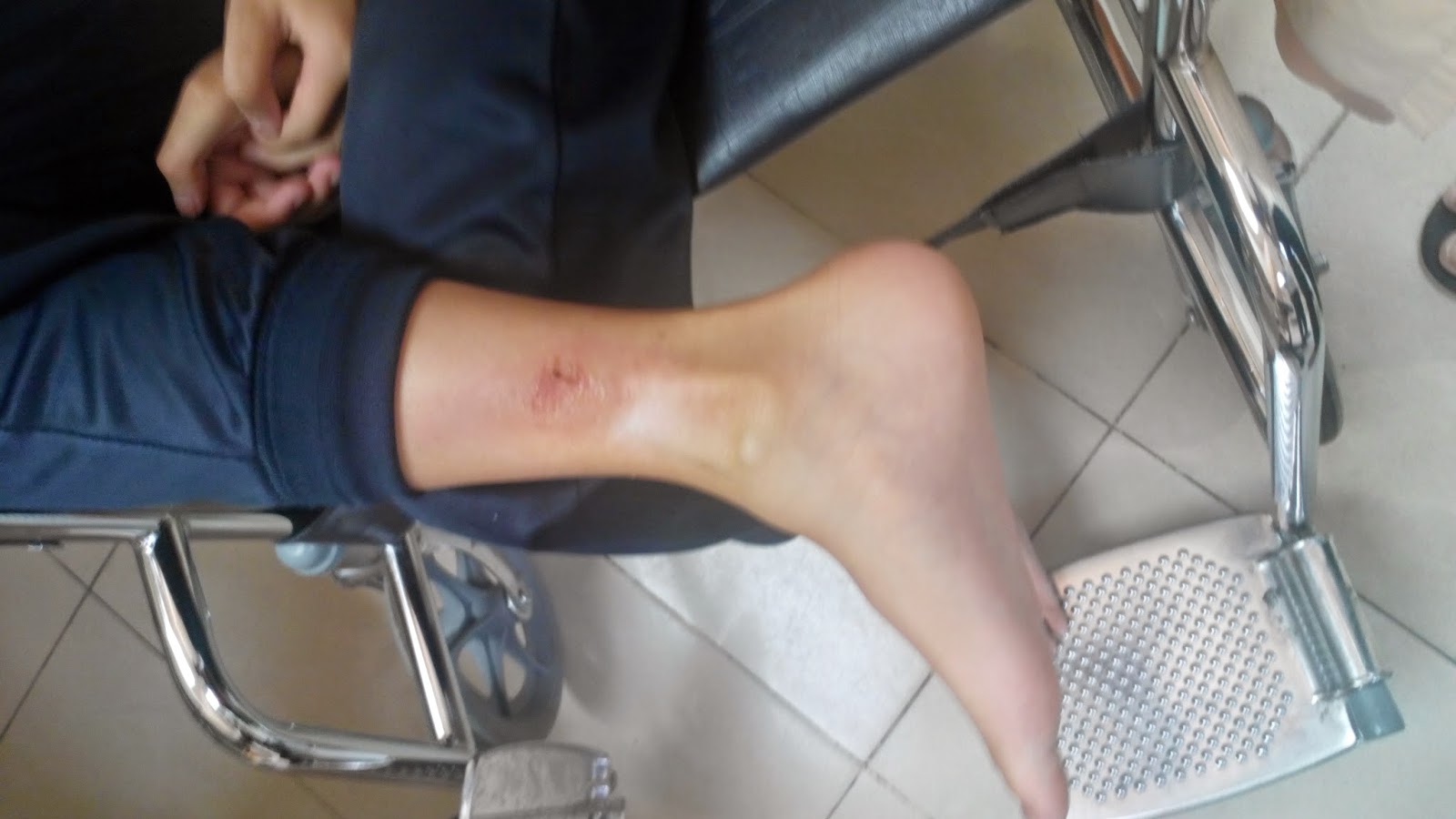
My son had his left foot swollen and was unable to walk sometime last week. It began I supposed on Wednesday when he was involved in a marching session. He didn't complain anything the time he came home and it was already evening (his school session is in the evening) and we did not notice anything (I was also busy then). It was only the next day that he told his elder brother, Ihsan, that his foot is hurting and is visibly swollen. We told Ihsan to bring him to the clinic. There were some insect bite marks near his ankle and guessed that could be the problem. We searched for the bug in the bedroom but we did not find any; we thought probably he got it during his marching session. Antibiotics were prescribed, medical leave was given and we did not think much about it, hoping that the swelling will go away soon. Two days passed, the swelling seemed to get worse (see pic) and we got worried.

We decided then we have to take him to the hospital before it gets any worse. We do not want to make a fuss out of this (it's quite easy to belittle the problem) but knowing the medical history of our son, we are not taking it lightly. When he was quite small he had acute tonsilitis and was not responding well to antibiotics. At the time, I was foolish to be at a function of the university, leaving my son with my better half in the hospital. Should not have done it, particularly when the function could have proceeded without me. Learned my lesson. When he was a few years old, he broke his collar bone and we made extra effort to get him treated. When he was about six, he was again hospitalised for some bad viral infection (initially thought to be dengue). Later at about ten years old, he broke his arm (near the elbow). But it was when he was eleven, that I can't bear to see him suffer. A ping-pong table dropped on his leg and his leg was broken (see pics below).


My son had his left foot swollen and was unable to walk sometime last week. It began I supposed on Wednesday when he was involved in a marching session. He didn't complain anything the time he came home and it was already evening (his school session is in the evening) and we did not notice anything (I was also busy then). It was only the next day that he told his elder brother, Ihsan, that his foot is hurting and is visibly swollen. We told Ihsan to bring him to the clinic. There were some insect bite marks near his ankle and guessed that could be the problem. We searched for the bug in the bedroom but we did not find any; we thought probably he got it during his marching session. Antibiotics were prescribed, medical leave was given and we did not think much about it, hoping that the swelling will go away soon. Two days passed, the swelling seemed to get worse (see pic) and we got worried.

We decided then we have to take him to the hospital before it gets any worse. We do not want to make a fuss out of this (it's quite easy to belittle the problem) but knowing the medical history of our son, we are not taking it lightly. When he was quite small he had acute tonsilitis and was not responding well to antibiotics. At the time, I was foolish to be at a function of the university, leaving my son with my better half in the hospital. Should not have done it, particularly when the function could have proceeded without me. Learned my lesson. When he was a few years old, he broke his collar bone and we made extra effort to get him treated. When he was about six, he was again hospitalised for some bad viral infection (initially thought to be dengue). Later at about ten years old, he broke his arm (near the elbow). But it was when he was eleven, that I can't bear to see him suffer. A ping-pong table dropped on his leg and his leg was broken (see pics below).

I can't imagine the pain that he was going through then (try dropping a ping-pong table on one's leg if this is really a small matter). Thus, when we knew his leg was swollen, the first thing comes to mind, was it the same leg? It was not. Nevertheless, we knew that we should take the swelling seriously, get the ankle x-rayed to remove whatever other (sinister) possibilities and administer antibiotics intravenously since he was not responding well to the ones taken orally.
So we got him admitted on Saturday, last weekend at Columbia Asia Hospital in Seremban (the nearest to our home). It was only after giving him the antibiotic intravenously that the swelling is reduced. Thus by Sunday night, we were told that he can be discharged the next day. Despite there was a scheduled meeting, I made sure I was there to take care of the discharge process. Took leave and was thinking of going to the office just for the meeting but fortunately enough the meeting is postponed.

Izzuddin is now at home and on medical leave till the end of the week. He still walks with a limp but is much better. We hope he will get well soonest as he is missing a lot of classes. Given that what he has gone through, I can't help being overprotective and overconcerned sometimes. Do take care, Izzuddin.
Saturday, January 30, 2016
Farewell and Rest in Peace, Prof. Twareque Ali
I was told that the flight KL810 that is bringing Prof. Twareque's body home (via Amsterdam) has just flown a few minutes ago. My prayers to him and a safe journey home back to his family.
There is a sense of relief but also a sense of guilt much in the same way that I felt way back in 13 July 2009 when my mum passed away. At the time, I had just sent back my brother Dzafa to Kuala Lumpur since I was about to leave for the conference QTS6 on July 18 and I will not be at home. I felt guilty in a way that he was not able to spend the final moments with my mum as if I had robbed him those precious moments. In the same way, I felt that by inviting Prof. Twareque here for EQuaLS8, I have robbed him the final moments that he could have been with his family. Despite as a muslim, we believe that this is fate as willed by God, still felt the same guilt and wished to be forgiven.
It was on Monday that Prof. Twareque Ali passed away and from the post-mortem it is now confirmed that it was due to a heart attack. The process to get the body released from the hospital was quite involved in a way that I did not imagine. The presence of his brother Syed Haroon Ali and his wife from Singapore later has actually helped to speed up matters and we are thankful for that. On our part, we tried to facilitate as much as we could and I must thank my staff in helping out particularly Mr. Firdaus. We also thank the police and hospital staff that had helped smoothen the process. The body finally had its ritual final cleansing on Thursday night. The funeral prayers was conducted at the UPM mosque after Friday prayers. A certain amount of relief is that we could participate directly in these prayers. There was a good crowd at the funeral prayers, together with the director, his brother and many students and staff of the institute. We hope that our prayers will help him in the next world and may Allah grant His Mercy.
There is a sense of relief but also a sense of guilt much in the same way that I felt way back in 13 July 2009 when my mum passed away. At the time, I had just sent back my brother Dzafa to Kuala Lumpur since I was about to leave for the conference QTS6 on July 18 and I will not be at home. I felt guilty in a way that he was not able to spend the final moments with my mum as if I had robbed him those precious moments. In the same way, I felt that by inviting Prof. Twareque here for EQuaLS8, I have robbed him the final moments that he could have been with his family. Despite as a muslim, we believe that this is fate as willed by God, still felt the same guilt and wished to be forgiven.
It was on Monday that Prof. Twareque Ali passed away and from the post-mortem it is now confirmed that it was due to a heart attack. The process to get the body released from the hospital was quite involved in a way that I did not imagine. The presence of his brother Syed Haroon Ali and his wife from Singapore later has actually helped to speed up matters and we are thankful for that. On our part, we tried to facilitate as much as we could and I must thank my staff in helping out particularly Mr. Firdaus. We also thank the police and hospital staff that had helped smoothen the process. The body finally had its ritual final cleansing on Thursday night. The funeral prayers was conducted at the UPM mosque after Friday prayers. A certain amount of relief is that we could participate directly in these prayers. There was a good crowd at the funeral prayers, together with the director, his brother and many students and staff of the institute. We hope that our prayers will help him in the next world and may Allah grant His Mercy.
Tuesday, January 26, 2016
In Memory of Prof. Syed Twareque Ali
I write this post with deep sadness of losing a great mentor and friend, Prof. Syed Twareque Ali yesterday morning. I had invited him for EQuaLS8 for the whole of last week, not knowing that it had to end this way. He had been supporting EQuaLS since right from its beginning until now, for which we have even planned for the next EQuaLS.
Let me retell my own story of knowing him. I only knew of him by name in the beginning as far back as during my PhD studies on quantization. I believe one of his earliest papers that I have read is on systems of imprimitivity, coauthored with E. Prugovecki. He was among the selected individuals that I had kept on radar for my own study. Little did I know that I am going to meet him in person later in my life.
When I joined the Institute for Mathematical Research (INSPEM) in UPM in 2006, had the idea of continuing a lecture series that I have started in ITMA (Institute of Advanced Technology). I renamed the lecture series as Expository Quantum Lecture Series (EQuaLS). Among the earliest person that I had in mind of inviting is S.T. Ali; I was reading then his huge review article (co-authored with Miroslav Englis) entitled "Quantization Methods: A Guide for Physicists and Analysts", an article true to its name. The article itself has been cited more than a hundred times according to Google Scholar (and 45 times in the World Scientific database). Not having any connections with him before this, I hesitated in writing to him since I wasn't sure that I will receive a positive reply. Then on July 18, 2007, he wrote:
"Dear Prof. Zainuddin,
I am back in Montreal now and I am happy to let you know that I would be able to accept your invitation to come to your university and to give a set of lectures on quantization techniques, within the framework of your TSL Lecture Series 6. Since I would be in Cotonou, Benin (West Africa),
between Oct. 26 and Nov. 2, 2007, i.e., the week preceeding your meeting, I would have to make my travel arrangements relatively early, in order to get flights to the various places on the right dates. ..."
That was then a sure beginning of EQuaLS1 and his slides are still available here (we almost lose these webpages; I hope the future webmaster will keep these around).
At the end of EQuaLS1, he hugged me, saying something to the effect that I've started a good thing and it is always sad to see a good thing ended. We continued to correspond thereafter, particularly he was suggesting that Malaysia should try to host the well-known International Colloquium on Group-Theoretical Methods in Physics series during which the Wigner Medal and Weyl Prize are given (see the 2016 edition) and the sister event, International Symposium on Quantum Theory and Symmetries series (see the 2015 edition). This did not materialise (we did bid for them) unfortunately. I do get to participate in both events of QTS6 in Kentucky and Group-29 in Chern Institute, Tianjin with the help of Prof. Twareque Ali. Besides that, I had also asked my ex-M.Sc. student Nurisya to pursue her PhD under him. This brought us to closer contact with each other.
The next installment of EQuaLS, EQuaLS2 saw Prof. Twareque Ali participating voluntarily as a contributing speaker. His talk was on Coherent States and Bayesian Statistics based on his 2008 IOP paper. He had also helped me to get Paul Busch to be one of the invited speakers.
The next EQuaLS that Prof. Twareque Ali had participated was in early 2012 for EQuaLS5 in which he gave a set of lectures on "Coherent States: Theory and Applications". His slides are still available here.
Prof. Twareque Ali spent some time in the institute as a visiting scientist at the end of 2012, after which he became a speaker at EQuaLS6 which was double-billed as the 6th Asia-Pacific Workshop on Quantum Information Science (on quantum foundations). There he spoke on the work he did with Syed Hasibul Hassan Chowdhury on "Symmetry Groups of Two-Dimensional Non-Commutative Quantum Mechanics". I remembered how we had discussed on the problems of extending this to three or odd dimensions. This later led to the present research direction pursued by our PhD student Mohd Faudzi Umar on further models of non-commutative quantum mechanics, possibly interfacing with non-commutative geometry.
Fast forward to EQuaLS8, it is an event that Prof. Twareque Ali that essentially brought together speakers who came on their own travel expenses and without him, we will probably not be able to organize the event. He wasn't sure of coming in the first place but I kept on asking for him to come. He finally agreed to give a contributed talk on "Pseudo-Bosons, Complex Hermite Polynomials and Integral Quantization", which is also related to his previous work with Nurisya. For pics see here.
At the end of EQuaLS8, I told Nurisya that we should have a private conversation with Prof. Twareque Ali on possible future work and programmes with him and thus our dinner on the 24 January 2016. We agreed to have it in Seremban near where I lived. See the pics below.

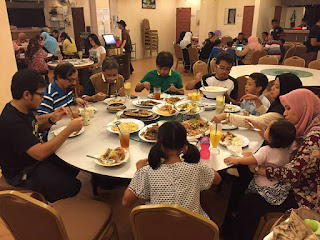


There was no indications that he has any problems at the time of the dinner but I did notice he was relatively quiet. He mentioned that we should get involved in the ICTP Fellowship Programme (and I immediately pointed to Nurisya, given that I'm way too old). We ended the dinner discussion with possibility of doing projects with CRM. I mention that quantum information had revived interest in quantum foundations and was speculating the possible rekindled interest in quantization itself. He told me to write some of these ideas and my mind was already filled of thoughts of doing so. The time was about 10.30ish, and we waved goodbye to each other and told me that I should go to Montreal some time.
It was just before 7am the next morning that Mr. Firdaus (INSPEM officer) rang me up about the bad news. My heart sank. He was scheduled to leave the hotel for his flight home that morning but he did not turn up. The hotel staff finally opened up his room to eventually see that he has passed away. My other half and I with my second eldest rushed off to Everly Hotel Putrajaya to see the situation. His body was brought to the Putrajaya Hospital until the final arrangements to be made with the Canadian Embassy today.
"We surely belong to Allah and to Him we shall return". May Allah grant mercy on his soul and his contributions in science and in life in general be rewarded continuously.
Let me retell my own story of knowing him. I only knew of him by name in the beginning as far back as during my PhD studies on quantization. I believe one of his earliest papers that I have read is on systems of imprimitivity, coauthored with E. Prugovecki. He was among the selected individuals that I had kept on radar for my own study. Little did I know that I am going to meet him in person later in my life.
When I joined the Institute for Mathematical Research (INSPEM) in UPM in 2006, had the idea of continuing a lecture series that I have started in ITMA (Institute of Advanced Technology). I renamed the lecture series as Expository Quantum Lecture Series (EQuaLS). Among the earliest person that I had in mind of inviting is S.T. Ali; I was reading then his huge review article (co-authored with Miroslav Englis) entitled "Quantization Methods: A Guide for Physicists and Analysts", an article true to its name. The article itself has been cited more than a hundred times according to Google Scholar (and 45 times in the World Scientific database). Not having any connections with him before this, I hesitated in writing to him since I wasn't sure that I will receive a positive reply. Then on July 18, 2007, he wrote:
"Dear Prof. Zainuddin,
I am back in Montreal now and I am happy to let you know that I would be able to accept your invitation to come to your university and to give a set of lectures on quantization techniques, within the framework of your TSL Lecture Series 6. Since I would be in Cotonou, Benin (West Africa),
between Oct. 26 and Nov. 2, 2007, i.e., the week preceeding your meeting, I would have to make my travel arrangements relatively early, in order to get flights to the various places on the right dates. ..."
That was then a sure beginning of EQuaLS1 and his slides are still available here (we almost lose these webpages; I hope the future webmaster will keep these around).
 |
| EQuaLS1 |
At the end of EQuaLS1, he hugged me, saying something to the effect that I've started a good thing and it is always sad to see a good thing ended. We continued to correspond thereafter, particularly he was suggesting that Malaysia should try to host the well-known International Colloquium on Group-Theoretical Methods in Physics series during which the Wigner Medal and Weyl Prize are given (see the 2016 edition) and the sister event, International Symposium on Quantum Theory and Symmetries series (see the 2015 edition). This did not materialise (we did bid for them) unfortunately. I do get to participate in both events of QTS6 in Kentucky and Group-29 in Chern Institute, Tianjin with the help of Prof. Twareque Ali. Besides that, I had also asked my ex-M.Sc. student Nurisya to pursue her PhD under him. This brought us to closer contact with each other.
The next installment of EQuaLS, EQuaLS2 saw Prof. Twareque Ali participating voluntarily as a contributing speaker. His talk was on Coherent States and Bayesian Statistics based on his 2008 IOP paper. He had also helped me to get Paul Busch to be one of the invited speakers.
 |
| EQuaLS2 |
The next EQuaLS that Prof. Twareque Ali had participated was in early 2012 for EQuaLS5 in which he gave a set of lectures on "Coherent States: Theory and Applications". His slides are still available here.
 |
| EQuaLS5 |
Prof. Twareque Ali spent some time in the institute as a visiting scientist at the end of 2012, after which he became a speaker at EQuaLS6 which was double-billed as the 6th Asia-Pacific Workshop on Quantum Information Science (on quantum foundations). There he spoke on the work he did with Syed Hasibul Hassan Chowdhury on "Symmetry Groups of Two-Dimensional Non-Commutative Quantum Mechanics". I remembered how we had discussed on the problems of extending this to three or odd dimensions. This later led to the present research direction pursued by our PhD student Mohd Faudzi Umar on further models of non-commutative quantum mechanics, possibly interfacing with non-commutative geometry.
 |
| EQuaLS6 |
Fast forward to EQuaLS8, it is an event that Prof. Twareque Ali that essentially brought together speakers who came on their own travel expenses and without him, we will probably not be able to organize the event. He wasn't sure of coming in the first place but I kept on asking for him to come. He finally agreed to give a contributed talk on "Pseudo-Bosons, Complex Hermite Polynomials and Integral Quantization", which is also related to his previous work with Nurisya. For pics see here.
At the end of EQuaLS8, I told Nurisya that we should have a private conversation with Prof. Twareque Ali on possible future work and programmes with him and thus our dinner on the 24 January 2016. We agreed to have it in Seremban near where I lived. See the pics below.


There was no indications that he has any problems at the time of the dinner but I did notice he was relatively quiet. He mentioned that we should get involved in the ICTP Fellowship Programme (and I immediately pointed to Nurisya, given that I'm way too old). We ended the dinner discussion with possibility of doing projects with CRM. I mention that quantum information had revived interest in quantum foundations and was speculating the possible rekindled interest in quantization itself. He told me to write some of these ideas and my mind was already filled of thoughts of doing so. The time was about 10.30ish, and we waved goodbye to each other and told me that I should go to Montreal some time.
 |
| Our last discussion |
It was just before 7am the next morning that Mr. Firdaus (INSPEM officer) rang me up about the bad news. My heart sank. He was scheduled to leave the hotel for his flight home that morning but he did not turn up. The hotel staff finally opened up his room to eventually see that he has passed away. My other half and I with my second eldest rushed off to Everly Hotel Putrajaya to see the situation. His body was brought to the Putrajaya Hospital until the final arrangements to be made with the Canadian Embassy today.
"We surely belong to Allah and to Him we shall return". May Allah grant mercy on his soul and his contributions in science and in life in general be rewarded continuously.
Saturday, January 23, 2016
EQuaLS8 Done
Yesterday EQuaLS8 ended. As usual, there is a sense of relief as well as sadness with a feeling of incompleteness. Below are some pics from the event (more pics are available here).
All invited speakers are distinguished researchers, some of which are holding influential positions such as Prof. Englis as Vice Rector of Silesian University and Prof. Chengming Bai as Vice Director of Chern Institute. As usual, these researchers are pretty much down-to-earth (despite their positions) and were happy to be at our small event.
This time, EQuaLS8 was done on a very tight budget. We are much indebted to the speakers' willingness (both international and local) to finance their own travel without which we will be unable to hold such event. We still manage to hold a dinner for our overseas speakers at the KL Tower (Atmosphere 360^o) and another bbq dinner together with the participants and staff (see pics below). Given the austerity drive due to our current financial situation, the choice of the KL Tower might be strange to some. To thwart off critics, let it be known that the expenses will not be forked out from the event's budget or the management. In the past, we normally bring our guests to Restoran Seri Melayu which had cultural performance during the night but this restaurant is now closed, making way for more luxury hotels. Thus what we did is merely following what our Director has done for past guests. I hope there is not too much fuss about this.


I have to thank my staff for going all out to make things happen and I'm pretty certain that our guests appreciate very much what we are doing. Whatever others would like to say, I think it is good that we have gone a further mile in our efforts in entertaining our guests, living up to the reputation of Malaysian hospitality.
Perhaps another criticism is that the topics presented are way too advanced for the Malaysian audience. This is precisely the reason I started out EQuaLS. We have been always stereotyped that we are not able to handle really technical subjects. I think much of these technical things are simply a matter of getting accustomed to and yes of course a good amount of effort in learning them, and it is not impossible to learn them (despite some would like to paint them so). In the past, I have always said that while it is good to be able to understand the content of a talk on the go but some may just need to understand the ideas and the details have to be worked out later. In a way, this is why we prefer selecting good speakers for EQuaLS so that some amount of ideas cut through to even the basic audience, the very least.
A better way, is of course to prepare the participants with some background knowledge. We have been toying around the idea of a prequel programme called prEQuaLS to do just that but we have never managed to do this (hence the sense of incompleteness). With enough background, the participants may be able to ask meaningful questions during EQuaLS and hence more interactivity. For now, we have to leave this to the interactivity between the speakers themselves (much can be learned from just even this) and that's the reason we always have a few like-minded speakers to be on board in EQuaLS.
Perhaps we can plan carefully for the next EQuaLS which is tentatively scheduled in December 2017. I hope in a way my junior colleagues will gradually take over since I'm getting busier than ever. I am glad that they have shown commitment n the present EQuaLS and hence would like to thank them. A certain amount of sacrifice is certainly needed to make things work here ...
 |
| EQuaLS8 group photo with all invited speakers |
 |
| Martin Schlichenmaier |
 |
| Teo Lee Peng |
 |
| Miroslav Englis |
 |
| Chengming Bai |
 |
| Isamiddin Rakhimov |
 |
| Riccardo Adami |
 |
| Syed Twareque Ali |
 |
| Syed Hasibul Hassan Chowdhury |
 |
| Tay Buang Ann |
All invited speakers are distinguished researchers, some of which are holding influential positions such as Prof. Englis as Vice Rector of Silesian University and Prof. Chengming Bai as Vice Director of Chern Institute. As usual, these researchers are pretty much down-to-earth (despite their positions) and were happy to be at our small event.
This time, EQuaLS8 was done on a very tight budget. We are much indebted to the speakers' willingness (both international and local) to finance their own travel without which we will be unable to hold such event. We still manage to hold a dinner for our overseas speakers at the KL Tower (Atmosphere 360^o) and another bbq dinner together with the participants and staff (see pics below). Given the austerity drive due to our current financial situation, the choice of the KL Tower might be strange to some. To thwart off critics, let it be known that the expenses will not be forked out from the event's budget or the management. In the past, we normally bring our guests to Restoran Seri Melayu which had cultural performance during the night but this restaurant is now closed, making way for more luxury hotels. Thus what we did is merely following what our Director has done for past guests. I hope there is not too much fuss about this.


I have to thank my staff for going all out to make things happen and I'm pretty certain that our guests appreciate very much what we are doing. Whatever others would like to say, I think it is good that we have gone a further mile in our efforts in entertaining our guests, living up to the reputation of Malaysian hospitality.
Perhaps another criticism is that the topics presented are way too advanced for the Malaysian audience. This is precisely the reason I started out EQuaLS. We have been always stereotyped that we are not able to handle really technical subjects. I think much of these technical things are simply a matter of getting accustomed to and yes of course a good amount of effort in learning them, and it is not impossible to learn them (despite some would like to paint them so). In the past, I have always said that while it is good to be able to understand the content of a talk on the go but some may just need to understand the ideas and the details have to be worked out later. In a way, this is why we prefer selecting good speakers for EQuaLS so that some amount of ideas cut through to even the basic audience, the very least.
A better way, is of course to prepare the participants with some background knowledge. We have been toying around the idea of a prequel programme called prEQuaLS to do just that but we have never managed to do this (hence the sense of incompleteness). With enough background, the participants may be able to ask meaningful questions during EQuaLS and hence more interactivity. For now, we have to leave this to the interactivity between the speakers themselves (much can be learned from just even this) and that's the reason we always have a few like-minded speakers to be on board in EQuaLS.
Perhaps we can plan carefully for the next EQuaLS which is tentatively scheduled in December 2017. I hope in a way my junior colleagues will gradually take over since I'm getting busier than ever. I am glad that they have shown commitment n the present EQuaLS and hence would like to thank them. A certain amount of sacrifice is certainly needed to make things work here ...
Friday, January 15, 2016
Hard Life Is Not Good For Work
I begin this post with a remark I have read from an FB post: "Stay away from negative people. They have a problem for every solution." This is very much what I feel these days. I'm feeling uncomfortable between my job, people's comments and what I really desire for myself. I can't stop people to say whatever they want to say but on my part, I would like to rationalise matters, solve problems if there is any. If it is about ego and power play, then I prefer to shy away and continue to do my own little things that I can do.
Also, lately I have been reading news highlight of hardship of some university students and comments surrounding the issue. Some of the comments are really uncalled for, trivialising other people's problems. The issue here is about economic hardship that the students are going through, some to the extent of limiting one's meal for a day. I asked my own son who is studying in the university if he knows any such hardship cases. He personally knew one case for which he helped out by lending some money. There are some who go commenting something like if they can afford smartphones, the students should be able to spend some money on food. Little did they know (or they don't simply care) that many academic matters can only be accessed online and smartphones (as opposed to laptops) may be the best option to take, which can doubled up as a communication device. Rather than making negative comments, it would be better if they help out some of the community programs such as the freeshop shown below or find better solutions or else be quiet.

Some perhaps the matter has been sensationalised. Perhaps so, but then so are many other things. For me, it is more of the awareness of the less fortunate.
I like to recall my own student days in Adelaide. When we were doing matriculation, I remember how little we have for our scholarship (yeah, yeah ... we should be grateful and knew others don't have such opportunity). Most of the money went into rent. Note that unlike here where many students can be crammed into a single place, we have little option but to abide by the conditions of the landlord/lady in limiting our number of sharing the place. Single heavy (own-cooked) meal and snacks is the norm and by the end of the month, we usually tighten up our belt. Cucur (fritters) whose ingredients are simply flour and salt (and possibly onions) and fried eggs are among the common food. I remember, once we do not have even flour or eggs, we simply fry onions to get by. Another memory is being scolded of using copper coins (one or two cents denomination) for bus fares, but that is all we had.
Some may comment, why not work? Well, I did try with my house-mates. Once we were collecting rubbish from gardens and lawns. I was a bit unfortunate that the employer finds me too frail to do such heavy work and I was asked not come back anymore. Like any other human, I felt hurt seeing my other housemates working while I'm not. Today, I sort of jokingly say that I was not good enough to be a garbage collector.
As we went for our undergraduate studies, I vaguely recalled that there were revisions for the amount of scholarship and it was enough for us to live a student's life. All these hardship experiences to me are valuable in shaping up a good character. If one has not experienced suffering, one would be less appreciative of all the good things that we have. On the other hand, one should uplift oneself from hardship as they maybe stumbling blocks to many other good things including the proper duty that we should be doing. I envy some of my friends who are actively involved in community projects. Perhaps their skills are there. For me, I would like to think some of the sacrifice for some academic activities (like EQuaLS) is our way of contribution to a sector of the community. I have to mention at this juncture, my thanks to my colleagues and students who have helped financially or otherwise in many of our activities.
Also, lately I have been reading news highlight of hardship of some university students and comments surrounding the issue. Some of the comments are really uncalled for, trivialising other people's problems. The issue here is about economic hardship that the students are going through, some to the extent of limiting one's meal for a day. I asked my own son who is studying in the university if he knows any such hardship cases. He personally knew one case for which he helped out by lending some money. There are some who go commenting something like if they can afford smartphones, the students should be able to spend some money on food. Little did they know (or they don't simply care) that many academic matters can only be accessed online and smartphones (as opposed to laptops) may be the best option to take, which can doubled up as a communication device. Rather than making negative comments, it would be better if they help out some of the community programs such as the freeshop shown below or find better solutions or else be quiet.

Some perhaps the matter has been sensationalised. Perhaps so, but then so are many other things. For me, it is more of the awareness of the less fortunate.
I like to recall my own student days in Adelaide. When we were doing matriculation, I remember how little we have for our scholarship (yeah, yeah ... we should be grateful and knew others don't have such opportunity). Most of the money went into rent. Note that unlike here where many students can be crammed into a single place, we have little option but to abide by the conditions of the landlord/lady in limiting our number of sharing the place. Single heavy (own-cooked) meal and snacks is the norm and by the end of the month, we usually tighten up our belt. Cucur (fritters) whose ingredients are simply flour and salt (and possibly onions) and fried eggs are among the common food. I remember, once we do not have even flour or eggs, we simply fry onions to get by. Another memory is being scolded of using copper coins (one or two cents denomination) for bus fares, but that is all we had.
Some may comment, why not work? Well, I did try with my house-mates. Once we were collecting rubbish from gardens and lawns. I was a bit unfortunate that the employer finds me too frail to do such heavy work and I was asked not come back anymore. Like any other human, I felt hurt seeing my other housemates working while I'm not. Today, I sort of jokingly say that I was not good enough to be a garbage collector.
As we went for our undergraduate studies, I vaguely recalled that there were revisions for the amount of scholarship and it was enough for us to live a student's life. All these hardship experiences to me are valuable in shaping up a good character. If one has not experienced suffering, one would be less appreciative of all the good things that we have. On the other hand, one should uplift oneself from hardship as they maybe stumbling blocks to many other good things including the proper duty that we should be doing. I envy some of my friends who are actively involved in community projects. Perhaps their skills are there. For me, I would like to think some of the sacrifice for some academic activities (like EQuaLS) is our way of contribution to a sector of the community. I have to mention at this juncture, my thanks to my colleagues and students who have helped financially or otherwise in many of our activities.
Wednesday, January 06, 2016
Discomfort Varia
Some days back, I felt embarrassed and uncomfortable when a schoolmate called me genius in FB for which I am not. As my colleague would say, if any of us are geniuses, we probably will not be here but somewhere else in a thriving intellectually stimulating environment. To confirm this, took an online IQ test just for fun and my IQ is below the 145 genius mark. I do work hard for my studies but not that hard (though had the record of three days without sleep). I love to laze around at home as well. I'm very much like everyone else, an average Joe.
These days I am uncomfortable about something else. Expectations. Perception. I like to do things. I like to see things work. I like to be part of something successful. I like to expand my potential though not chasing positions. I take life as it comes, a step at a time. I enjoy academic life much more than that of an administrator. Today's schedule of having four meetings consecutively with students' seminar will not be something I dream of. But if I have to do it, then I will do what I can.
Perspective of work: I would like to make it enjoyable even if it is hard work. Hard work is good for life. Hard life is not good for work. With hard work, it will make us appreciate things better. Making life difficult does not really help anyone. Of course, life can be difficult if things are not in our control, but if things are within our control, it would be silly not to take charge. Differing goals, expectations and ideas may be a source of matters not within our control. It can be extremely frustrating when our work depends on factors that are beyond our control. That is why in an organization, one must have shared goals to minimize such matters. Alignment between personal goals and organizational ones will be a step in this direction and the choice is ours to do so. I have made my own alignment and others will have to do theirs, uncomfortable or not.
These days I am uncomfortable about something else. Expectations. Perception. I like to do things. I like to see things work. I like to be part of something successful. I like to expand my potential though not chasing positions. I take life as it comes, a step at a time. I enjoy academic life much more than that of an administrator. Today's schedule of having four meetings consecutively with students' seminar will not be something I dream of. But if I have to do it, then I will do what I can.
Perspective of work: I would like to make it enjoyable even if it is hard work. Hard work is good for life. Hard life is not good for work. With hard work, it will make us appreciate things better. Making life difficult does not really help anyone. Of course, life can be difficult if things are not in our control, but if things are within our control, it would be silly not to take charge. Differing goals, expectations and ideas may be a source of matters not within our control. It can be extremely frustrating when our work depends on factors that are beyond our control. That is why in an organization, one must have shared goals to minimize such matters. Alignment between personal goals and organizational ones will be a step in this direction and the choice is ours to do so. I have made my own alignment and others will have to do theirs, uncomfortable or not.
Tuesday, January 05, 2016
MJMS@10
Today, we had a small celebration for the 10th anniversary of the Malaysian Journal of Mathematical Sciences. The first issue of the first volume of this journal was published in January 2007 and presently we have just put out the first issue of Volume 10. When the first volume was published, I had just joined the institute and thus I was not there during its planning. I can't also precisely remember when did I join the editorial committee but it was almost automatic once one is a member of the institute's management. By the second volume, the journal started to receive international contributors and the number begins to grow thereafter. Initially the journal published only two issues per year but as the number of submitted articles increased, the journal has now increased the frequency to three per volume (year). I'm happy to say my little visible contribution to MJMS is in suggesting the LaTeX format of the journal. With the help of my previous postdoc, Saeid, together with Bakri, we have now a LaTeX template for MJMS. Note that LaTeX is the publishing typesetting standard for most mathematical journals. In some circles, researchers will frown on the mention of the use of non-TeX commercial word-processing software for publishing documents.
Today's celebration had the Director cum Chief Editor of MJMS giving a speech, together with a cake with the journal's cover on it and then lunch. Here are some pics:


It so happened that the event also include the occasion of transferring the duty of chief editor to my little self, which is effective in January 2nd for the period of three years. Had the letter of appointment given earlier on the day of my birthday (some birthday present!) but I did not realise it until about a week later. Was asked to give a speech. Thought I had some points in my head but things get muddled up once I start to open my mouth (always that is the case - should have a prepared text).
The main things that I have said is more or less the following:
Today's celebration had the Director cum Chief Editor of MJMS giving a speech, together with a cake with the journal's cover on it and then lunch. Here are some pics:


It so happened that the event also include the occasion of transferring the duty of chief editor to my little self, which is effective in January 2nd for the period of three years. Had the letter of appointment given earlier on the day of my birthday (some birthday present!) but I did not realise it until about a week later. Was asked to give a speech. Thought I had some points in my head but things get muddled up once I start to open my mouth (always that is the case - should have a prepared text).
The main things that I have said is more or less the following:
- Honoured to be given the trust by the university press and the MJMS committee though the duty is a heavy responsibility to shoulder.
- Will continue with what has been carried out so far for MJMS.
- Realising the plan to have an online submission using ScholarOne system, hopefully to be implemented within this year.
- To increase the visibility of the journal comparable to the more established Bulletin of Malaysian Mathematical Sciences Society.
The third point is essentially part of our strategy to be included in the Science Citation Index. MJMS has already been Scopus-cited and currently is listed in Thomson-Reuters Emerging Sources Citation Index (ESCI). The last point being simply to benchmark against a comparable journal ranked above 'us'. MJMS are currrently being ranked by MyCite as number 12 in the Science category while the Bulletin is number 2. If I were asked to elaborate how can this be done, I would probably mention the idea of establishing a particular identity for the journal and building a community surrounding it. As in many established journals, they are known to publish articles from certain sectors of (mathematical) sciences and community from within these sciences will often flock to such journals. Such identity and community building around a journal will certainly take a long journey but it is journey we should be planning from now. A good place to monitor how the journal fare so far is here.
Having said all this, I still have fear taking up this duty and I just pray that I can perform as well as the previous chief editor.
Subscribe to:
Posts (Atom)