Saturday, July 21, 2018

Conference Going

Conferences, workshops and seminars have been part of academic's life. The traditional role of these activities is to allow the academic to convey and discuss his scientific findings to the public and in particular the scientific community. Good conferences tend to initiate more scientific discussions and even better new collaborations. There is an unfortunate trend these days to have conferences marketing themselves to promise submitted (selected) articles to be considered for publications in some journals. This does have the effect of attracting participants who wish to boost up publications in their CV. However this may take place in higher priority over having interactions with other researchers. Hence, we can see in some conferences that participants disappear as soon as they have presented their talks. Worse is the trend to treat conferences and workshops as commercial activities with profit making as a goal. As such, these activities tend to usually degrade the original goals of conferences and workshops.

Luckily, we still do have good conferences around and they tend to be organized by established institutes and professional organisations. For me, I have been following conferences organized by Institute of Advanced Study, Nanyang Technological University down south in Singapore. The institute has been promoting the work in fundamental sciences and their conferences tend to invite luminaries including Nobel Laureates and Fields Medalists. My colleagues, students and I were fortunate to be at two of them earlier this year. The first is a Memorial Conference for Robert Brout, January 16-19, 2018, whose speakers include Nobel Laureate Francois Englert co-discoverer of spontaneous symmetry breaking with the late Robert Brout and Peter Higgs. Other Nobel Laureates who came are David Gross, Duncan Haldane and Gerard 't Hooft plus a Fields medalist,Michael Atiyah. Below are some memorable photos.

During the first day dinner:


During the banquet dinner. I was happy to meet my Part III lecturer, Malcolm Perry (together with Edward Teo)


Finally our group photo:


The other IAS, NTU conference that I went was the Conference on Particles and Cosmology on 5-9 March 2018. This conference coincides the Meeting of ASEAN Federation of Physical Societies forwhich I attended on behalf of Prof. Kuru. Below is the group photo after the meeting:


Most of the conferences I went to in IAS, NTU had the generous partial support of IAS, to which we are grateful (colleagues, students and I). It is amazing that they are able to run such serious high-level conference and yet support many participants. I sincerely wish that we could do just even a fraction of what they do, noting that they had access to more funds than we do.

Earlier when we had Michel Planat visiting us in INSPEM (see pics below), we were discussing the possibility of going together to Group 32, a well-known series of conference on Group-Theoretic Methods in Physics. Have been once to the one held in Chern Institute, Tianjin in 2012. That conference was very generous to its participants - had my local expenses paid for, thanks to the recommendation of late Prof.Twareque. It is the kind of serious conference that I would love to be associated with. Unfortunately I could not get the local support needed for Group 32 and thus was hoping then that I could get a research grant in time instead. I was also invited by Michel to visit FEMTO as he is about to retire. As time went on, it was clear that I could not get the grant (if successful) in time and decided not to go (if I did, I will use up all my savings).


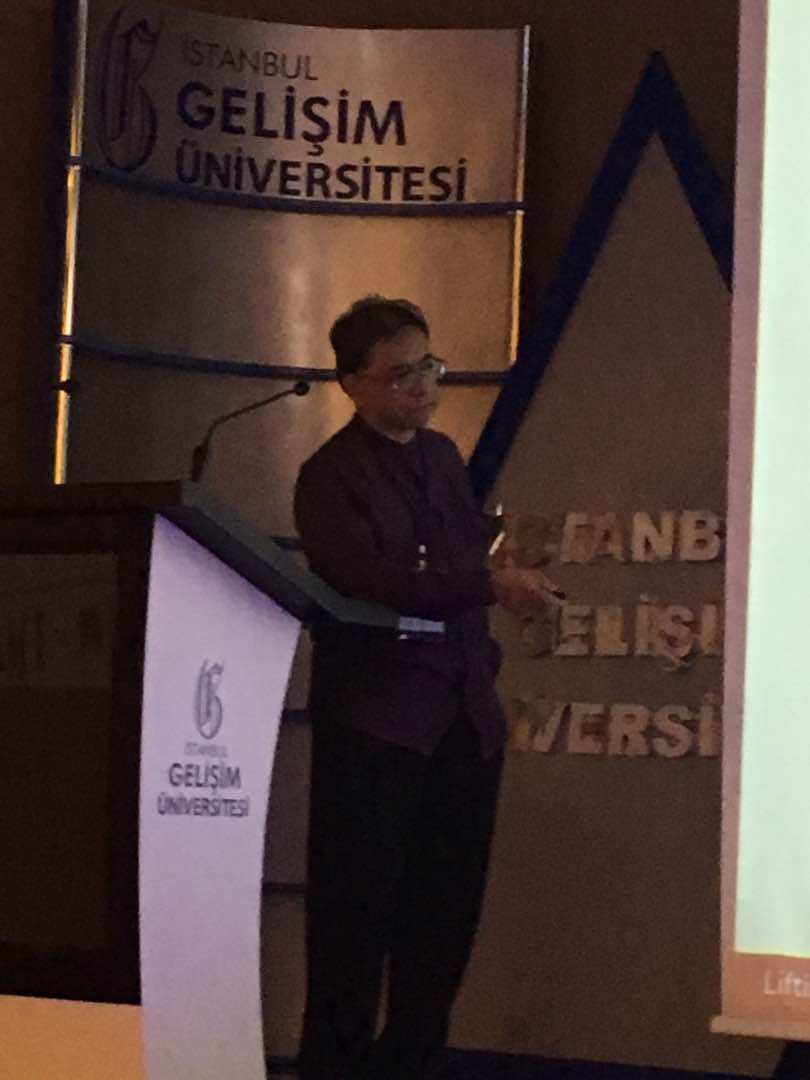
Unable to go to Group 32, there was another conference that the Director asked me to go instead of her. It is the International Conference on Applied Analysis and Mathematical Modeling (ICAAMM 2018) held in Istanbul on 20-24 June 2018. This conference series began as a cooperation between Malaysian and Turkish mathematical scientists in which our institute was heavily involved. Not having gone to the conference series before, there was hesitation in the beginning, partly due to the conference is almost immediately after 'Eid. Given that I have never been to Turkey and that the organizing committee is supporting the local expenses (travel was supported by the institute), I finally said yes to the invitation and I'm glad that I did. My presentation there spurred some discussions, met nice mathematicians there and got to see historic places. Here are some pics:




It would have been nice to bring my family there. In fact, they wanted to go given that the conference coincides with school holidays. Alas, I don't have that much savings to do so and even I had to forego my third son's back treatment (together with my own), sadly (will need to rely on self-exercises). Anyway, I hope I will have another opportunity with perhaps better financial situation. Anyway, this Istanbul trip is very much a working trip; we managed to squeeze in time to visit our MoU partner, Yildicz Technical University (see pic below).


Early next month, I will go to yet another conference, one that is co-organized by the institute. This is the International Quantitative Research and Applications Conference (IQRAC2018). It is a new conference initiated by Malaysian Academy of Mathematical Scientists (AISMM). As a new conference, it is going to be challenging to put up a community of followers and to make it as a conference that matters particularly for the regional community. I hope to follow this conference closely and wished it to be successful. One worries these days that one's conference is not taken seriously by others given the proliferation of conferences. In fact recently, there is an article raising the issue of "the proliferation of questionable conferences". This brings back to the point I made in the first paragraph of this post: let us make our conferences meaningful by taking scientific interactions as the main goal.

Friday, June 15, 2018

'Eid 1439

(Updated 22 June 2018)

Today Muslims in Malaysia are celebrating 'Eid-ul-Fitr. As mentioned in one of my FB post, there was very little mood in me to celebrate since I have many unfinished tasks and a forthcoming trip to Istanbul much on my mind. Anyway, here I am in Segamat with the whole family for 'Eid.

Like most families, in the morning, we had our breakfast (signifying we are no longer fasting) and then went for 'Eid prayers. After the prayers, we meet each family member to seek forgiveness from each other. Another tendency these days, is to have the family to don clothes of same or similar colour. So here we are:


With brothers-in-law:


Just before Eid, the institute also took some group photos for 'Eid purposes. Here is a fun pic:


Below are pics taken on the third raya when we visited my brother and sister-in-law.


Thursday, June 14, 2018

An Average Normal Guy Dreams

We have now reached the end of another Ramadhan and in each Ramadhan, I have set targets for my Muslim self. Unfortunately, I think I have not achieved much this year and perhaps in some respect, even regressed to my state of being 2-3 years ago. I hope I will get another opportunity to meet Ramadhan next year and progress more as a good Muslim. Such is the situation of a normal guy, with ups and downs. This is not quite what I want to discuss in this post. As an academician, one is more often judged by the degree of intelligence that one shows. So here is how I picture myself: just an average guy but is working hard to be good intellectually in the limited way I know how.

Many of us would like to perceive ourselves as intelligent, usually much to reaffirm our sense of self-worthiness but some would like to think of themselves better than others. Such behaviour can be seen a lot on the social media, though this is not really quite the platform to appropriately judge one's intelligence. Actually this has got me bored with FB, particularly the political posts. Now I have started to switch to Twitter for quick useful news items (including arXiv tweets). Occasionally I tweet too and those interested can follow me at @hishamuddinz1.

Let me trace back to my younger self in the school days. I was not the top student but perhaps I'm within the top 10-15 students. I tend not to study as hard as some of my school-mates but yet scored well on some subjects. So news spread around about me doing well despite of me going to bed early. The thing is that I tend to absorb lessons quite well in class and once I understand things, then I do not really need to study too much for them. I guess this trait carries on with me until today. When I listen to talks and seminars, I tend to skip details (which could be picked up later) but focus more on the gist of the talks. So the time at school had build up my confidence to a certain extent.

Now, my high school is a very small world often shielded from much wilder world of competition out there. As I traveled to Adelaide for my matriculation and bachelor degree, I found many more people who are out there as 'lazy' as I was but are able to do well in their exams. It was only in my third year of B.Sc. (note: Honours year will be the fourth year) that I took my study a tad more seriously to compete with Australian students. I still remember two persons that I looked up to then was Gerald Dunne and Simon Twisk, who did much better than me. During Honours year, took up a project on modifications of minimal SU(5) grand unified theory and also found myself doing well in the exams that got me First Class Honours. I guess then I was not that bad. I wanted to do supergravity (still new at the time) but a professor (name withheld) told me that I don't have the personality to do it and reminded me how competitive this field of research is. I took that comment as a challenge and went on to study Wess and Bagger thereafter and later Peter van Nieuwenhuizen's Physics Report paper. After graduating, I joined UPM and found myself in the Physics Department. The only people then who was theoretical physics inclined are Prof. Mohd Yusof Sulaiman (nuclear physicist) and Dr. Zainul Abidin Hassan (condensed matter theorist). In terms of physics of my interest I found that I don't have many people to talk to. At the time, I got myself interested in religion, started scouring religious books and even subscribed to MAAS Journal of Islamic Science. Later, I found myself deciding that I can't be proficient in religion together with my interest in theoretical physics. This is much due to me not knowing Arabic which disallowed me to access the primary and original sources.

Later, I applied for Part III of Mathematical Tripos (equivalent to a M.Sc. coursework) in DAMTP. There, everything that I thought I was good at, shattered - having to compete some of the best in the world (one of which is Fay Dowker). Anyway, I managed to get through (some of  my friends did not). Instead of getting a PhD offer at DAMTP, I got one in Cavendish if I decide to stay in Cambridge but doing so would mean leaving the area that I have grown to love at the time. I was already subscribing International Journal of Modern Physics A, a journal which just started at the time published by the Singaporean publisher World Scientific. I remembered looking into Witten's article "Topological Tools in Ten-Dimensional Physics" and said to myself that this is what I would like to do, more than I wanted to do supergravity. There is something about using somewhat abstract mathematical ideas to describe physics in a surprising way, that got me attracted. That stayed with me until today. My journey continued with a PhD study in Durham under the supervision of Richard S. Ward. The research was not quite on integrable models but more on quantisation started off by Chris Isham. With the PhD done, I knew well that I wasn't that good and wished that I was given a better beginning academically to pursue theoretical physics.

This has led me to dream and go on a mission to create the appropriate working environment for theoretical physics right here in UPM. This has not been easy particularly when I am alone (at the time) with Prof. Yusof and Dr. Zainul leaving UPM. An opportunity came with the invitation of Prof. Wan Ishak to form a theoretical studies laboratory in ITMA, suggested by our then visitor Prof. M.A.K. Lodhi. At the time I did not know INSPEM is about to form and I invited mathematicians (Dr. Nik Mohd Asri and Prof. Adem) to help establish programs in the lab with the assistance of Prof. Usmani, his student Dr. Rita Sinha as well as other theorists from neighbouring universities. There was a mismatch of areas with what I would like to pursue but we worked closely as much that we could then. Only five months after that, INSPEM was formed that caught me by surprise. I had to think and reorientate the direction of the lab itself perhaps closer to the aims of ITMA as a technological institute. At the time we came up with the idea of quantum science and technology, a program which unfortunately had to discontinue after the restructuring of the institutes, which involves the 'merging' of the Theoretical Studies Laboratory with INSPEM. In INSPEM, again I had to reorientate the research direction again, aligning with the aims of the institute. I started reading on complex networks which I thought would be useful to the institute and start to take students on this (at the time Lam Shi Xiang and Zurita Ismail). Dr. Chan Kar Tim (my ex-PhD student) has also started to work in this area and hopefully this will be firmly established in the few years to come. Of course I envision the institute to do more, interfacing mathematics with various other sciences but even within mathematics itself where one can see some of the greatest discoveries in mathematics involve more branches of mathematics fused together. For interfacing with physics, Dr. Nurisya Mohd Shah (my ex M.Sc. student and Ph.D. student of the late Prof. Syed Twareque Ali) can pursue this alongside with my other students. One of my dreams, of course, is to see more of geometry and topology being pursued since these areas have been fertile not only in mathematics but also in theoretical physics. There is also category theory with logic and theoretical computer science, which we have yet to be explored fully (only one M.Sc. student, Siti Aqilah so far).

As I said, being an average guy intellectually, I think we have progressed but we have not quite hit the target that I've been dreaming thus far. There is still a long journey ahead. Beginning with EQuaLS, I had been planning that there one should first understand and be comfortable with the sophisticated forefront areas within our environment. After being comfortable with such areas, then can only one contribute new knowledge. The next stage is to be known for our work. Here, I do not mean only locally or limited to some circles but at a much more international level and this is ultra hard (competing ideas among the world's best). I do still dream to hit on some original good ideas in the limited time I have left and I hope my younger colleagues do dream too. It is thus important to always be exposed to the international community for this to work. After achieving such level, I think we would have reached a sustainable phase for future good theoretical work. Dream on ....

Saturday, June 02, 2018

Mid-Ramadhan 1439 Post

It has been more than a month since I last post to this blog. We already have gone past half of Ramadhan this year with many historic events gone by. We have now a new government installed just before Ramadhan. Leading the new government is our fourth Prime Minister Tun Dr. Mahathir but now attached to a different party and coalition, becoming our seventh Prime Minister. At the risk of being called cliche, Tun Dr. Mahathir being 93 and working at this age, prompted me to reexamine my previous thoughts. I find it embarrassing that I have been looking forward to my retirement, complaining of old age and so on. But the real reason for breaking my silence is simply to respond to certain events that I felt some need to air my own personal views.

On the position of the institute, we are still going strong despite budget cuts and shrunk human resource, thanks to our researchers and staff. We continue to do our work regardless comments or even imminent (imagined) changes that some would like to happen. We are submitting our application to be a national HiCoE and continue further with international collaboration through MICEMS. Personally I would like to see the institute grow in reputation and be well-respected internationally. I see ideas and opportunities to develop the institute if given enough support. Hopefully with the new government, we will have better funding despite the national financial situation.

I have been with the institutes (three different ones) for more than 16 years. I was lucky to be part of the institute in its early days. There were uneasy episodes between the faculties and institutes but I would have expected after more than 16 years, most of these have been resolved. Indeed presently, research contributions (papers and grants) from the institute's research associates (who are faculty members) will also be counted as the faculty's. As far as institute's management members' time, the agreement in the early days was that they will still contribute to teaching in the faculty and is limited to such since they need to develop the institute as implied by their duty when appointed. I still hold on to this principle. It will be double-fold duty if management members need to contribute to meetings in both institutes and faculties. Of course when there is real necessity for the management members to be there at the faculty, the members can be contacted personally.

Sometimes questions arise what has the institute contributed. I believe, there is a lot. Perhaps, one just need to compare the research of say, mathematics department about 15 years ago and of now. Of course, there are compound effects but let us not deny that the institute helped. Personally, I would like to think our role at the institute is to create new opportunities and environment for researchers besides the one that they have at the faculties. I will just simply take my theoretical physics research group as an example to make it more specific. At the institutes, we have visiting scientists program and events (involving prominent researchers) that had benefited the group. The late Prof. S. Twareque Ali (whose loss affected us greatly) was invited by us during the first EQuaLS and he later became the PhD supervisor for Dr. Nurisya Mohd Shah, our group member. In fact, Prof. Twareque did more than just that, he participated in most of our EQuaLS events (see links here) and became our visiting scientist during the period October-December 2012. He was also the thesis examiner for my PhD student Dr. Saeid Molladavoudi. At the end of EQuaLS1, Prof. Twareque Ali hugged me and said something like "this is the beginning of an important tradition" but EQuaLS will never be the same without him and we have yet to think how to start again in his absence.

The other group member is Dr. Chan Kar Tim whose PhD thesis was on parallel computation of cusp forms on hyperbolic spaces. This research actually started earlier where I realise in order to have a complete picture of how hyperbolic geometry affects quantization, we need to do numerical computation of quantum bound states, something which I dreaded in the beginning (not really a computation guy). So in the beginning, we reined in the help of Holger Then who had computed Maass cusp forms of modular group for large eigenvalues. This started us off in developing Mathematica programs for computing the cusp forms. Later, we also reined in the help of Fredrik Stromberg, another expert on cusp form computation (see here), whom we invited as visiting scientist and speaker for EQuaLS5. With advices from both experts, we successfully published papers on such computations through the PhD work of Dr. Chan Kar Tim. In the physics department now, Dr. Chan would be the resource person for computational aspects in physics.

The above is just simply for the theoretical physics group. I am pretty sure other members of the faculty has benefited from the institute's visitors and programmes. As such, I hope there will be less negative talk on the institute's contributions. It will be unfortunate and disappointing if faculty-institute rift resurfaces (in whatever form) after years of coexistence. Personally, I prefer to be forward-looking and be not involved in office politics. My main concern now is how to make the progress we have made so far to be sustainable. Surely there is enough work there.